
My grandmother lived on a Christmas tree farm in Indiana. December weekends meant hauling evergreens, pulling needles from our socks and pretending I was far more help than hindrance. But the real event – the thing the whole month orbited – was Christmas Day dinner: the good china, the stiff grace and the quiet family rule that no one under 20 offered up an opinion unless asked.
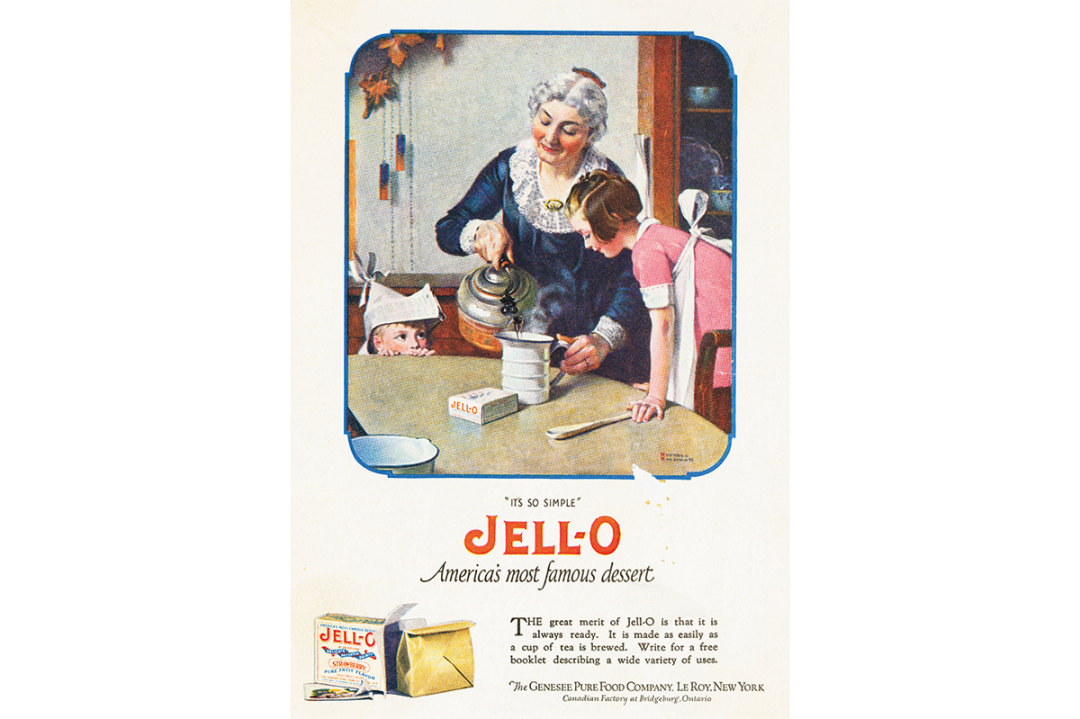
The table was a study in American aspiration: a ham glossy with cloves, wassail steaming on the hob, potatoes whipped into obedient fluff, canned cranberry sauce still bearing its aluminum-molded rings… and always, inevitably, the Jell-O. There were several, because my family believed in abundance, even when the abundance quivered.
Aunt Deb and Uncle Fritz arrived with their famed Jell-O eggs. My grandmother contributed her annual dish, torn from a vintage Betty Crocker paperback. It had rings of lime studded with mandarins, ruby molds freckled with maraschino cherries – each one layered in improbable translucence, streaked with Cool Whip like trapped fog. The Jell-O emerged from the mold with that soft, suctioned sigh – wobbling onto leaf-shaped glass trays on the Formica counter, with colors so bright they seemed lit from within.
Paintings by my mother hung around the table – one showed two kids in high waters clutching fishing poles, the oil thick and earnest. On a nearby shelf sat a small ceramic figurine: Norman Rockwell painting himself in a mirror. And the various Jell-O monuments sat at the center of it all, gleaming and absurd. They were the focal point of the holiday that prized pageantry. By the time the meal began, half of it had already vanished. It was the first thing touched, the only thing finished.

We laughed at the Jell-O, of course. By the time I was old enough to hold a fork without adult supervision, Jell-O had already crossed from modern miracle to party punchline. It still appeared, but its meaning had shifted. It had become nostalgia made edible. The shimmer dulled, replaced by the faint embarrassment of earnest domesticity.
Somewhere between the invention of the remote control and the arrival of Blockbuster, America lost its taste for anything that wobbled. As the century aged, so did our appetites. We traded the slow jiggle of dessert rings for the quick-cut dazzle of music videos; the molded ideal yielded to the microwave minute. Jell-O was once everywhere and then suddenly nowhere. Its earnestness made it uncool, its simplicity, gauche.
But what a thing it was, while it lasted. For half a century, Jell-O was a dream you could boil, pour and chill into submission. It caught the light like stained glass, refracting it like hope. On kitchen counters across the Midwest, it stood as proof that progress could be plated.
Before Jell-O arrived, gelatin was hard work. Cooks boiled calves’ feet or fish bladders for hours, clarified the liquid with egg whites, and chilled it overnight. Clear jellies appeared mainly on the tables of Europe’s wealthy, molded into animals, crests or miniature architectural scenes – signals of households with time and staff to spare.
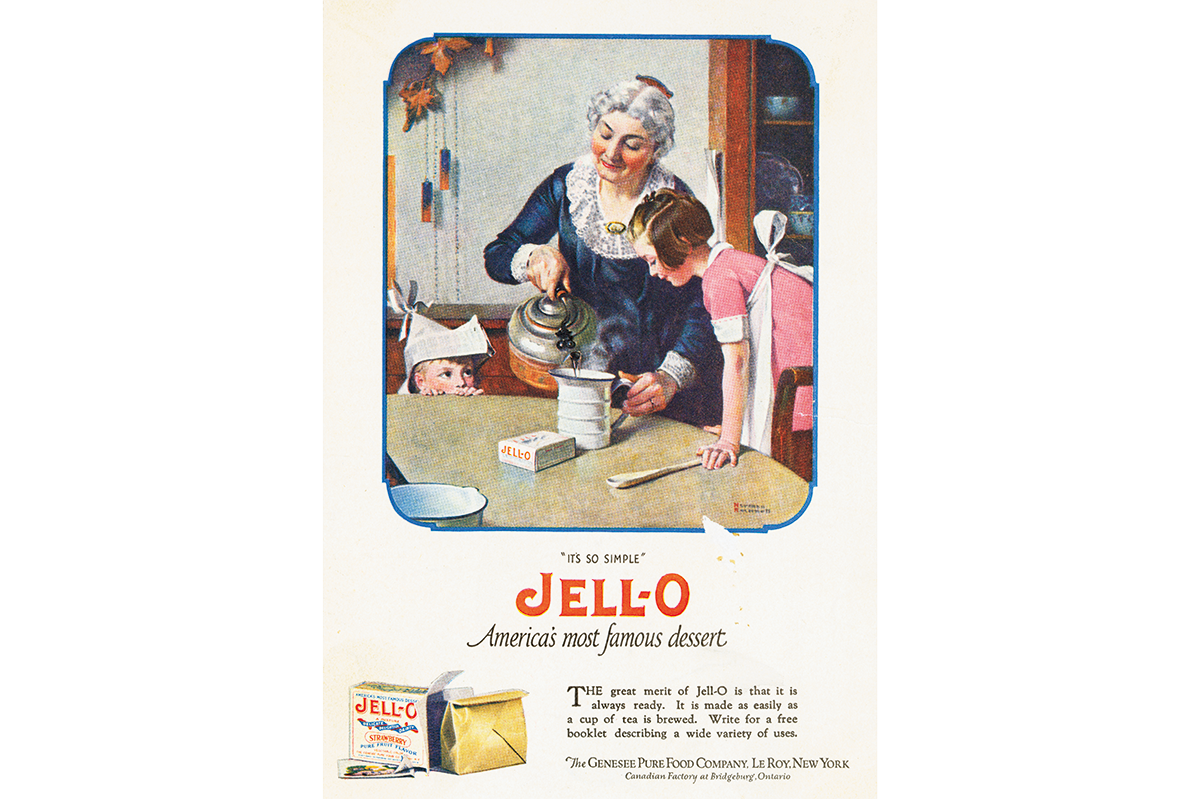
Industrial production in the 19th century changed all that. Powdered gelatin made the once-elaborate process accessible to home cooks, and Victorian recipe books embraced molded jellies as marks of modernity. Copper molds became common wedding gifts – a well-set jelly signaled competence and care. In 1897, Pearle Wait of Le Roy, New York, combined industrial gelatin, sugar and fruit flavorings. His wife named the result “Jell-O.” The Waits sold the trademark to local entrepreneur Orator Woodward, whose recipe booklets, magazine ads and traveling demos carried it across the country.
Home refrigeration accelerated its rise. By the 1930s and 1940s, Jell-O had become a national staple, promoted for both sweet and savory uses. Alongside fruit molds came gelatin “salads”: vegetables, cottage cheese, canned tuna, tomatoes and shrimp suspended in translucent wobble. By the 1950s and 1960s, molded dishes were everywhere –church suppers, school events, company picnics, holiday meals. Jell-O’s appeal was its predictability: cheap, quick, adaptable and reliably impressive.
To make Jell-O was to participate in a national project: the elevation of convenience into virtue. This was science you could eat. Those bright domes anchoring every church basement and Christmas table said more about the era than any Eisenhower sermon. Jell-O was edible optimism.
But optimism curdles. By the late 1970s, the country had soured on the mid-century rituals of cheerful domestic theater. “Fresh” became the new virtue, even as food became faster and more packaged than ever. Jell-O, with its need for chilling and shaping, became a cultural ghost.
And yet, like all ghosts, it lingers. In avant-garde kitchens, shimmering domes of gelée have returned. On TikTok, pastel jelly cakes spin like edible vinyl. Cocktail bars charge $18 for Jell-O shots made with small-batch gin. The qualities that doomed it – artificiality, theatrical color, a refusal to take itself seriously – make it perfect for an age of performative nostalgia. Jell-O has come back as a meme.
Maybe that’s fitting. Jell-O has survived by becoming self-aware. It was never just dessert. It was a mirror. And like all mirrors, it reflects what we most want to believe: that something can hold its shape, however briefly, before it disappears.
Maybe that’s why the memory stays. Some of my mother’s paintings hang in my house now, and the little ceramic Rockwell sits on my shelf. The scene it once watched over could easily have been one Rockwell created. And in my own kitchen, the same wassail recipe still simmers – citrus and clove rising into the air just as they did in the farmhouse rafters. No irony. No commentary. Just something good we’ve always made without thinking. And this year, there will be Jell-O.
We’ve spent decades laughing at Jell-O. But perhaps the joke is on us. In its wobble lies something deeply American: a faith in form, a devotion to presentation, an optimism so bright it borders on delusion. Maybe that’s worth honoring – especially at Christmas, a time built on improbable belief.
So this year, skip the artisanal pavlova or the discourse around dry brining. Find a good ring mold – maybe even crown-shaped. Pour in your mandarins and cherries, your lime and whipped cream, your Jell-O – and let it set. When it releases with that soft sigh and quivers in the light, you’ll see what my grandmother saw: a sweet monument to who we were, and who, for better or worse, we still are.
Saffron, Mandarin, & Yogurt Jello
Serves 12-ish
Ingredients
- 2 boxes (3oz each) orange gelatin mix
- 2 cup boiling water
- 4 cups nonfat plain Greek yogurt
- 2 cans mandarin orange segments, well-drained
- pinch saffron
- finely chopped, toasted pistachios (for garnish to taste)
- drizzle of honey per person
- whipped cream (for garnish, to taste)
- Cooking spray (for the mold)
Instructions
- Prepare the gelatin: In a large bowl, dissolve the orange gelatin mix & pinch saffron completely in 2 cups of boiling water, stirring for at least 2 minutes.
- Cool slightly: Allow the gelatin mixture to cool slightly (around 15-20 minutes) so it doesn’t heat the yogurt too much.
- Whisk in yogurt: Whisk the Greek yogurt into the slightly cooled gelatin mixture until it is smooth, fully blended, and evenly colored. The mixture will become creamy and light.
- Add fruit: Gently fold in the well-drained mandarin orange segments.
- Prepare mold: Lightly spray your desired mould (e.g., a Bundt pan or individual ramekins) with cooking spray to ensure easy unmolding.
- Pour and chill: Pour the creamy yogurt and mandarin mixture into the prepared mould.
- Refrigerate: Chill in the refrigerator for at least 4 hours, but preferably overnight, until the mixture is completely set and firm.
- Unmold and serve: To unmold, gently run a knife around the edges to loosen. For a large mould, you can briefly dip the bottom of the mould in warm water for a few seconds. Place a serving plate on top of the mould and, in one swift motion, invert them together.
- Top with finely chopped pistachios, whipped cream, and a drizzle of honey!
Lucian Prellwitz is a Southern Lake Michigan based Chef with 20 years of West Coast (California/Oregon) training. He focuses on foods based (but not bound) by tradition and seasonally driven menus.
This article was originally published in The Spectator’s December 22, 2025 World edition.





Comments