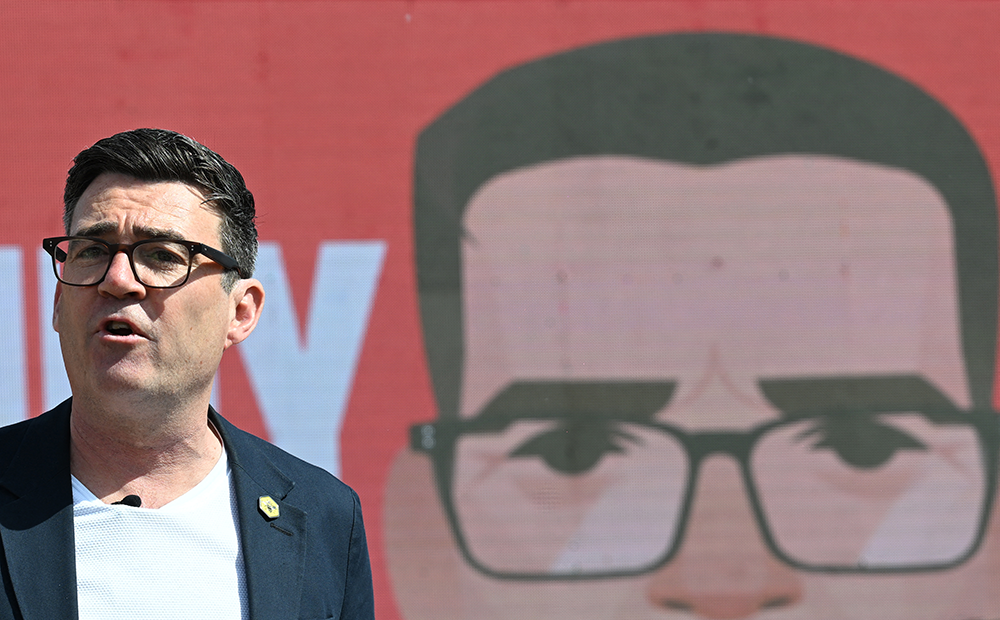


There appears to be a missing chapter in the story of Andy Burnham. Depending on the whims of voters in Makerfield, Britain could soon have its first prime minister with a degree in English literature and its first Cambridge-educated premier since Stanley Baldwin. And while we have been treated to countless long reads on the so-called King of the North – his political philosophy, his years in Manchester and his apprenticeship in New Labour – his undergraduate years have barely been scrutinised.
Burnham is tight-lipped about his Cambridge days (1988-1991). His comments over the years have been mostly limited to saying he had ‘imposter syndrome’ as he struggled to fit in at a university that was dominated, he felt, by private school students. Unlike him, they ‘weren’t aware of the issues involved’ with the Hillsborough disaster, which took place during Burnham’s first year and ‘radicalised’ him.
When he’s been asked about his favourite memory from Cambridge, he jokes that ‘I need to say meeting my future wife there’. Marie-France van Heel was in her first year at his college and he impressed her with his ‘Madchester’ connections. After he graduated, she appeared on ITV’s Blind Date, holidaying in Gibraltar with Will from Surrey, who went on to become the Conservative party’s marketing director under Michael Howard. She decided to stick with Burnham.

How did Burnham pass his time as a student? Having applied unsuccessfully for St Catharine’s College, he was ultimately sent up the hill to Fitzwilliam, one of Cambridge’s more modern institutions, founded in the 1860s for those who couldn’t otherwise afford the fees. He recalls that in his first interview for St Catharine’s he was offered sherry and asked whether he saw any parallels between The Canterbury Tales and a modern package holiday.
English literature at Cambridge differs from its Oxford counterpart on two fronts: the study of Old English (in particular Beowulf) is not compulsory, and there is a focus on ‘Practical Criticism and Critical Practice’. I.A. Richards and F.R. Leavis, two Cambridge men often credited with inventing Practical Criticism, loom large.
Can Burnham’s plans for Britain be traced to lectures he attended 35 years ago which recalled Leavis’s condemnation of our march towards a ‘technologico-Benthamite civilisation’? While Terry Eagleton delivered his Marxist seminars at Oxford, all Cambridge English students read his introduction to literary theory. What would these anti-industrial socialists have made of ‘Manchesterism’?
Professor John Mullan, who interviewed Burnham for Fitzwilliam and taught him throughout his time at the college, tells me he remembers him fondly. Mullan notes that Burnham ‘gave the impression of somebody who really enjoyed’ being at Cambridge. Possibly that’s because, unlike so many of our prime ministers in their student days, he didn’t spend his time hacking his way to the top of the Union or scrapping in the Labour Club. Instead, he was – somewhat blandly – ‘a good student’ who ‘loved football’.
He graduated with a solid 2:1, in a degree course that included tragedy, the long 18th century, Chaucer and Shakespeare. The latter must have made some impression as during the 2015 Labour leadership he cited The Complete Works of Shakespeare as his favourite book, something of a cop-out – pick one! He more recently told the New Statesman his favourite novel was Middlemarch, which Mullan thinks is the choice ‘of somebody who really loved literature’ even if (since the Guardian recently named it the greatest novel ever) it is a rather obvious one.
Still, he is undoubtedly more literary than our current prime minister. Keir Starmer, when asked, was unable to select a favourite novel and instead opted to bring a ‘detailed atlas, hopefully with shipping lanes in it’ as his book on Desert Island Discs. (He also doesn’t have a favourite poem, doesn’t have a favourite film and – perhaps the weirdest of all – doesn’t dream.) When Burnham was on Desert Island Discs, he chose The Damned Utd by David Peace, which tells the story of Brian Clough’s 44-day spell as manager of Leeds.
Burnham’s two other literary loves are ‘20th-century poetry and Chaucer’ – clearly he recovered from his St Cats interview. He has mentioned Philip Larkin and Tony Harrison (particularly the latter’s ‘V’, which was written during the miners’ strike and opens with an Arthur Scargill quotation) as influences on his politics. He’s read Dickens’s ‘The Election for Beadle’ aloud in Soho House and compared its landlord party leader to Jeremy Hunt. He likes the ‘understated humour’ of Dickens.
Burnham was liked by his peers. He flirted with girls by telling them about the Smiths, and played football
Burnham made several contributions to Varsity, the student paper, during his time at Cambridge. He reported on an eclectic mix of karate, cricket and football, and covered sports scandals such as the University Football League’s alleged misuse of funds and Trinity’s refusal to participate in cricket matches they deemed too easy to win.
Much has been written about the university exploits of Boris Johnson, David Cameron and other senior Oxford Tories. One might expect Burnham to have a similarly storied past: writing political polemics, getting caught up in student politics, or avowing Marxist literary theory. But there is no evidence he did any of this. The most interesting discovery I stumbled upon was that he was once a member of the Mornie Onion Society, a male-only drinking club, whose initiation ceremony reportedly involved drinking a yard of ale with an onion floating on top while naked or wearing a towel.
Put simply, Burnham seems to have been a popular but completely normal undergraduate. He was liked by his peers. He did his work, flirted with girls by telling them about the Smiths, and played a lot of football. Bad news for a journalist hoping to uncover a story. Yet perhaps this is reassuring for the voters of Makerfield: if Burnham appears to be a regular bloke, there’s enough of a chance that he is. Maybe our next prime minister is slightly more exciting than our current one – but there’s not much in it.





Comments