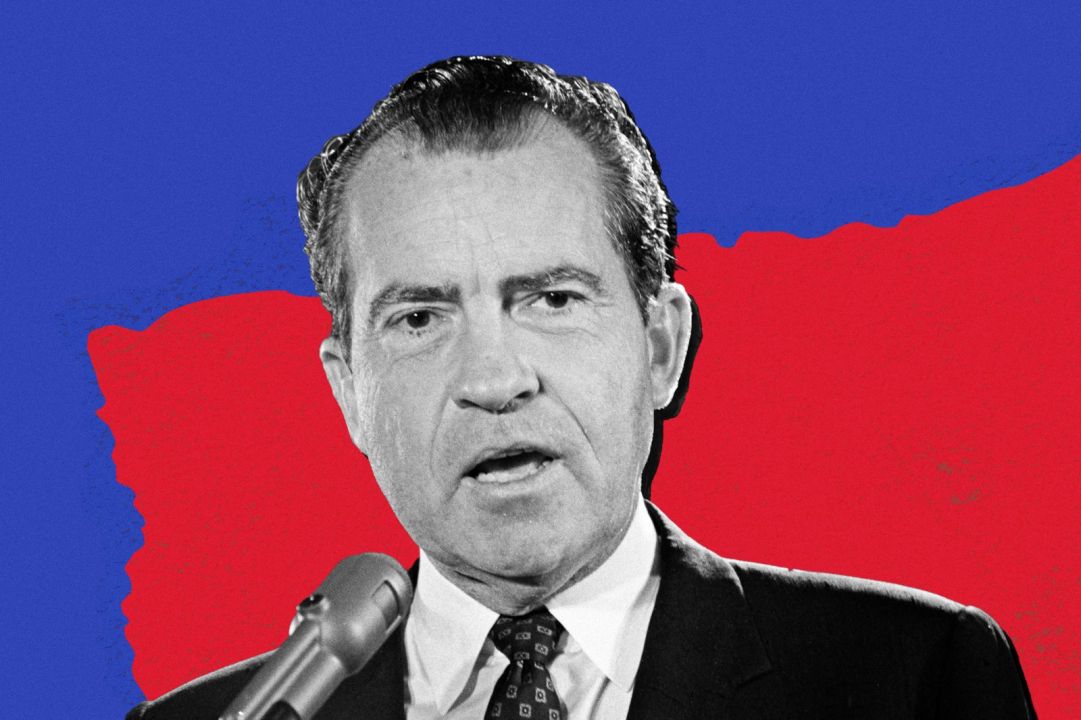


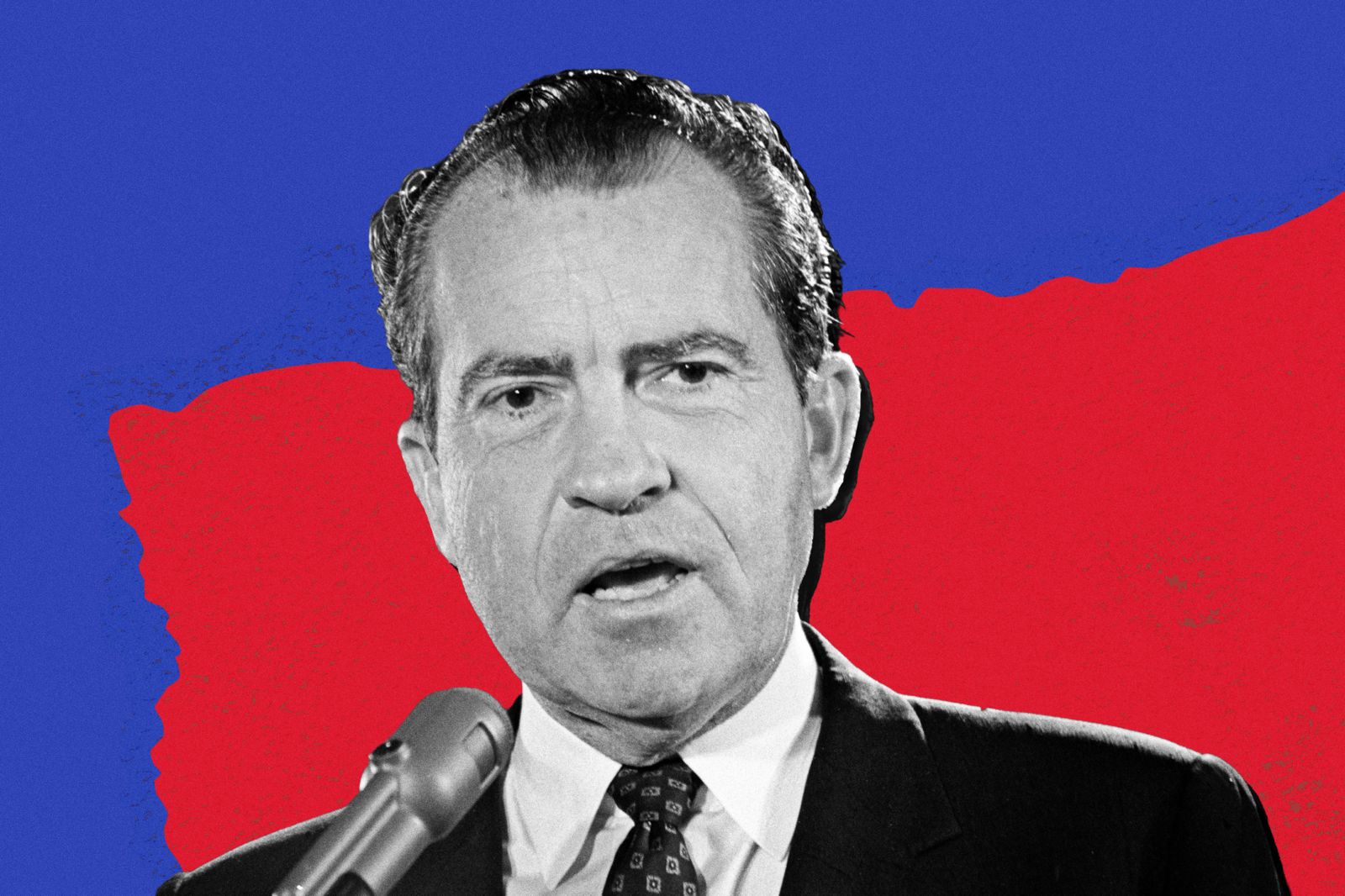
The kids call it “Nixonmaxxing,” and I invented it 30 years ago. “I think that his historical record is enjoying a bit of a renaissance, but I think deservedly so,” Vice President J.D. Vance says about Richard Nixon, who has become, as a recent Wall Street Journal headline put it, “an unlikely new icon” for young conservatives.
Maybe I can’t claim to have been the first teenage Republican to have embraced Nixon chic, but all the way back in 1996 a young Danny, irked by the banality of college application essay questions, decided to make his pitch to higher education by writing about the merits of the president who’d been taken down by Watergate. It was a way of daring colleges and universities to reject me.
It was also a way to rebel against the commodification of rebellion under America’s first boomer president, Bill Clinton. A generation of dope-smoking, draft-dodging, self-righteous hippies had become the Establishment – they were running the government, higher education and the entertainment industry, continuing to pose as outsiders as they made millions on Wall Street in the early days of post-Cold War globalization. Peaceniks were waging war as proof of their humanitarianism. Nixon was more honest. Saying “yes” to him was a way of saying “hell no!” to Pearl Jam.
That was then, but today is not so different, except that more of what used to be the conservative counterculture has been co-opted by social and economic liberalism. There’s a reason the young right is more interested in Nixon than in Ronald Reagan. The real, historical Reagan has long since been replaced by a Reagan myth that serves to reconcile Republicans to globalism.

For conservatives under 50, “Reaganism” means calling for even more and bigger wars than we already have; celebrating tax cuts even if the country turns into one gigantic drag ball; and owing allegiance to global market efficiency, not any place or people. The fact that Nixon wasn’t a “conservative” in the sense ideologically approved by their elders is part of what the young right finds attractive.
For the most part, they aren’t actually embracing the Nixon record, which consists of bombing Cambodia; failing to end the Vietnam War either successfully or quickly; letting inflation get out of hand and making things worse with wage and price controls; instituting the beginnings of affirmative action; and watching as the Supreme Court invented a constitutional right to abortion in Roe v. Wade.
Even Nixon’s greatest success can’t be seen as an unmitigated triumph from the viewpoint of the 21st century. His opening to communist China arguably did help to win the Cold War – but also paved the way to the post-Cold War world in which China would grow and grow while America’s industrial workforce would shrink and we would come to depend on Chinese production for a vast array of basic goods. If Nixon hastened the defeat of one communist superpower, prolonging his strategy after the fall of the USSR has expedited the rise of another – though that’s something for which George H.W. Bush, Bill Clinton and other later presidents deserve more blame.
In any event, it’s the Nixon image, Nixon as a symbol, that the young right finds fascinating, as the Manhattan Institute’s Christopher Rufo astutely observes. “The right’s rediscovery of Richard Nixon is not about particular policies – some good, some bad – but about the aesthetic, the attitude and the narrative of the self-made man who won 49 states on behalf of the Silent Majority, and was taken down in a Deep State coup,” Rufo recently wrote on X.
Nixon is inseparable from Watergate, but Watergate itself is now a symbol of boomer liberal hypocrisy. The Watergate story serves as the moral foundation of the mainstream news media of the past 50 years – news media that are perceived by growing numbers of Americans, and by virtually all conservatives, as biased and untrustworthy.
Instead of the Watergate legend raising the moral standing of the media, today deep distrust of the media has cast Watergate in a new light. So has the revelation that Bob Woodward’s and Carl Bernstein’s key insider source, “Deep Throat,” was a man who aspired to the power once wielded byJ. Edgar Hoover and brought down the president who refused to make him director of the FBI.
Hoover was a man above the Constitution, thanks to his ability to intimidate and blackmail members of the elected government – Congress was afraid to touch him. Mark Felt believed he was entitled to what Hoover enjoyed, and when Nixon defied him, Felt, through Woodward and Bernstein, showed the president who really had the power to destroy whom.
An unelected government within the government ought to be the subject, not the sponsor, of media investigations. The relationship between the media and those parts of government in agreement with the liberal-leaning news industry’s own biases is a scandal unto itself. Nixon’s reputational recovery is the flipside of the media’s dwindling authority. Rising esteem for Nixon is reciprocal with the plummeting of newspaper circulations.
He was more sympathetic than the self-regarding elite that has largely run our country since his downfall
“If Watergate happened tomorrow, it would be like a 12-hour news story. The idea that it would have taken down a presidency is crazy,” Vance told an audience at the Nixon Library in Yorba Linda, California, in June. Yet the Nixon saga isn’t ancient history: “If you look at the story of how the Deep State took down Richard Nixon, it’s not all that different from what the same groups of people, the same institutions tried to do to Donald Trump in the first Trump administration,” the Vice President argued.
Nixon was a tragic figure – almost an American Macbeth. His story is human in a way that moves the young right, who have been subjected all their lives to stories that are mere ideological morality tales. It’s not Nixon’s ideology they admire; they admire him for not being easily reduced to inhuman “principles.”
He did wrong as he tried to do right for his country. That makes him more interesting, even more sympathetic, than the self-regarding elite that has largely run our country since his downfall.






Comments