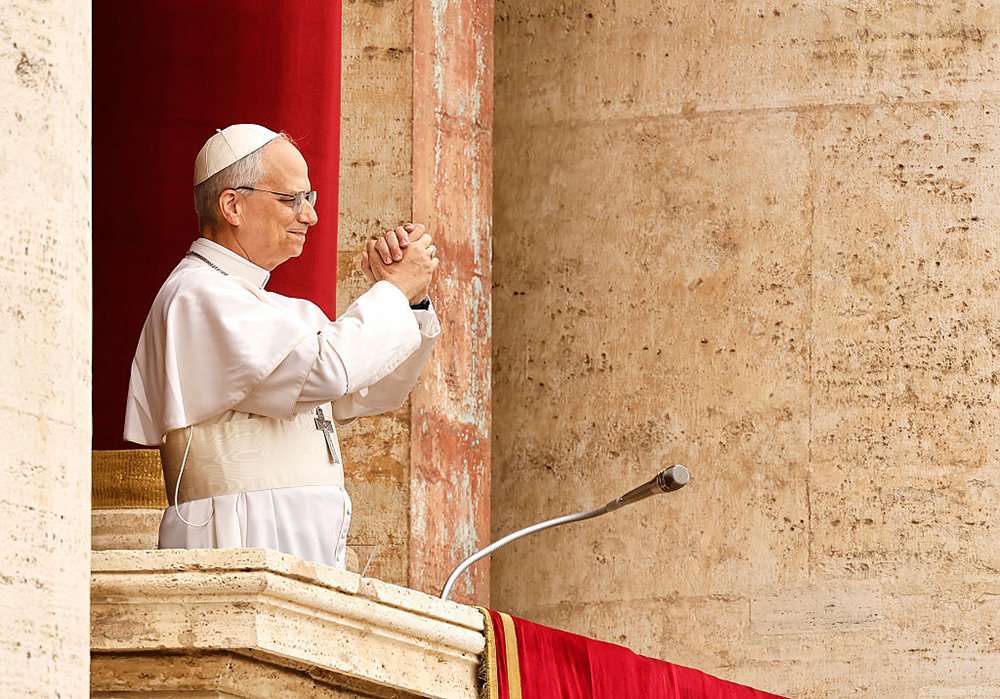
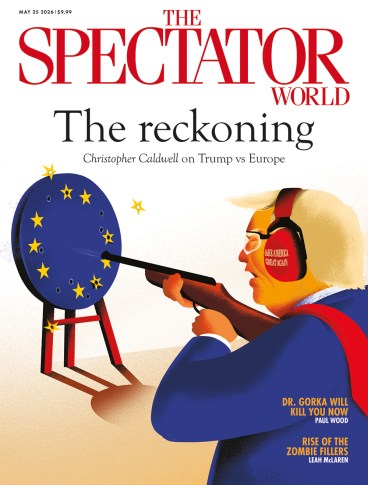
I have always believed that no Catholic with a sound understanding of his faith, which represents the ultimate in realistic thinking and a realistic view of the world, should be shocked by anything. For this reason, the recent contretemps between the President of the United States and Pope Leo XIV left me completely unaffected. Donald Trump is not a Catholic and the Pope in Rome serves in persona Christi, the 367th temporal embodiment of the Lord before the Second Coming.
I believe further that a great many devout Catholics devote too much attention to whoever it is who happens to be serving as the Vicar of Christ at any given moment and that it is theologically wrong to treat him as an international celebrity, as it has been the custom of Catholics to do in the postwar era. The chief intellectual, spiritual, and (I believe) supernatural influence behind my conversion 34 years ago was Flannery O’Connor, whose letters constitute my principal bedside reading and which I know backward and forward, more than well enough to be able to say with pretty fair surety that she scarcely – if ever – refers in them to any particular Pope, let alone a sitting one, though The Habit of Being is in part a comprehensive introduction to the nature of Catholic thought.
War is Hell, and in Hell justice comes from two sources: God, and the souls who sent themselves there
Pope Leo, like his predecessors, is the center of the Church administratively and its infallible voice when speaking ex cathedra and generally on matters of faith and morals, as Vice-President J.D. Vance noted. When he proclaims the moral justifiability, or the absence thereof, of any given war, in the eyes of the Church, he speaks with a divine authority that the world is free to recognize as it chooses and as the Lord permits.
As the ruler of Vatican City, His Holiness is not, however, a head of state briefed daily, hourly and by the minute on the state of existing international crises, counseled by his own military advisors and informed by nuclear scientists and other technicians and specialists of every sort, all of them immediately connected with their colleagues and related “experts” and privy to shared resources and information possessed only by officials at the highest and most secret levels of many other governments, all of them in communication with one another. Nor, as the head of a separate and distinct religious institution, is he admitted into their deliberations and invited to share their information and their material resources. And of course, as Stalin famously remarked (as reported by Winston Churchill), he lacks their legions, and thus the practical responsibility conferred by military power. Lastly and most importantly, it is simply a fact of a fallen and unredeemed world that while every issue has a moral dimension, that does not make it the most decisive one in any given human situation. Much is made of the death and destruction visited on innocent civilian populations by modern warfare – war from the air especially – which doubtless weighs preponderantly on Pope Leo.
But the bombing of civilians from the air played the decisive role in World War Two, when both the Allies and the Axis powers employed it with horrible efficiency. And while international opinion deplored the atomic slaughter at Hiroshima and Nagasaki, very few people save for the dogmatic pacifists protested or otherwise showed much sympathy for the residents of Dresden and Berlin, while the loss of the 53,000 people killed in the Battle of Britain and the Blitz was accepted with a dreadful and unemotional stoicism as part of the cost of the most brutal war the human race had every experienced. Certainly no one – the Germans included – demanded that the RAF cease and desist in the name of morality and the rules and principles of “just war.” There are certain situations in which morality is a distinctly secondary consideration, survival being the immediate concern for all the parties involved. War is Hell, and in Hell justice comes from two sources: God, and the souls who sent themselves there.
In this context it is difficult to know what to make of Pope Francis’s assertion in 2022 that “there is no such thing as a just war: they do not exist!” and of Pope Leo’s recent claim that, “No one can use [God] to justify war. He does not listen to the prayers of those who wage war.” Apologists for both pontiffs have claimed that modern science has simply made modern weaponry too technologically sophisticated and destructive for its use to be considered “justifiable” in any circumstances. The same sophistication, however, has also given it a strong element of the unknown, offering a threat that the enemy cannot risk taking a chance on; neither side, in other words, can say for certain whether, in the circumstances, war is “justifiable” or not. Certainly the Pope is in no position to do so. Section 2309 of the Catechism of the Catholic Church states four conditions for “legitimate defense by military force.” Human behavior not being an exact science, that seems to be the best that the Church, or anyone else, will ever do.



Comments