
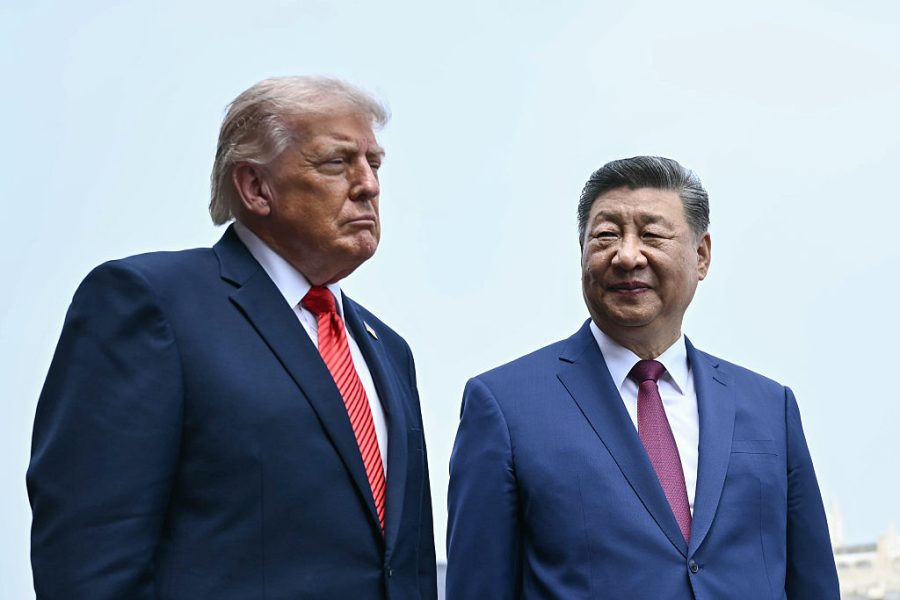
Taiwan is “the most important issue,” Xi Jinping warned Donald Trump. “If mishandled, the two nations could collide or even come into conflict, pushing the entire China-US relationship into a highly perilous situation,” according to Chinese state media. The contrast with Trump’s comments was striking.
Trump had earlier named trade as the most important issue. In opening remarks, the American President stuck to bland flattery, saying he and Xi had a “fantastic relationship,” that Xi was a “great leader” and that “it is an honor to be your friend.” “The relationship between China and the USA is going to be better than ever before,” he insisted.
The two men sat opposite each other at a pair of long tables in their opening session in the Great Hall of the People in Beijing. Flags stood at the head of the table and flowers separated the two leaders. State media televising their opening remarks. It was an early indication of Xi’s confidence that he has the upper hand over an American president distracted and stretched by his war against Iran. This summit could be perilous for Trump.
This summit could be perilous for Trump
Ahead of their meeting, there were signs of almost desperate maneuvering to come up with something – anything – that Donald Trump could call a deal. There were last-minute meetings between officials in Seoul on the eve of the summit, and confirmation that Jensen Huang, the CEO of Nvidia, would be joining Trump in what felt like a summons. Nvidia’s top end chips are crucial for training AI models, and the US has sought to keep the most advanced components out of China, which has launched a massive smuggling operation to get them into the country.
On his way to the summit, Trump demanded that China “open” its markets to US business, and announced that he does not need Beijing’s help in ending the war in Iran (read: he would like it, but has been rebuffed). Yet in signs of Beijing’s hardening position, China’s Ministry of Commerce this week ordered domestic companies not to comply with US sanctions against Chinese refineries allegedly enabling Iran’s oil trade. New regulations are aimed at obstructing multinational companies from shifting supply chains out of the country and thereby “derisking” from China. Beijing doesn’t feel it has to dance to Trump’s tune.
Mao Ning, a Chinese Foreign Ministry spokesperson, suggested that sweeping restrictions on the export of rare earths, critical for high technology and military industries, remain on the table. “The two sides need to jointly deliver on the important common understandings,” she replied when asked about these critical minerals. China has a near monopoly over rare earth supply chains and last year postponed the restrictions for a year as part of a broader trade war truce, which also saw both sides scale back sky-high tariffs and Trump lift some restrictions on Chinese firms. The rare earths controls are China’s most significant weaponization yet of the supply chains it controls and triggered a scramble by the US and other Western companies for alternative supplies. “As China’s control over critical inputs and technologies expands, so, too, does its ability to weaponize this leverage,” the American Chamber of Commerce warned this week.
Xi believes he has the upper hand. Trump is reluctant to return to trade hostilities that will increase the pain to a global economy already suffering as a result of the Iran War – and to a US economy that saw inflation surge this week to 3.8 percent. And while China is also hurting – beyond the technology hype, the economy remains fragile – Xi believes that in the short term he can weather the impact better than most, having built significant oil reserves. Exports – the lifeblood of the Chinese economy – also appear to be holding up (helped by some diversion of US-bound exports via third countries), and Xi is calculating that a postwar global rush for energy security will also help shift China’s vast surplus of heavily subsidized renewable technologies.
The Trump visit is squeezed between those of Iran’s foreign minister, Seyyed Abbas Araghchi, and Russia’s Vladimir Putin, seemingly designed to demonstrate that the China-Russia-Iran partnership remains intact. “Iran places its trust in China,” said Araghchi, a few days after it was reported that Iran had used a Chinese spy satellite to target US bases across the Middle East. Putin, whose war against Ukraine is, in effect, being economically underwritten by China, has pledged to boost energy supplies in order to “compensate” China for any shortages resulting from the closure of the Strait of Hormuz. Chinese companies have been accused of shipping dual-use items, including engines, computer chips, fiber optic cables and gyroscopes to drone factories in Iran and Russia. Shortly after Trump arrived in Beijing, the New York Times, quoting US officials, reported that Chinese firms have been discussing arms sales to Iran.
If trade is Trump’s priority, he should study the experience of four of the top businessmen in his entourage. Tim Cook (Apple) and Elon Musk (Tesla) are both heavily reliant on China as a market and production base. Cook, who once described Apple’s relationship with China as “symbiotic,” has built the world’s most sophisticated supply chain in China. But he is now diversifying production to India and Vietnam – a process that is being obstructed by the Chinese authorities. Musk delivered electric vehicle expertise (willingly and as a victim of cyber theft) and now faces fierce global competition from the heavily-subsidized beast he helped create.
Nobody will be watching events in Beijing today closer than Taiwan
Both Cook (privacy is a “fundamental human right”) and Musk (a self-described “free speech fundamentalist”) have been happy to leave their principles parked at the Chinese border. Both initially received enormous Chinese state support in setting up their operations. Both are warnings of how China’s “open door” is highly conditional; it can be swung open and slammed shut according to the interests of a capricious Chinese Communist party.
Then there is Nvidia’s Huang, drafted in at the last minute, whose chips are crucial to the fight for AI supremacy. Trump has already allowed him to sell some high-end chips (but not the most advanced) to China. Might further security-damaging relaxations in chip controls be on the cards? Then spare a thought for Kelly Ortberg, the CEO of Boeing. A promise of more orders for jets (along with beef and soybeans) is a standard sop handed out by Beijing on such occasions.
Just do not mention China Eastern flight 5737, a Boeing 737 which plummeted into a Chinese hillside four years ago, killing all 132 people on board. The crash was the most deadly in China for decades, but the authorities have yet to release a final report, claiming that to do so would “endanger national security and social stability.” Last week, findings from the US National Transportation Safety Board, released under the Freedom of Information Act, said that fuel switches on both engines had been moved to a cut-off position, suggesting the crash was intentional – possibly pilot suicide. Anywhere else in the world such a cover-up would be greeted with outrage, not least by Boeing. But not with China, which is, after all, an important market.
Nobody will be watching events in Beijing today closer than Taiwan. Xi’s opening remarks will intensify fears that the CCP is pressuring Trump for concessions, limiting future arms sales to the democratic, self-governing island and possibly changing American rhetoric to more explicitly oppose “independence.” For decades, the US has pursued a policy of “strategic ambiguity” over the island’s defense. That has largely kept the peace, and to shift that as the price of a broader deal would be seen as a dangerous betrayal.
Trump and Xi’s first meeting lasted for more than two hours. They then posed for photographs in front of the Temple of Heaven – “Great place, incredible,” said Trump, adding that “China’s beautiful.” A state banquet will follow this evening. The most likely outcome of this summit remains a messy stalemate, dressed up as progress. If a deal comes, we know what to expect. Beijing is unlikely to comply with whatever is agreed, using the deal instead to disguise a continued move towards and technological dominance. And all of it accompanied by a traditional dose of Trumpian bombast.




Comments