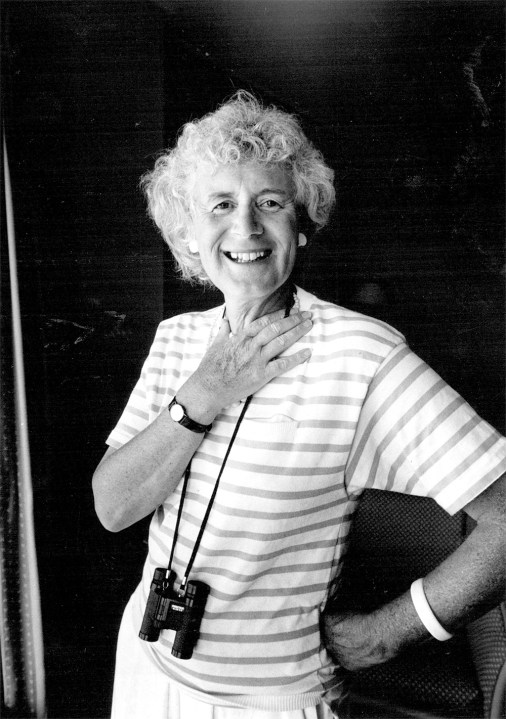
Jan Morris was driven by almost super-human levels of energy and ambition, producing more than 40 books as well as news and travel articles, introductions, interviews, reviews and essays, travelling incessantly and taking on every job that was offered. That’s as far as I can go without a pronoun, because of course Morris’s life is divided into two parts. For the first half he was James, for the second she was Jan.
James Morris was born in 1926, aware from early on that she was female, trapped in a male body. The transition to Jan, made in the early 1970s, remains at the heart of our fascination with Morris. Sara Wheeler handles it with grace and compassion, while never losing her grasp on a character riddled with contradictions – a deeply conservative trans pioneer; a writer both superficial and profound; a self-made woman who remained obstinately masculine; and an admirer of empire who was a passionate Welsh nationalist. Well researched and beautifully written, this is a superb biography that puts Morris into the context of her time and makes a solid case for the enduring significance of her work.
Imagine being a cat in the body of a dog. Every move would feel wrong
Morris was already writing pieces for the local press from school at Lancing, where sex with boys was fun but ‘nothing fitted’. He joined up for the last year of the war and served in a cavalry regiment until 1947, which gave him a passion for travel. His tutor at Oxford described him as ‘confident, vigorous and [with] a dangerous facility with pen and typewriter’.
By then he was married to Elizabeth Tuckniss, the fixed point all through Morris’s life. Elizabeth shared his secret, but not much else. As a successful journalist, James was travelling for weeks at a time, while she was left to manage pregnancies, children, schools, house moves and their precarious finances. When James was home, clacking away on the typewriter or planning the next journey, he was not to be disturbed. ‘Her understanding,’ as he, and later she, would often say, ‘was fathomless.’ He found a job on the Times and talked his way on to Sir John Hunt’s Everest expedition in the spring of 1953. The news that the summit had been conquered on 29 May only reached Morris, 8,000 feet below at Camp 4, early the following afternoon. After a bone-battering scramble down the icefall to Base Camp, he thumped out a coded message – which, passed on by a bicycle-operated radio station at Namche Bazaar, eventually reached the Times, which announced the news on 2 June, Coronation Day.
Morris stayed on with the paper, but was increasingly frustrated by its refusal to let him write a book about the Everest expedition – or indeed any other global event he was sent to cover. In 1956 he left and joined the less restrictive Manchester Guardian, while Faber & Faber published a swift succession of books on his travels, including Everest.
Yet he was still trapped in the wrong body, and the experience was not about sex but identity. Imagine being a cat in the body of a dog. Every move would feel wrong. Ceaseless activity dulled the anguish, but Morris knew he had to address it or die. From the late 1950s, with Elizabeth’s support, he began to take feminisation hormones. He felt ill much of the time, but never stopped working.
Then came Venice (1961). Having planned it as an objective dispatch, Morris found that the book came out as a ‘highly subjective, romantic, impressionist picture less of a city than an experience’. Venice is a place where past and present co-exist and, in responding to its reflections, Morris found his voice – funny, sharply observant, touched with sadness, using concrete sights and sounds to evoke what was just out of reach. Some critics huffed about the sloppy history and over-indulgent prose, but readers loved it. The book sold thousands of copies and stayed in the bestseller lists for weeks.
Morris left the Guardian to go freelance. The torrent of articles and books continued, and the family moved to Wales. Wherever he went, and especially in India, Morris was fascinated by the juxtaposition of old and new and how the past infiltrates the present.
The three volumes of Pax Britannica were published between 1968 and 1978, covering the period from Queen Victoria’s accession in 1837 to the death of Winston Churchill in 1965. Morris presents the Raj in a dramatic progression of brilliantly choreographed set pieces and adventures that, in Wheeler’s words, ‘sweep butchery and appropriation aside to the tune of a bugle reveille’. In the late 1960s, academics were beginning to raise awkward questions about the British Empire; but its retired colonels and civil servants were still living out their days in Cheltenham and Tunbridge Wells. The Raj was not yet a cause for perpetual apology.
As a writer, Morris never claimed to be a historian, and only described the British version of India. The horrors are usually seen as the consequences of ‘bad apples’ in command rather than any inherent cruelty in colonialism itself. There is no attempt to explore the Indian experience of British rule, nor its failures, nor its legacy – which was collapsing in blood and sectarian hatred in Northern Ireland as the trilogy appeared. Wheeler observes that Edward Gibbon, with whom Morris was often compared in contemporary reviews,
saw empire as inherently unstable and unproductive, whereas Morris perceives it… as a development agency. Decline and Fall is not an elegy for empire. In many ways, Pax Britannica is.
The first volume of the trilogy, Climax of Empire, was the last book to be published by James Morris, since hormone therapy had almost completed the transition to Jan. She began to wear women’s clothes among trusted friends, one of whom was my father, John Julius Norwich. They had bonded over Venice, and when he invited Morris to dinner, she replied she would come as a woman – leaving my mother in a quandary. Was Jan to be included in the gathering of ladies withdrawing to ‘powder their noses’ after the last course? In the end, wearing a broderie anglaise blouse and a long red kilt, she stayed in animated conversation with the men while we ‘girls’ (I was one, aged 17) trooped upstairs to gasp over her five o’clock shadow and big hands.
In the summer of 1972, Jan’s eldest son Mark drove her to Heathrow to catch a flight to Casablanca for the main operation. When it was over, Jan wrote to tell Elizabeth that at last she was free of her obsession and hoped to make up for ‘all the torments I’ve plagued you with over so many years’. Elizabeth, who died four years after Jan, in 2024, never shared her experience of being married to a high-functioning narcissist with gender dysphoria, so her torments remain unexpressed. But Wheeler has talked to three of her four surviving children, who bear the emotional scars. ‘My father wasn’t a parent,’ says Mark, ‘and Elizabeth couldn’t be a parent because Jan made the rules.’
After transition, Jan may have felt feminine, but she was as demanding and domineering as ever
While the advance for Conundrum, Jan’s memoir on her transition, was generous, the book was a disappointment – no gory details, no struggles with pain or practicalities. Germaine Greer wrote that Morris seemed like ‘a man who had eaten a great many pills’, an opinion shared by many. Jan may have felt feminine, but she remained as demanding and domineering as ever.
The book did bring comfort to many who had lived their lives in terror of revealing their true natures. Now a well-known writer had told her story, and in hundreds of letters readers thanked her for giving them hope and begged her for advice and addresses. To their disappointment, Jan had no interest in her trans fans. Having established her womanhood, she became an ardent Welsh nationalist – celebrating its language and culture, that is, not campaigning for Plaid Cymru.
She never stopped writing. But an unspoken dissatisfaction arose as the years wore on – a sense of something missing. Among the best of her later works are the fictional Last Letters from Hav (shortlisted for the Booker Prize in 1985) and Trieste: The Meaning of Nowhere (2001). Of the imaginary city of Hav, Jan admitted that Trieste ‘lurked between every line’. Trieste, haunted by refugees and disillusioned romantics, was the urban distillation of the mood that haunted Jan’s last years – a restless search for what never did and never could exist.
Sara Wheeler will be giving a talk on Jan Morris and Venice in aid of the Venice in Peril Fund at the RGS on Tuesday 12 May at 7.15 p.m. Buy tickets here.



Comments