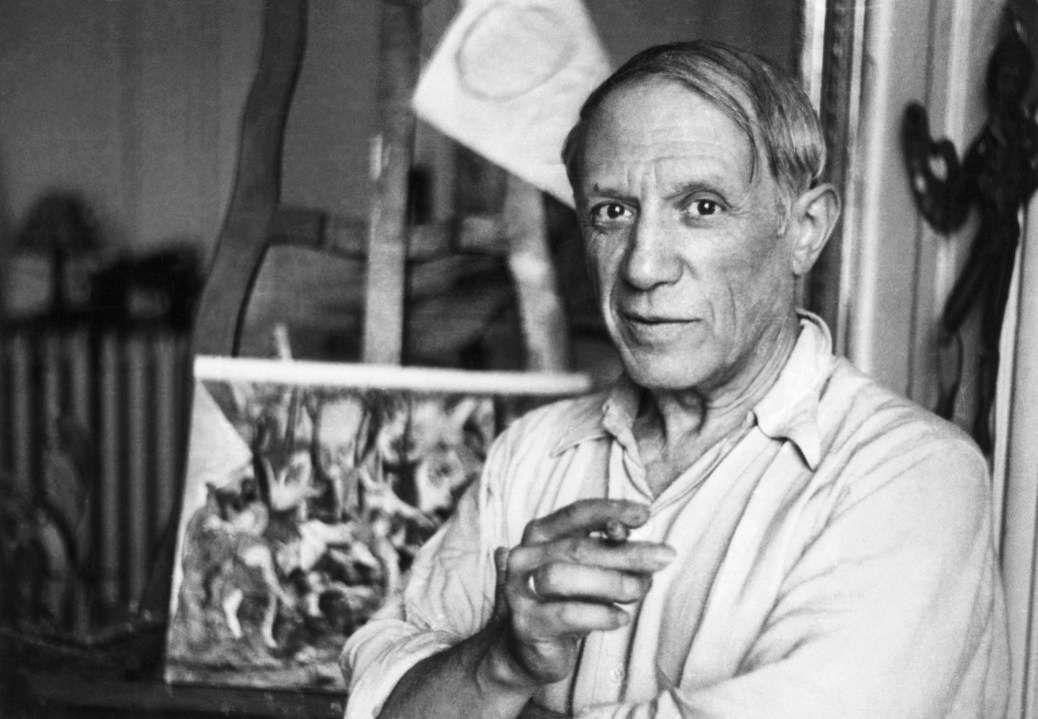
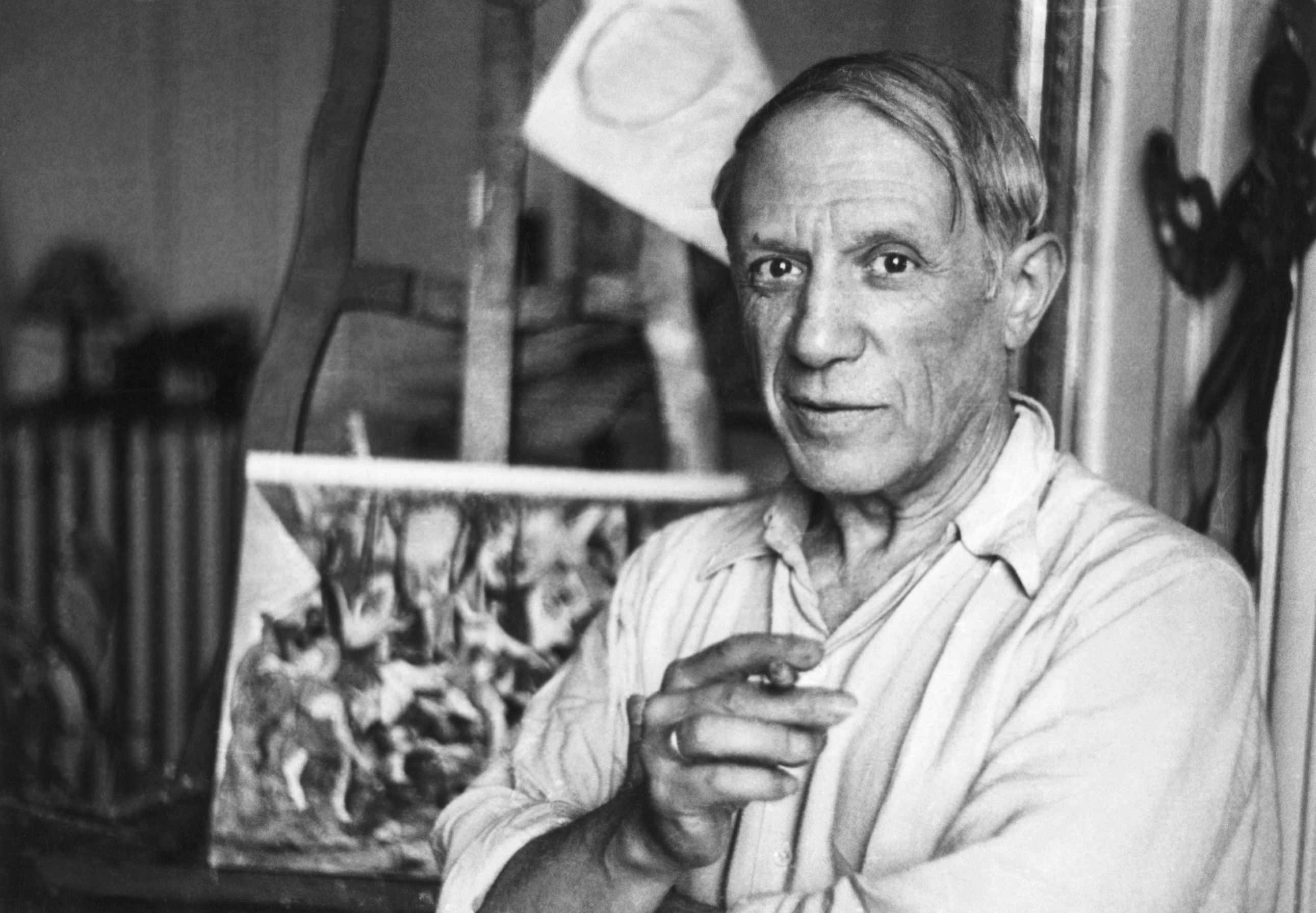
There’s a new exhibition on Picasso which is actually transgressive: Picasso and the Bible. That promises to stir things up among worshippers of the great man, who was known for being Republican, Communist and atheist.
The premise of the exhibition – which was opened this week with great fanfare at Burgos Cathedral in Spain – is that an artist can leave the Church, but the Church never really leaves him. The real theme of the exhibition isn’t Picasso and the Bible; it’s Picasso and Catholicism, a more explosive subject. The opening was attended by Picasso’s grandson, Bernard Ruiz-Picasso (a distinguished-looking gentleman who looks like his grandfather, crossed with Vladimir Putin), who lent works to the show, Queen Sofia and Cardinal Tolentino, head of the Vatican’s Dicastery for Culture.
The Cardinal spoke at the inauguration in a freezing side-chapel of the cathedral, and grasped the nettle firmly: how do you claim Picasso as a Catholic when he very conspicuously abandoned his baptismal faith? Look closely, the Cardinal urged: ‘The images are not neutral: they possess a cultural history, they draw on pre-existing symbolic codes, and they rework common roots. And these roots are no small matter.’
So, although Picasso was rarely explicitly religious in his work, the work is infused with Catholic preoccupations. As his grandson Bernard observed, ‘we are all creatures of our land and country and environment’, and Picasso was steeped in the symbolism of the Spanish Church. There are 44 pieces in the exhibition, divided by themes. There’s Maternity – the poster image for the exhibition is his monumental painting of his wife Olga with their son – which obviously invokes the Madonna and Child as well as classical archetypes.
There’s Vanitas – as in Vanity of Vanities – which gives us his disturbing skull studies (the archetypal memento mori) as well, interestingly, as a still life with a wineglass, conjuring up the Last Supper. There’s Golgotha, the hill of the Crucifixion, which gives us Picasso’s representations of the crucifixion – not just an early version, naturalistic but with a disturbingly distorted face from 1896 but the gut-wrenchingly agonised cross of 1932, anticipating Guernica. And then there’s the curiosity of a traditional and moving meditation of 1892 of Christ in the Tomb Adored by Angels.
Picasso’s work was affected by personal trauma – notably the suicide of his friend Casagemas in 1901 – as well as the horror of the coming war. As for the works around Guernica, the figure of the Pietà is everywhere. Cardinal Tolentino, in his address quoted the theologian Paul Tillich: ‘Guernica shows the human condition without any veil and, in this sense, is perhaps the greatest religious painting of our time: not because it illustrates a dogma, but because it touches the very core of the experience of sacrifice.’
And then there’s Hope, under which we get Picasso’s famous doves – of peace, deriving from Noah’s Ark, obviously. But there’s also the moving, simple representations of a boy carrying a sheep, a preparation for his famous sculpture, The Man With a Lamb. It’s a classical theme but Christ as The Good Shepherd is inescapable. I asked Paloma Alarcó, the curator of the exhibition and also chief curator of modern painting at the Museo Nacional Thyssen-Bornemisza in Madrid if it was possible just to see the picture simply as a boy with a sheep and she said emphatically: ‘it is obvious that he’s drawing on The Good Shepherd.’
Perhaps the most emphatic element of all was right at the start: Education. As Cardinal Tolentino observed, ‘Religious education was for him a sensory experience. The masses he attended with his mother, the dim light of the Andalusian and Catalan churches, the smell of incense, the gestures of the liturgy, the sacred images that populated everyday spaces: all of this was deposited in his bodily memory even before becoming an object of intellectual reflection. Catholicism was not for him a professed faith, but an inner landscape, an alphabet of the soul that precedes and transcends belief.’
An exploration of Picasso and Catholicism looks now less like ecclesial body snatching
It’s in this early section we see the formative influences on Picasso: going to church with his parents, his devout mother, the statue of the Mother of Sorrows in the home. And then there’s his time in the studio of the religious painter, Jose Garnelo Alda. The early works are unrecognisable as Picasso; there’s a lovely picture of an altar boy and another of an acolyte giving oil from a thurible to an old woman at the altar (there was one in Alda’s studio).
Then there are his artistic influences: the Spanish Baroque – he was keen on Murillo and his Madonnas; Romanesque statuary (more Madonnas); Grunewald’s gruesome Altarpiece; the Burgos Christ (another grim one) which he saw during his visit to the Burgos cathedral in 1934. Obviously there were other influences, but Catholic iconography was first and formative.
Pretty well every other aspect of Picasso has been explored in exhibition after exhibition, so why did it take this long, I asked his grandson, for this obvious aspect to get a show? ‘There needed’, he said, ‘to be a critical distance from the twentieth century’. In other words, an exploration of Picasso and Catholicism looks now less like ecclesial body snatching. This is reverse cultural appropriation.
Once the Catholic roots of Picasso are laid bare, the connections feel obvious, self-evident. It’s plain that the sensory and symbolic aspects of his religious formation were also part of his artistic formation. And it explains something of the barrenness of much contemporary art that they lack that crucial element.



Comments