
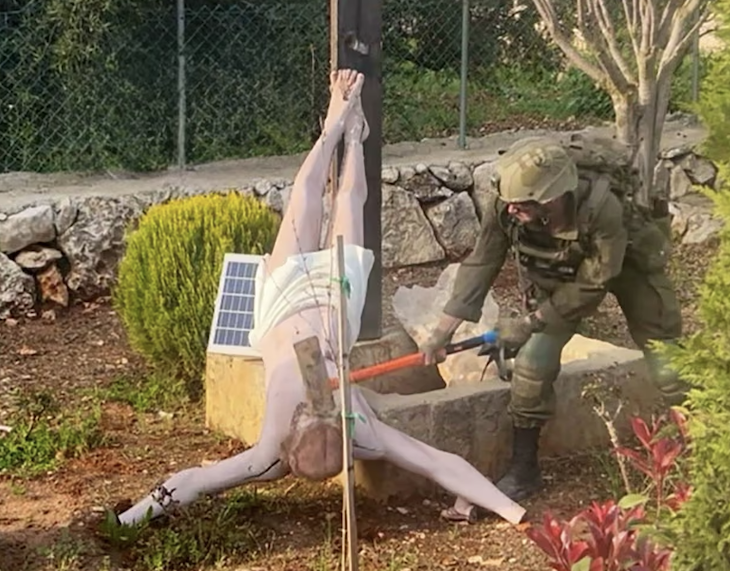
There’s something apposite, I suppose, about the desecration of a crucifix. In this case, it was an Israeli soldier in southern Lebanon who took a sledgehammer to one on private property and smashed the Jesus figure on the cross. The original crucifixion, as anyone who heard the gospels over Easter will recall, was marked by the humiliation of Jesus; this attack on the figure of one who took on suffering willingly was another humiliation, through the image. Mind you, if the charmer with the sledgehammer had reflected that the Christ-figure is, in Christian belief, not just God-made-man but God-made-Jew, he might have eased off a bit.
It looks like the export of the attitudes of extremist Israeli nationalists to Lebanon from Israel
The episode has caused outrage in the Middle East and has gone down as well as you might have expected with American Christians, who are the constituency which matters here. US evangelicals have been among the closest supporters of extreme Israeli nationalists (and these fundamentalists, in turn, are the bete noir of Christians actually living in the Holy Land).
Well, they didn’t care for President Trump’s whimsical depiction of himself as Christ any more than Catholics did. And while this Protestant constituency isn’t terribly keen on religious imagery, there is only one way to interpret the desecration of a statue of Christ by a soldier belonging to America’s ally in the war in Iran. Duly, Mike Huckabee, a Baptist minister and the US ambassador to Israel, said on X that “swift, severe and public consequences are needed.” Let’s see. There wasn’t much done when Israeli soldiers conducted abusive ceremonies in an Orthodox monastery in southern Lebanon in 2024. The IDF (Israel Defense Forces) promised to investigate that incident. But was anyone punished? There have been no reports of disciplinary action taken against those responsible.

Benjamin Netanyahu, the Israeli Prime Minister, has prudently condemned the latest episode; Gideon Saar, Israel’s Foreign Minister, wrote that “this shameful act is entirely at odds with our values. We apologise for this incident.” It may be against the values of the state of Israel; it’s not obviously against the values of this particular administration. Rather, it looks like the export of the attitudes of extremist Israeli nationalists to Lebanon from Israel.
Were those attitudes in evidence in the week before Easter, on Palm Sunday, when Israeli police barred the Latin Patriarch, Cardinal Pizzaballa, and the Franciscan Custos, or guardian of the sites sacred to Christians, from saying Mass at the Holy Sepulchre in Jerusalem on Palm Sunday? The ceremonies recalling Christ’s passion at Easter in Jerusalem are a big deal; and while the usual crowds were barred on account of the conflict on Iran, it was quite something for police actually to stop the Cardinal and the Custos from re-enacting Christ’s entry into Jerusalem. The Israeli President, Isaac Herzog, swiftly condemned the incident and the PM ordered an about-turn. But it didn’t appear to be in any way untypical of the attitudes of this coalition government, specifically the party led by the Minister of National Security, Itamar Ben-Gvir.
I have been in Jerusalem twice – most recently three years ago – as a guest of the Orthodox Patriarch of Jerusalem, Theophilos, who wanted journalists like me to draw attention to the attempts by Israeli groups, like Ateret Cohanim, to buy up strategic sites in and around the Old City of Jerusalem. But in the course of both visits, our group met representatives of the main churches in Jerusalem – Catholic, Anglican, Armenian, as well as Orthodox – and what emerged was a consensus of a pattern of intimidation against Christians by, in particular, Jewish settler groups. And it’s still happening; a report from the Rossing Institute records a significant increase in attacks on Christians in Israel. Last year, there were 155 incidents, including attacks on clergy.
To give one small example from my visits, Jewish pilgrims to the Wailing Wall go through the Armenian quarter; while they pass, some habitually spit at the Armenian church and at Armenian clergy. One priest said that when he returns to the cathedral, he often has to change his cassock, for it’s covered in spittle. Alas, when I tried to run after one of these young men outside the church to explain his philosophy, he took off on a bicycle. Small beer, you may say, but indicative of hostility.
The Benedictines we visited at the site of the Last Supper made the same point about the extremist youths who throw stones at them – in one case, a life-threatening big rock. The Orthodox patriarch was exercised by the deliberately insulting way in which loud festivals were allowed during the most sacred periods of the year outside his door. Christians are also desperately worried by the attempts to establish a national park in the area covering the Mount of Olives, at present under the administration of Catholic religious orders. These orders are good and careful custodians of the site; it’s not as if the National Park project, which adversely affects local Palestinian residents, is to rescue the area from bad management.
Beyond Jerusalem, Palestinian Christian villages like Taybeh are subjected to settler attacks just as non-Christian ones are. Granted, all this pales in comparison with the genuinely troubling expansion of Jewish settlements in the occupied territories, specifically to thwart a two-state solution to the conflict, but the hostility to Christians is still indicative.
So when Netanyahu races to condemn the IDF loon who desecrated the figure of Christ on the cross, we should consider the possibility that he wasn’t some outlier, some weirdo utterly unrepresentative of the inclusive mindset of the current Israeli administration, but entirely of a piece with the outlook of some members of the coalition government. And that is precisely the problem.






Comments