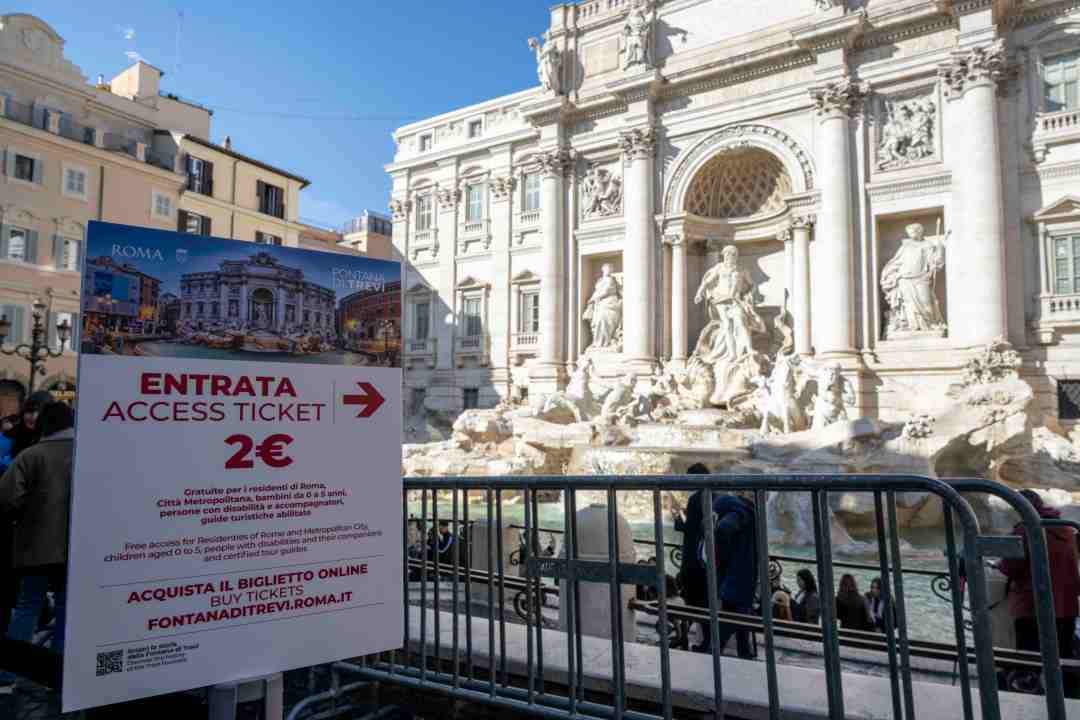

As a general rule, once a city erects turnstiles to tourist attractions which were once free to visit, it is time to go elsewhere. Never more so than in the case of Rome. Last week the Italian capital introduced a €2 charge to visit the Trevi Fountain. Tight-fisted tourists like me will still be able to see the Trevi from a distance – it happens to stand in a public street. The charge will be only for sad Instagrammers who want to get close enough to chuck their coins in the water.

The city’s tourism department has suggested the fee is needed to manage the throngs of holidaygoers. Even then, God forbid, they won’t be able to take off their sandals and take a dip – that will earn them a €500 fine. Which raises the question: why bother visiting the fountain at all? You’ll find more attractive water features in your local B&Q.
This 17th-century vanity project was built on the part of Clement XII to make supposedly dramatic use of the waters fed by the Aqua Virgo, an eight-mile long Roman aqueduct. Had the Romans known to what use the waters would end up being put, maybe they wouldn’t have bothered. Their grand purpose was one of promoting sanitation and health. The Trevi Fountain, by contrast, is founded on frivolity and excess. Its ghastly over-decoration is the very opposite of the fine piece of engineering that feeds it.
The Trevi is Rome all over. The Romans built an elegant, functional and technologically advanced city – before their descendants buggered it up through neglect or redevelopment. From overpriced food to decaying infrastructure, these days you’ll find only potholed roads lead to Rome.
When it comes to its crumbling monuments, the vainglorious Victor Emmanuel II Monument is the absolute end: a 19th-century wedding cake dumped in the heart of Roman Rome. It should be taken down and its stone recycled – just as the locals did to the Colosseum so many centuries ago.
The Spanish Steps? You may as well visit one of the terraces at the original Wembley Stadium. In their heyday, they were just as crowded and there was usually something more interesting to watch. Oh, and it didn’t cost to linger at Wembley, either – you get another €250 fine for sitting on the Spanish Steps.
The Romans built an elegant, functional and technologically advanced city – before their descendants buggered it up
The first time I visited Rome, the place was heaving – and yet, still, a waiter was so miserable about his employment prospects that he begged for my help finding him a job in Britain. Eleven years on and it seems little has changed: according to Istat, Italy’s answer to the Office for National Statistics, tourism makes up 9.6 percent of the country’s economy. Yet total numbers were down by almost 1 percent in the second half of last year compared with the same period in 2024. It may be a small decline in what is otherwise the fifth most visited country in the world but, even so, it puts Italy in a perilous position. The country really can’t afford to upset its tourists by springing fines and charges on them.
If you really must visit Rome, then take my advice: go and see the Pantheon – which has lasted so much better than the crumbling tower blocks and highway bridges that blight modern Italy – and then get out. The best bits of Rome aren’t even in the city itself. If you want to see Roman remains in their proper context, the best place is Ostia Antica – a town’s worth of ruins a 45-minute train from the capital.
All the same, perhaps it’s best to give Italy a miss altogether these days. It’s always been full of dodgy gelato salesmen, but now it’s not just them trying to rip you off – it’s the city authorities, too. The sign to turn your back on Venice was when the city introduced a €5 entry charge three years ago – not to visit museums or buildings but just to walk the streets and squares. Italy’s cities are reverting back to closed, medieval spaces surrounded by walls and gates.
The Instagrammers can have Venice, although Italy’s tourism chiefs shouldn’t take them for granted; they will be off somewhere else when it gets more ‘likes’. As it stands, the influencers may as well take Rome, too. But when the city’s authorities find they’ve drained the capital’s lifeblood through sheer greed, they’ll have only themselves to blame.



Comments