A few weeks before the end of the year, I was invited to a house party at which I had the misfortune of becoming embroiled in a conversation with a man I’ll call Joe, because his name was Joe and I don’t feel inclined to offer him the dignity of a pseudonym.
There’s a theory I’ve corroborated since moving to New York in 2020. Every conversation at a party in this city eventually gravitates toward one of five subjects: traffic, the weather, real estate, sex or the mayor.
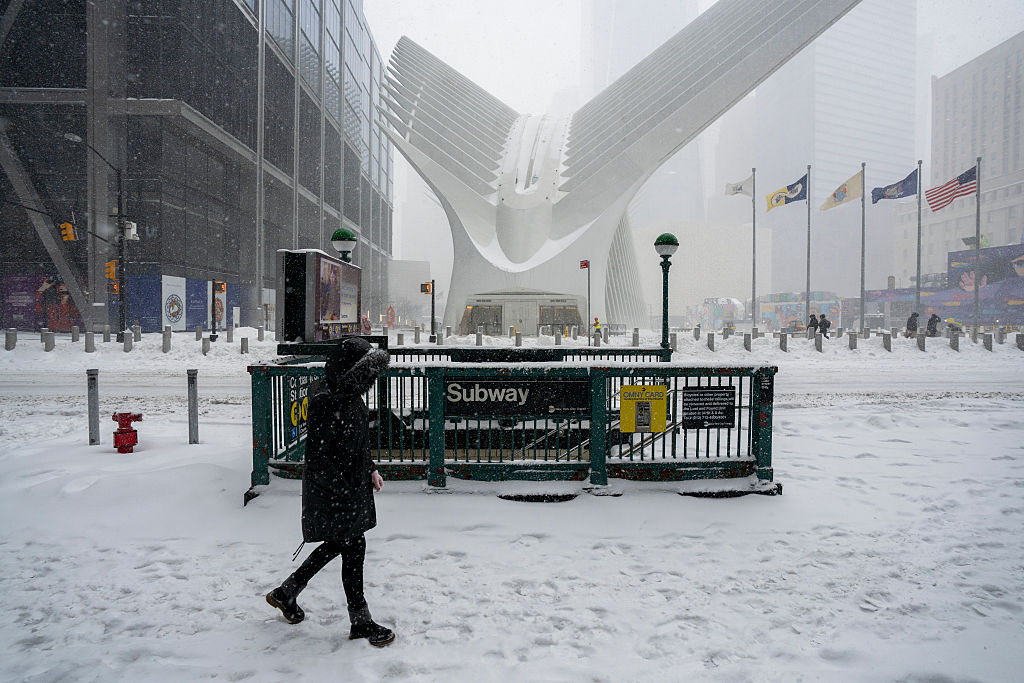
The ultra-rich are among the subway’s most devoted riders
Joe told me he works in finance (which he pronounced “fin-ants”) and it seemed he wasn’t bothered about the weather. He wasn’t a tax-optimizing Connecticut commuter, so had no unsolicited opinions to share about traffic. Thankfully, he appeared to have exhausted his tirades about Zohran Mamdani’s plans to turn the city into a “socialist dystopia.” And had he started talking about sex, I would have jumped out of the window, leaving this column forever unwritten. Which left us with real estate.
“I’m in the market,” Joe declared, adopting a pathetically coquettish expression he had almost certainly practiced using a picture of George Clooney and a mirror. “Got my eye on a brownstone.” Joe had recently come across a place on West 72nd Street and he was about to make an offer. It was, he assured me, a bit of a “steal” – a word that, in Manhattan real-estate-speak, probably means emotionally destabilizing but legally sound. “That’s great,” I said absently, my attention already drifting toward a smoked salmon blini gliding through the room. “There’s the Trader Joe’s right there,” I continued, “the park, of course. Oh, and the 2 and 3 express trains.” I managed to say all this while mentally already masticating the blini. “Downtown in 15 minutes. Boom.” Joe snorted, as though I’d just confessed to enjoying something unfashionably democratic. “Yeah,” he scoffed. “Only I’m more of an Uber kind of guy.”
At that precise moment, the blini entered my orbit, allowing me – in one graceful, self-preserving swoop – to place the entire thing into my mouth. It was bigger than it looked, which saved me from saying something that would have caused a rupture in the evening’s social fabric.
I know. His comment was probably meant to be innocuous; an offhand opinion – the sort we’re all entitled to in this vaunted land of free thought and speech. But here’s the thing: opinions about the subway are also something of a personality litmus test.
The subway – the 122-year-old rapid transit system that weaves through the five boroughs – is a feat of awesome engineering. It deserves admiration and, at a minimum, a basic level of respect. Yes, it’s filthy. Yes, it smells like despair and warm metal. Yes, between June and September it becomes a subterranean sweat lodge in which time, deodorant and optimism cease to function. And yes, you must keep your wits about you to avoid stepping on something – or someone – you’ll regret. But to dismiss it outright is as offensive as describing New York City as provincial. As rude as calling it soulless.
Perhaps more damning, to categorically snub the subway signals a performative elitism so naked it’s almost impressive. Interestingly, I’ve noticed that the ultra-rich – the scions of old money who have absolutely nothing left to prove – are among the subway’s most devoted riders. One such individual, firmly ensconced in that gilded class, regularly extols its virtues to me over lunch. His enthusiasm isn’t fueled by novelty. He’s lived here his entire life. He simply recognizes an infrastructural marvel when he sees one. And he knows to value it.
It’s only the ascending millionaires – the aspirational, the status-anxious, the sad posers thirsty for attention and adoration – who believe that by declaring the city’s subterranean lifeline as beneath them they’re somehow accruing social capital, presenting themselves as a superior, nobler, more evolved and enlightened breed. As if character could be Ubered to them.
One argument I do buy is the safety one. I too, somewhat sheepishly, tapped my way through the turnstiles a few years ago after a spate of people being pushed – seemingly at random – onto the tracks. But it never stopped me from choosing a 20-minute, high-speed journey priced at $3 over a $50 Uber ride in what can only be described as a vomit comet. (If, that is, comets moved at five miles an hour and were piloted by people who believe good driving consists of alternating between the brake and accelerator until the passenger turns green and abandons the vehicle mid-block.) As a relevant aside, recent data happen to show that the subway has just had its statistically safest year in more than 15 years.
There’s a cartoon displayed in many subway cars intended to raise awareness of indecent behavior – assaults, unwanted advances and the like. The caption urges riders not to “become someone’s subway story.” In other words, don’t become the anecdote someone tells every time they order an $80 car home, complete with a rain-triggered surcharge.
A few days after the house party, as I glanced up at that cartoon on a smooth, civilized uptown-bound 2 train, I laughed. Joe had become my subway story.
Perhaps one day I won’t feel like braving the gritty depths of commuter mayhem. Perhaps I’ll hesitate after another slew of violent incidents, or avoid a midsummer carriage with no air conditioning. Perhaps I’ll simply be too tired to navigate the labyrinthine purgatory that is the Times Square transfer between the 1/2/3 and the N/Q/R/W. But then I’ll remember Joe, and I’ll reconsider. Because I never want to be the kind of person so insecure in their social standing that they have to sneer at one of New York’s most formidable features.
Somewhere between the turnstiles and the exits, the subway has a way of revealing who belongs to the city, and who is merely passing through it in search of something to flatter their brittle ego. So yes, I think I’ll take the train. The blinis may well be all eaten by the time Joe arrives.
This article was originally published in The Spectator’s February 2, 2026 World edition.






Comments