

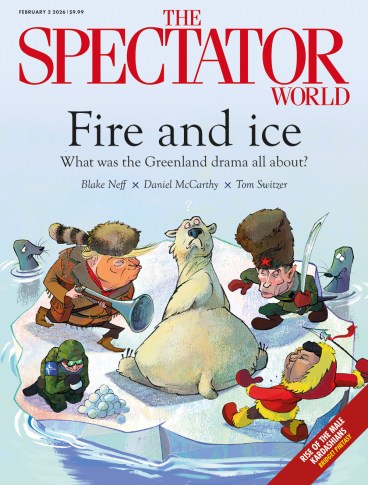
It began, as most things do under Donald Trump, with an idea that struck outside observers as a lark. An interested party – in this case, billionaire Ron Lauder – suggested to the President during his first term that the United States should acquire Greenland, a move that would represent the largest expansion of US territory since the purchase of Alaska from the Russians more than 150 years ago.
The notion was reportedly considered and then left on the shelf, like so many ideas in Trump’s first term. Yet time away from the presidency gave it more resonance. Now the President is back on the case – and he seems very committed to the move, to the shock and horror of European observers who never took his Arctic ambitions seriously.
Trump’s bluster about expansion should not have confused the fact that there is a long history among the Republican foreign-policy expert class, particularly for those mindful of Chinese and Russian threats to the Northwest Passage, of focusing on the importance of achieving an increased security posture in Greenland.
The addition of scads of rare-earth minerals, which the Danes who are currently in charge of the world’s largest island have not fully accessed, just makes it even more enticing for the Trump administration. A security-justified move that grants massive access to land and resources? Of course that’s something this President will want to do, the delicate feelings of Denmark be damned.
There are any number of moves that could have been entertained by the Europeans in the intervening time. A condominium arrangement, which would entail joint sovereignty over Greenland, could have been created. A renewed security agreement (the previous one was drawn up in 1951) involving increased access to the island in exchange for American tax dollars directed to Greenlanders was also possible.
Instead, the disagreement has turned very sour. It took on a more personal flavor when Trump was not offered the Nobel Peace Prize for his moves in the Middle East (although he didn’t technically qualify for it, time-wise). So on January 17, the President announced a plethora of tariffs and the Europeans took great offense. Trump doubled down by posting purportedly private messages from the head of NATO and French President Emmanuel Macron on Truth Social. France, Germany and Sweden all deployed small groups of troops to the island in a show of solidarity. Senators in Washington, including a significant number of Republicans, issued skeptical statements. And European Union President Ursula von der Leyen called for “permanent” independence from the US. “Of course nostalgia is part of our human story, but nostalgia will not bring back the old order,” she said, in one of the more honest acknowledgements you can hear from a Eurocrat.
Will Greenland fall into the category of ‘things the staff wishes we’d put further down the list’?
At the Davos gathering, Trump suddenly declared that he wouldn’t impose the tariffs on Europe or use military force, and followed up by announcing an agreement over a new strategic framework for the security of Greenland.
At its worst, these new developments risk undoing the NATO alliance at a particularly inopportune time. Even if you buy into the idea, as many close to the President do, that the alliance is a decrepit relic of the Cold War, its function has proven itself through the Ukraine war. NATO has, in a world full of hot spots, been a quieter participant at the table during Trump’s tenure. The President’s much-vocalized efforts to make the European nations pay more for their own defense has borne fruit. And if the point of the alliance is to prevent an explosion in nuclear weapons production, that purpose has held. What might happen after a breakdown of the alliance remains an open question.
There is, moreover, a risk of political and economic backlash for Trump. His threat of a trade war with Europe in the interests of territorial expansion is not exactly the reason that people voted Trump back into office, and there is potentially a significant amount of uncertainty that could come to the American economy in very short order. For Republicans on Capitol Hill who were just beginning to feel some degree of confidence heading into the midterms, as economic signals show silver linings and tax refunds start flowing, this is a roll of the dice that could end a lot of careers.
For now, the diplomats are just talking. Danish foreign minister Lars Løkke Rasmussen and Greenlandic foreign minister Vivian Motzfeldt met with Vice President J.D. Vance and Secretary of State Marco Rubio in Washington to discuss the matter, with comments afterwards that indicated a major gap in opinions. “It was not an easy meeting,” Danish Prime Minister Mette Frederiksen told the Wall Street Journal, adding that “there is a fundamental disagreement because the American ambition to take over Greenland is intact.”
But is it an American ambition or a purely Trumpian one? According to a recent poll from YouGov, 28 percent of those surveyed supported a purchase of the island, and just 8 percent approved of a military move to take it over, with more than half of Republicans in opposition. Using military might to bomb Iran or exfiltrate Nicolás Maduro is not in the same category as using it to take over a little-populated island most Americans have no desire to even visit.
A central question about this second Trump term has been: how much is too much? For a President who wants to move at lightning speed and remake the world, the country, the courts, the economy, the military and even the White House itself, is there a point where the breakneck pace becomes far too much for his team to handle effectively? Will this be a case where, looking back, something like this attempt at Greenland falls into the category of “things the staff wishes we’d put further down the list”?
Trump’s Greenland effort could prove more costly than other choices he has made on the world stage, particularly for the American economy and the future of European security. But it seems unclear who has the President’s ear to say it – certainly not Republicans on Capitol Hill. The consequences of the end to any semblance of global order isn’t a serious threat if, as a party, you view that order as a slumping zombie anyway. Of course, there’s one more person who might suffer the consequences even if Trump’s gambit is successful. But who says Marco Rubio can’t do one more job?




Comments