
During his lengthy interview with the New York Times, President Trump was asked if there was anything that could check his power on the world stage. “Yeah, there is one thing,” he said. “My own morality. My own mind.”
What are we to make of Trump’s morality? That’s between him and God, I suppose, and perhaps only the all-knowing could parse his mind. But it’s fair to wonder where morality factors into Trump’s foreign policy, and whether America’s moral justification of force has only ever been a convenient pretext for acting in our own interest.
At the World Economic Forum in Davos today, Trump said he “won’t use force” to take Greenland. Fears of an invasion had been raised in the past few days, especially after Trump sent a catty text message to the Norwegian Prime Minister saying he no longer feels “an obligation to think purely of Peace,” considering that “your Country decided not to give me the Nobel Peace Prize.”
Maybe the Nobel snub was Trump’s tipping point in making up his mind on Greenland, maybe not. It has not, at least, escalated into boots on the ground, but rather a call for “immediate negotiations” for US acquisition of the territory. Still, the moral questions around Trump’s recent actions – strikes on drug boats in the Caribbean, the capture of Nicolás Maduro, readying troops to deploy to Minnesota, economic threats to push Europe into handing over Greenland – have certainly troubled many observers. Among those, perhaps unsurprisingly, is the Catholic Church, which has already been critical of Trump’s policy on immigration and deportations.
In early January, Pope Leo gave his annual remarks to the Vatican’s diplomatic corps. It was just days after the US raid on Venezuela and Maduro’s capture. “War is back in vogue,” the Pope said, “and a zeal for war is spreading.”

Three US cardinals – Blase Cupich of Chicago, Robert McElroy of Washington, DC and Joseph Tobin of Newark – issued a statement this week to reiterate the importance of Leo’s address, writing that America’s role “in confronting evil around the world” is “under examination.” They renounced war “as an instrument for narrow national interests” and said that military action should only be seen as a “last resort in extreme situations, not a normal instrument of national policy.”
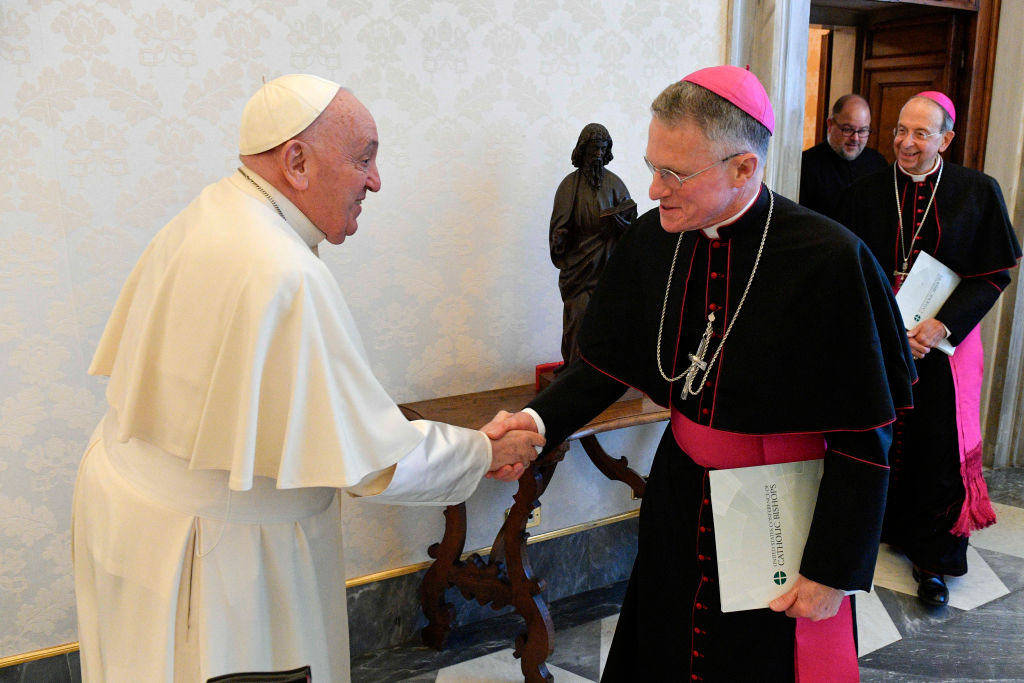
Perhaps the most relevant commentary on Trump’s foreign policy has come from Archbishop Timothy Broglio, who heads the archdiocese for military services and oversees military chaplains. On Sunday, he told the BBC that he “cannot see any circumstances” in which the hypothetical invasion of Greenland would be morally just.
Archbishop Broglio said that if Trump were to order soldiers to invade Greenland, troops “could be put in a situation where they’re being ordered to do something that’s morally questionable,” and that “within the realm of their own conscience, it would be morally acceptable to disobey” that order. Broglio’s concern is about putting troops in an “untenable situation,” where their conscience conflicts with lawful orders and they could be court martialed for disobedience.
While Trump has ruled out using force to take Greenland, it’s worth considering Broglio’s concerns about the morality of military action. For a situation in which America invaded another country, in the eyes of the Catholic Church, it would have to meet the criteria for just war. In his Summa Theologica, Thomas Aquinas set out these three conditions: that the authority of the sovereign waging war is legitimate, that a just cause is required and that belligerents have the right intention of advancing the good or avoiding evil. The Catechism gives further criteria, including the need for any attack to have “serious prospects of success” and that it must not “produce evils and disorders graver than the evil to be eliminated.”
Just war theory does not only apply to Catholics. While it was formulated in an explicitly Christian setting by theologians like Augustine and Aquinas, it has been translated into the secular language of military ethics and international law. Trump might disparage NATO’s ineffectiveness, and perhaps he wants to see the UN replaced by something like his Board of Peace, but the UN didn’t invent the prohibition on aggressive force, or NATO the principle of just self-defense. Moving away from governance by global organizations doesn’t mean we’re left with realpolitik.
A just cause is usually one of retaliation against an aggressor. It’s quite difficult to see how invasion and forced annexation of a NATO member and US ally could be considered an act of justice – it would be less clear in the case of adversaries like Cuba, Iran or Venezuela.
In the Maduro raid, for example, there were grounds for justifying retaliation against an aggressor who was orchestrating drug and human trafficking over our border, and the strike was executed without civilian casualties. At this stage, though, there’s still a question of whether the Trump administration has “serious prospects of success” there in the long term. Marco Rubio, who is Catholic, might reasonably have reconciled his faith with getting a little Old Testament in South America. Other Catholics – the Pope, for one – might have balked. Both would be defensible.
Regarding right intention, Aquinas wrote that “an unpacific and relentless spirit” and “the lust for power” are rightly condemned in war. Trump’s fixation on having “Complete and Total Control of Greenland” can be viewed as an affront to US allies and a threat to the notion of sovereignty, and his rhetoric is, quite nakedly, about gaining power in the region – but does that represent a lust for power for power’s sake? And if it does, should we still be concerned about a bloodless annexation?
The question about a “lust for power” gets us into the nebulous workings of Trump’s moral compass, and the answer depends on how sincerely you want to read into his text messages and ravings on Truth Social, or if you care to do some Freudian analysis of his statement that Greenland is “psychologically important for me.” The Trump administration has a legitimate security concern that Greenland and Europe have no effective deterrent to stop Russia or China from establishing a presence in the region.
However, how power is obtained and maintained matters as well. The effort to strengthen US power, whether in the Arctic, the Middle East or South America, should not just be about keeping power out of the hands of the bad guys by any means. It’s about how America would achieve that power and what we want to do with it. We hold – or have historically held – ourselves accountable to exercise power in more just and moral ways than our adversaries.
Broglio’s responsibility is to represent the interests and needs of Catholics serving in the military. He is right to draw attention to the morality of Trump’s foreign policy, because it is a matter that will concern the soldiers in his archdiocese. It is, perhaps, less helpful to speculate on the BBC as to whether their situation will become morally untenable. American Catholics who have made an oath to defend the Constitution will have grappled with the morality of their duties, and are equipped to consult their consciences to make judgments about complex moral issues.



Comments