
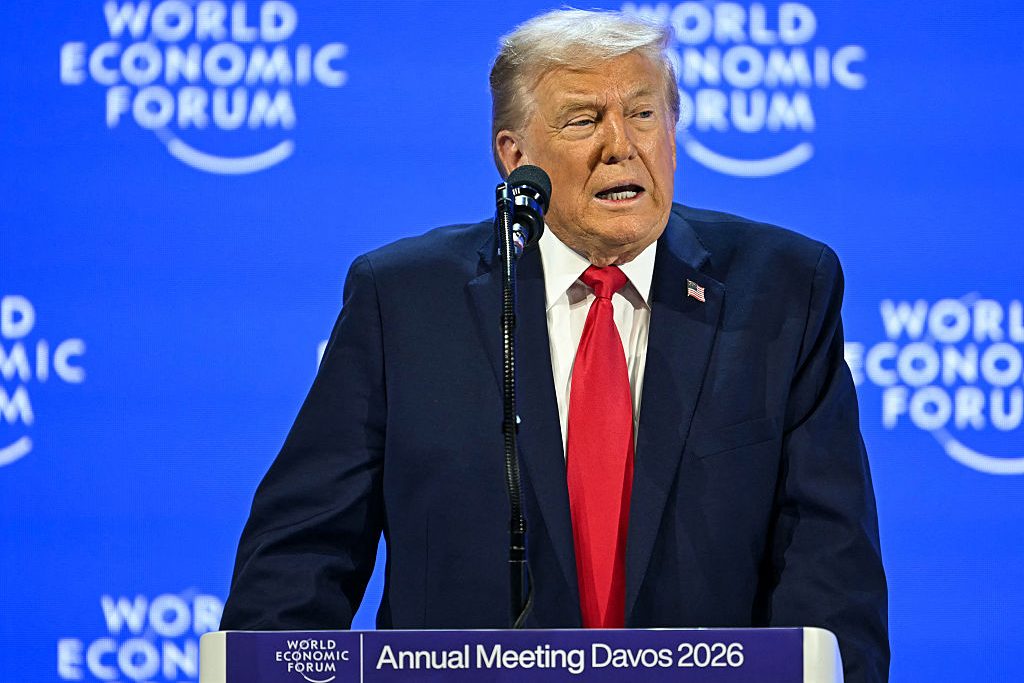
The headline from Trump’s Davos speech is clear: I won’t use military force to take Greenland. That’s what the President told the world’s leading politicians and business executives at the World Economic Forum.
That declaration was very good news for all of them and for US investors, who immediately started buying stocks, erasing about half the losses suffered Tuesday, when the threat of force seemed possible. They all knew that carrying out that military threat would shatter the institutional foundation of Western security: NATO and US-European relations.
Instead of military threats, Trump emphasized America’s disproportionate contributions to European defense since World War Two. It was finally time for them to bear a fair share of the burden. American leaders have been saying that for decades. But Trump, to his credit, has finally gotten results.
As for Greenland, he said, bluntly and accurately, that the US was the only country that could defend the island against rising threats from Russia and China. Denmark and its friends were far too weak to do it alone. Does anyone doubt it?
The US, he said, should have demanded the island after World War Two, when our forces alone protected the island. It was “stupid,” his word, that we didn’t get the island then. To protect it now, he said, the US would need full and formal control. He explicitly denied it was about mineral resources or “rare earths.” It wasn’t about economics; it was about the common defense of the West.
If the use of force is off the table, what’s Trump’s leverage to get Denmark to cede its colonial status? It was Trump’s credible threat to remember Denmark’s refusal. True, the threat was vague because the President didn’t say what the consequences would be. It was credible, though, because Trump has shown he is willing to punish even long-term allies if they refuse his offers.
He treats each negotiation separately, praises most leaders personally and focuses on specific policy demands. He threatens to take action if his demands aren’t met, and – this is crucial – he delivers on his threats. That follow-through is why no one is still repeating the meme, “TACO. Trump always chickens out.” You certainly don’t hear that phrase in Caracas anymore. You don’t hear it in the New York prison where Nicolás Maduro and his wife now reside. If you heard it from the Ayatollah and his Islamic Revolutionary Guard Corps, they are deluding themselves.
What Trump underscored in his speech, on both economic and security issues, was his demand for fair, reciprocal treatment. If you won’t let our products into your country, if you impose stiff tariffs on us, if you demand special discounts on American drugs, then expect us to hit you with similar restrictions. Deliver results – give us equal treatment – or expect punishment. Likewise, if you expect us to defend you, you must also shoulder your share of the costs.
Thanks to Trump’s credible demands and Russia’s rising threat, NATO partners are finally shouldering that share, or at least promising to do so. It’s not surprising, then, that Trump took credit for European pledges to spend 5 percent of their GDP on defense.
He took credit for quite a lot. In fact, the first half of the hour-long speech was a parade of his achievements over the past year. He doesn’t shrink from self-praise or harsh criticism of his predecessors. The soundtrack was “America is back,” thanks to my policies. We are growing rapidly, securing massive new investments from around the world, and bulking up our military.
One note surely jarred the globalists who filled the room. He offered a brief, unapologetic defense of Western civilization and its shared values. Those were very different, he said, from the values and practices of Somali immigrants, who came to America and systematically ripped off taxpayers with fraudulent schemes. Justice is coming for them, he said. It must have been bracing medicine for European leaders who face their own problems of unassimilated immigrants and now see populist parties capitalizing on voter frustration,
Trump was equally blunt on the foreign front, not only about NATO but about the bodies that piled up in Wuhan as the pandemic began. We saw them on satellite, he said, even as Beijing tried to hide that disaster from the world.
What was missing from Trump’s talk? Two things, above all. First, what’s next for Iran? The president didn’t elaborate on America’s military buildup in the region, which is the essential precursor for any US strike, and he didn’t repeat his demands that the regime stop the killings. His silence was not a concession; it was quiet, ominous preparation. Second, in a room full of globalists, he didn’t stress his own nationalist-populist stance and its difference from the spirit of Davos. He simply reiterated his policies, praised their success, and invited them to join him.
After planting the flag, the payoff will come in the series of bilateral meetings today and tomorrow. When we begin hearing what he and NATO partners, Ukraine’s Zelensky, and others spoke about – and what they agreed to – we will know whether the trip was truly successful or whether it was just another sales pitch from a master of the art.


Comments