
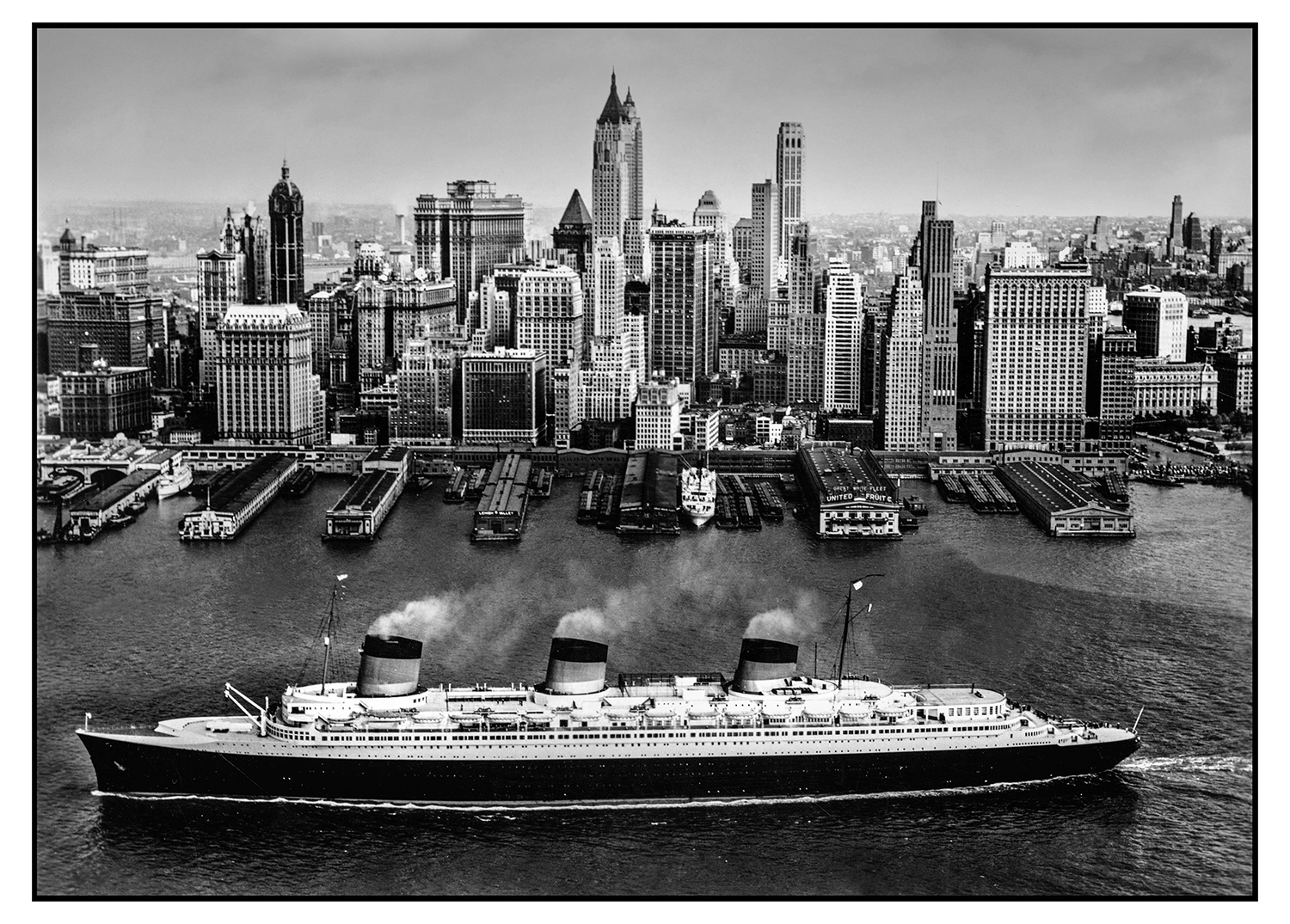
Some time in the next few weeks, a great ocean liner will be lost at sea. One of the greatest, in fact. When the SS United States made its maiden voyage in July 1952, it was the last word in transatlantic liner design. In an age of ocean-going elegance, the ‘Big U’ was the newest, the sleekest and the swiftest. To this day, it holds the Blue Riband – the all-time record for the fastest transatlantic crossing by a passenger ship. Now, after five decades rusting in dock, and a series of unsuccessful preservation attempts, the United States is about to make its final voyage. Stripped of masts, fittings and its massive red, white and blue funnels, it will be towed out and sunk as a diving reef off the Florida coast.
It’s heartbreaking to admit that this might be for the best. The era of the ocean liner ended – like so many glorious things – in the late 1960s, as air travel conquered the world. We still have passenger ships, it’s true, but the cruise liners of today are essentially floating holiday resorts, built to chug between tourist destinations. The true ocean liners were a different breed: formidably engineered thoroughbreds, designed to deliver an efficient intercontinental service to all classes, in all seasons and all weathers.

And they’ve almost all gone. Cunard’s Queen Elizabeth 2 has retired to Dubai; its predecessor, the Queen Mary, is a tourist attraction and occasional movie set in Long Beach, California. Holland America Line’s beautiful Rotterdam of 1958 is a hotel in its namesake port. For most, though – including P&O’s beloved Canberra, and the mightiest of them all, the colossal SS France – it was a one-way voyage to the shipbreaking beaches of India and Bangladesh to be ‘recycled’: in other words, sliced into scrap metal. The United States will at least escape that final humiliation. Better a burial at sea than such an ugly (if practical) fate.
Only one true transatlantic liner survives in service on the historic Southampton to New York route. At its launch in 2003, Cunard’s Queen Mary 2 became the 21st century’s first – and almost certainly last – real ocean liner. Its very existence is an anomaly. Cunard, today, is an arm of Carnival Corporation & plc, and well aware that the serious money is in leisure cruises.
George Bernard Shaw hated sea travel and couldn’t stand his fellow passengers
But sentiment can be a selling point, too. Cunard trades on its heritage, promoting its ships as the successors to the classic mid-century liners and the world they embodied. Now it has teamed up with Letters Live, which presents staged readings of historic letters written by passengers on board. Past performers have included Benedict Cumberbatch, Olivia Colman, Ian McKellen and Gillian Anderson (the exact line-up is kept secret until the night) and the figures whose letters they’ve read include some of the leading wits of the 19th and 20th centuries. It’s produced by Shaun Usher – author of Letters of Note – and he’s spoiled for choice.
‘These ships have such an amazing, rich literary heritage; an incredible history when it comes to letter-writing,’ explains Usher. ‘We’ve got letters from Elizabeth Taylor, Noël Coward, Virginia Woolf and Vita Sackville-West. Edna St Vincent Millay is one of my favourite letter-writers; she has such zip, and real cheek. They’d had quite rough seas but she says that’s exactly how she likes it. She boasts about how the crew admire her sea legs. Then there’s Mark Twain, and George Bernard Shaw, who hated sea travel and couldn’t stand his fellow passengers. But of course that’s just Shaw.’
When you think of the famous ocean liners, these are exactly the sort of names that spring to mind: bright young things, grand old men and interwar high society, thrown together for a few days in a self-contained world for the simple reason that there was no alternative. To travel between Europe and America before mass air travel, a five-night journey by sea was an irreducible minimum. Read about almost any creative life in the late 19th and early 20th centuries, and sooner or later you’ll find yourself on board a ship.
So en route to New York, Rachmaninov practised his new Third Piano Concerto on a dummy keyboard in his cabin. Gustav Mahler, returning to Europe to die, found himself sharing a ship (the SS Amerika) with the novelist Stefan Zweig and the pianist Ferruccio Busoni, who (according to Alma Mahler) visited the Mahlers’ state room to divert the ailing composer with wine and ‘crazy specimens of counterpoi nt’. (Mahler missed a treat: the Amerika’s menu was devised by Escoffier.) In 1933, westbound on the Italian Line’s flagship SS Rex, Stravinsky bumped into the cellist Gregor Piatigorsky while playing poker. By the end of the voyage, he’d completed a Suite Italienne specially for him.
The art of the great liners – for the higher-paying passengers, at least – was to make inconvenience enjoyable and even aspirational. Transatlantic voyages were a temporary world apart; a necessary, unavoidable time and place for leisure, reflection and dalliance. Not everyone approved. Writing after the Titanic disaster in 1912, Joseph Conrad – himself a master mariner, who had commanded sailing ships in the Indian Ocean – damned the new steamers as ‘Huntley & Palmers biscuit tins’, whose ‘seaside hotel’ luxury fuelled a dangerous complacency.
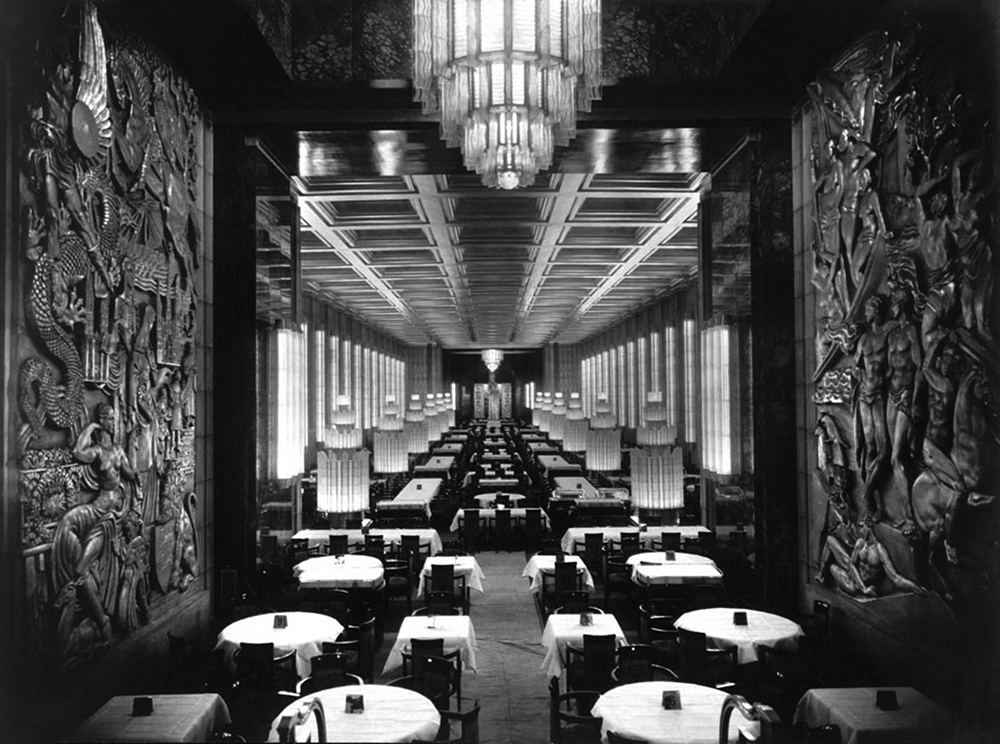
But Conrad spoke for a vanishing world, and in the early 20th century these ‘ships of state’ became floating showcases of national taste. The wood-panelled public areas of Cunard’s original Queen Elizabeth and Queen Mary evoked English country houses and London clubs. The rival French Line went for jazz-age chic, and their magnificent SS Normandie of 1935 – with its streamlined sweep and Lalique chandeliers – might have been the high water mark (in every sense) of art-deco design. Jean de Brunhoff painted bespoke Babar the Elephant murals for the children’s dining room.
Rachmaninov practised his new Third Piano Concerto on a dummy keyboard in his cabin
Wilhelm II’s arriviste German empire, meanwhile, was represented afloat by the Imperator, with its gargantuan bronze eagle figurehead (so much marble was used for the Imperator’s interior fittings that it threatened the ship’s stability). As late as the 1960s, P&O commissioned the young David Hockney to create artwork for the Canberra, and the original fittings of the QE2 (launched in 1967) were pure Swinging London.
And now? The ships have sailed into the sunset, but traces of their world live on in art and architecture. Where would interwar fiction be without the shipboard love affair? Think of Evelyn Waugh’s Julia Flyte and Charles Ryder on their stormy ocean crossing, consummating the passion that had been impossible back at landlocked Brideshead. Or Fred Astaire and Ginger Rodgers in Shall We Dance? (1937), tapdancing across the Atlantic on the Queen Mary to the melodies of Gershwin (another regular passenger). But then, out at sea Anything Goes: Cole Porter’s fictional SS American provides the whole setting for his 1934 musical.
On land, too, remnants survive. The palazzo-like Cunard Building on Liverpool’s Pier Head was effectively the first- class departure lounge for New York-bound passengers. And at the White Swan Hotel in Alnwick, Northumberland, you can dine inside an original lounge from the White Star Line’s ‘old lady’, the RMS Olympic (the near-identical sister to the Titanic). Its panels, mirrors and ceilings were bought at auction when the Edwardian survivor was broken up at Jarrow in 1935.
Beyond that, though, we’re left with art, images and those letters; glimpses of a time when ocean travel was simultaneously an integral part of life, and a brief, extraordinary parenthesis within it. ‘It wasn’t a particularly slow form of transport, for the time, but it was still nearly a week away from land and loved ones,’ says Shaun Usher. ‘It really does slow you down and give you time to reflect: it’s the perfect environment for letter writing. Passengers wrote about everyday concerns, but one recurring theme is love. These letters are full of longing.’
The ocean liner as a means of transport – as a necessary fact of life, rather than a luxury escape – has probably gone for ever. Who would choose (or could afford) to take five days over a journey that can be completed in eight hours? But then, who ever had a life-changing encounter, or wrote anything worth rereading, in the seat of an A380? It’s possible that the greatest luxury offered by the classic liners – one that has vanished just as completely from our digital world – was time itself.
Letters Live in association with Cunard is at the Queen Elizabeth Hall on 22 January.






Comments