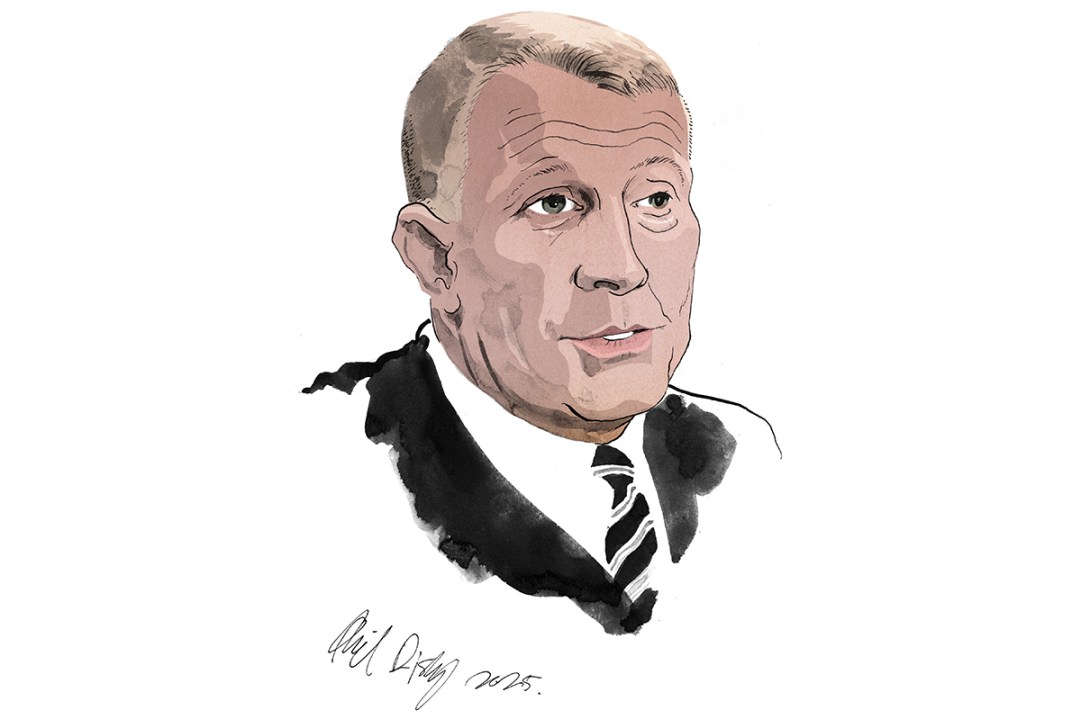
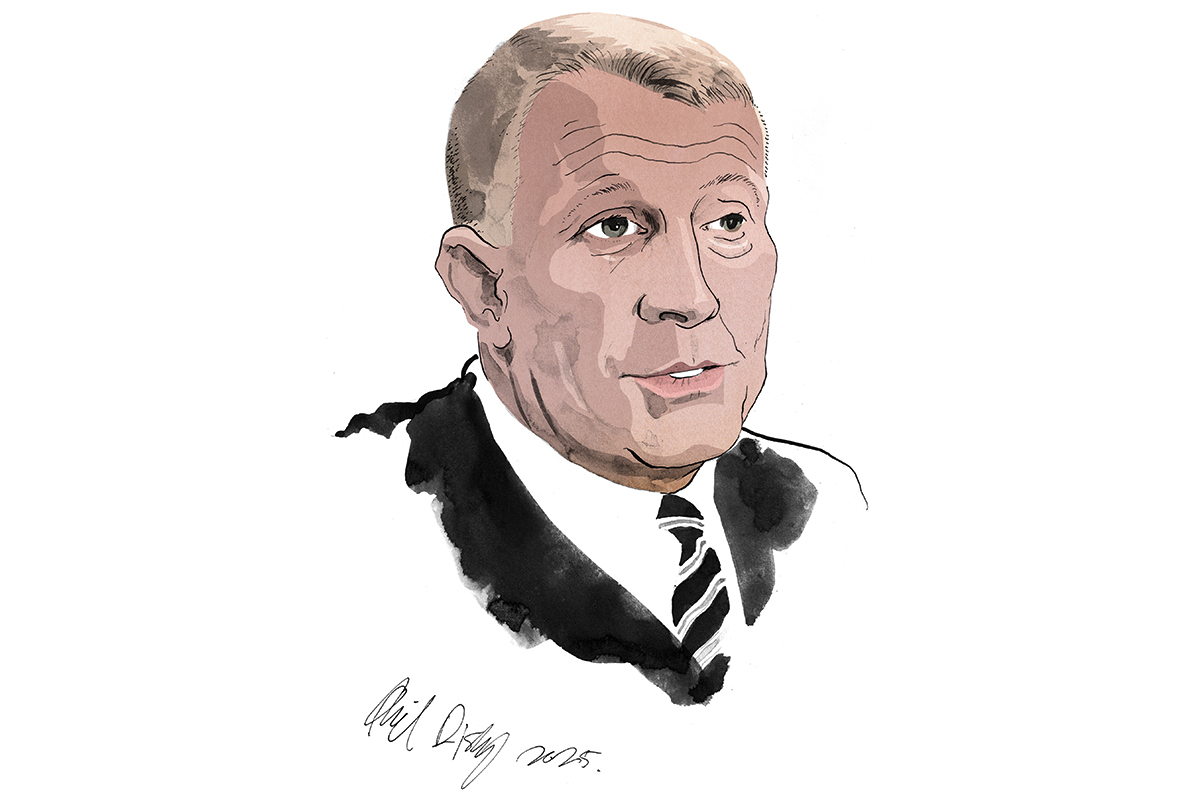
Erik Prince, the American mercenary, wants to sell you a phone. His Unplugged phone is aimed at stopping big tech and big government spying on you. It’s available in the United States, and shortly in the United Kingdom too. He tells me: “It’s been troubling for me to see the crackdown on free expression in the UK.” But the phone is a sideline. His main business remains sending private armies to some of the world’s most dangerous places. The Biden years were lean ones, or at least quiet ones; now that Donald Trump’s back, so is Prince.
Most people know Prince as the founder of Blackwater, the world’s most notorious private military company. In 2014, four of Prince’s soldiers got long prison sentences in the US for opening fire on Iraqi civilians, killing 14. Trump eventually pardoned the four men, but by then Blackwater had been renamed and merged out of existence. Prince moved on. He traded under a series of bland corporate identities: Xe Services, Vectus, Presidential Airways. His latest proposal is for a mercenary force to protect Christians in Nigeria.
Prince talks to me about this on a video call from what looks like a pickup truck as he drives around his estate in Virginia. He was once a Navy SEAL and is still absurdly clean cut: short blond hair, blue eyes, square jaw. “Tens of thousands” of Christians are being killed by jihadi gangs, he tells me; the Nigerian army won’t stop it because “corrupt” generals are skimming a bloated defense budget and $28 billion of oil is being stolen every year – the world’s “largest case of industrialized crime.” But, he says, “the private sector can actually help put that fire out.”
Prince offered his services to the Pope on X. Under a video of Pope Leo blessing a block of ice – a Papal gesture toward climate change – Prince posted: “@Pontifex Sir, I have a better idea. Why don’t you fund my colleagues to protect Nigerian Christians from the marauding Muslims who are slaughtering them.” He hasn’t heard back from the Pope and doesn’t really expect to. It’s all part of the Prince publicity machine.
Professor Sean McFate, who wrote The Modern Mercenary, thinks Prince might be the best-known mercenary in the world. But, he told me, one of the most important things a mercenary sells is plausible deniability – they can be deployed without any public link to whoever is paying their wages. “It is supposed to be the silent profession. [Prince] is anything but.” He calls Prince a “pitchman.” If so, he’s perfectly suited to doing business under Donald Trump, the ultimate pitchman.
Prince has long had an interest in Africa, land of opportunity for the private soldier. During his Off Leash podcast last year he said that in “pretty much all of Africa, they’re incapable of governing themselves… it’s time for us to just put the imperial hat back on, to say: ‘We’re going to govern those countries.’” He is working in the Democratic Republic of the Congo now, helping its government to fight smuggling, corruption and general lawlessness. If his men pacify the vast terrain they’ve been given, more taxes are collected – and Prince gets a cut.
Is this an American version of Russia’s Africa Corps, the Wagner Group as it used to be known? Wagner is half mafia, half mercenaries, a tool of Kremlin foreign policy, licensed to fill its boots with as much gold or oil or diamonds as it can. Prince rejects the comparison. Wagner just “muscles in” on mines and other lucrative assets, he says; his enterprises are more like the British East India Company, which had to perform the functions of government where they wanted to trade. “And, yeah, they definitely kicked ass when they had to. The French were removed from India, not by the British Crown, but by the East India Company.”
The East India Company was Prince’s proposed model for ending the Afghan war. This was not well-received in Afghanistan, where stories are handed down of Britain’s bloody 19th-century campaigns: “butcher and bolt.” But Prince tells me he could have held the country with only 6,000 private soldiers – “everybody else could leave.” He claims he could have done it for 5 percent of what the US government was spending.
The regular army is like the postal service, he tells me, whereas he’s FedEx – a line he’s used many times before. He says that conventional armies don’t understand unconventional warfare. The US military has a “CT [counterterrorism] fetish” of “just killing the leaders” of whichever group they are fighting. “It ignores the history of warfare. You have to crush the manpower, finances, logistics – at the bottom of the pyramid, the broadest number, not just a select few at the top.” If you need to kill a lot of bad guys, Prince will get the job done.
He has a contract in Haiti, where a desperate government is losing a war with street gangs. The gangs opened the prisons and tens of thousands of Haiti’s most dangerous criminals are now on the loose, armed with “increasingly heavy weaponry,” killing, organ-harvesting, practicing Voodoo, “some really, really bad stuff.” Some 90 percent of the capital is controlled by gang members, he says. His mercenaries use drones to kill them – more than 200 in the first three months of their deployment, according to a human rights group.
Prince doesn’t like the term mercenary. “The idea of compensating professionals that can bring specialty skills to local governments is as old as warfare.” The UN said that in 2019 he’d brought his “specialty skills” to the Libyan warlord Khalifa Haftar, including a “high-value target termination unit” – a death squad. A UN investigation found he’d broken the Libyan arms embargo by sending spy planes, attack helicopters and drones to help Haftar overthrow the government. Prince tells me he has an alibi: he was on a road trip from Wyoming to Alaska with his son. “So, I was not involved in that.”
The exhaustive UN investigation did not accuse Prince of going to Libya in person. Instead, it found he’d met Haftar in a hotel in Cairo to plot the coup. It ended in ignominious failure, with Haftar furious at the quality of the weapons he’d been sent. The mercenaries had to flee Libya in rubber dinghies. They blamed Prince, according to someone who spoke to them at the time. “They wanted to kill him. They wanted to hunt him down and execute him.”
In 2020, the Intercept reported that Prince tried to get back into Libya by proposing a partnership with the Wagner Group, by then already under American sanctions for its role in Russia’s 2014 invasion of Ukraine. Prince sued the website for libel, though the case was thrown out.
A source who helped with the UN investigation told me Prince was questioned in Egypt and in the UAE, which had supposedly paid for the Haftar operation and wasn’t pleased. Prince is having none of it. “You can quote me on this,” he says. “Tell your sources: go get fucked, because it speaks to how utterly idiotic they are… those motherfuckers are full of shit… Let them come out. Name themselves… I’m going to sue the motherfucking pants off them.”Prince has a tangled history with Russia. He visited Moscow in 2012 because, he says, the Russians wanted to ask him to recreate Blackwater there. Nothing came of it, and he’s had “no contact with them in any way, shape or form since.”
There was a curious meeting in the Seychelles in 2017 between Prince, the head of Russia’s sovereign wealth fund, and a fixer for the UAE. The Mueller report – remember that? – cast the meeting as a Russian attempt to open a back channel to the new Trump administration, with Prince a willing participant. Prince said he’d bumped into the Russian at the bar and they’d had a beer.
Is there anyone whose money he wouldn’t take? The Chinese Communist party was a big investor in Prince’s Hong Kong company, Frontier Resources Group. But he says: “We didn’t do any guns… we didn’t do any training of the security people.” All he did was to tell “airline or bank employees” how to avoid being kidnapped. He says he left when he came under pressure to have a CCP committee in the company. “Hard no.”
A former Blackwater mercenary, Morgan Lerette, told me Prince was “a hell of a businessman.” He went on: “The guy’s looking to make a buck. He can do patriotism and Christianity and all the other stuff. At the end of the day, he worships the almighty dollar.” As Lerette said, Americans are tired of war and don’t want boots on the ground anywhere. Demand for privatized warfare will only grow.
Controversy follows Prince around as he tries to cash in on this. He tells me that there’s “no shortage of assholes in the world” trying to tear down people who prefer to “do, not pontificate.”
He admires figures from military history such as John Smith, the British mercenary who led the settlers in Jamestown, Virginia; and Myles Standish, another British soldier who was hired by the Pilgrims to defend Plymouth Colony. America was civilized by mercenaries, “by bold people who wanted to create a new opportunity.”
Prince wants to do the same for Africa. “It pains me when I go to these struggling countries… the murder, rape and mayhem that is endemic in these places.” A “steady hand on the wheel” would be “infinitely better” for hundreds of millions of Africans suffering in this way.
“I am an unabashed defender and lover of western civilization.” In this new imperial mission, ideology meets profit, and every crisis is an opportunity.
This article was originally published in The Spectator’s November 10, 2025 World edition.




Comments