The Spectator

The Spectator at war: A pacifist replies

‘A pacifist protest’, a letter from the 15 August 1914 Spectator in response to a piece in the 8 August edition: SIR, - One is willing to believe that your article in last week’s issue called “Keep Your Temper” was not intentionally provocative, but it shows some lack of justice and of courtesy towards the pacifist. You divide pacifists into three classes. The first consists of obstinate fools who refuse to think their own country can do right; the second consists of cowards; and the third, which you are generous enough to admit to be a small one, of knaves. One would like to ask to which class you consign those pacifists par excellence, the members of the Society of Friends.
The Spectator at war: An American joins the fight

A letter from the 15 August 1914 Spectator: SIR,- As an American, I venture to point out that England’s decision to live up to her implied promises to France, as put forward for so many years, nearly concerns the self-respect of one hundred million Americans and British Colonials, as well as Englishmen. For no English-speaking person could any longer cite the quality of his race, or show his face in Europe, had England taken the course so vigorously urged by her puling intellectuals and certain of her newspapers.

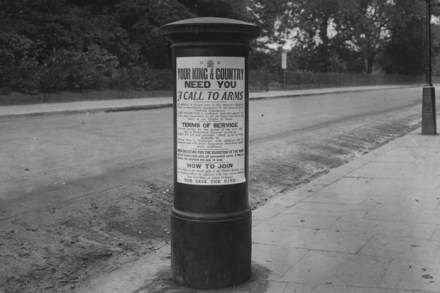
The Spectator at war: A call to arms

Let us say once more what we said as emphatically as we could last week – that the first thing to do is to get Lord Kitchener the five hundred thousand men who he must have to make the country safe. Till that is done, till we have got the men for the firing line, all philanthropic schemes, however good, nay, however essential in themselves, must wait. Sterilized dressings are absolutely necessary, but they must not get in front of the rifles. Therefore, once again, the first duty of ever man between nineteen and thirty is to join Lord Kitchener’s Second Army.  That is his way to help.

Video: Should Parliament be recalled over Iraq and ISIS?

Neither Obama nor Cameron seem ready to return from their holidays to debate how best to respond to the events in Iraq. However, in our look at the week ahead, Isabel Hardman argues that the debate shouldn't just be taking place in newspapers, but also in the House of Commons. Could we see a recall of Parliament, asks Fraser Nelson, or is Cameron simply too scared after last year's disastrous debate over Syria? Douglas Murray suggests that however much we may care about the events in Iraq, the only country that can do anything about it is America.

The Spectator at war: Gallant little Belgium

From ‘News of the Week’, The Spectator, 15 August 1914: The war continues to be as amazing as ever. We have now had actual firing for over ten days and yet there has been no serious invasion of French soil. What one was always told would happen in the great war, and what undoubtedly the German meant should happen, was a steady and rapid advance of the stupendous tide of German soldiers into France. Wave was to succeed wave of men on the frontier and all of them were to have their faces turned to France and Paris. The sea, no doubt, was to break in through Belgium, but Belgium, it was confidently predicted, would make no serious opposition. It would flow over Belgium just as an incoming tide flows over and covers as isolated rock.

Martin Gayford meets the jazz legend Wynton Marsalis

In this week’s magazine, Martin Gayford interviews the trumpeter and jazz legend Wynton Marsalis, who founded ‘Jazz’ at Lincoln Center in New York City. Here are some quotes from his piece. ‘One of the things we talked about was the difficulty of playing jazz — especially in front of an audience. ‘The pressure of playing in public makes it all for real, I love the pressure of it. That’s what makes it fun.’ ‘Marsalis has dedicated his career to keeping the jazz tradition alive: not just part of it but all of it. That is what Jazz at Lincoln Center is about. The most difficult aspect of his mission, he believes, is not teaching the musicians, it’s training the audience.

The Spectator at war: Fighting with vegetables

Under the heading ‘How can I help?’, The Spectator of 8 August 1914 advised young men on the process of joining the army, and suggested that older men try the Red Cross or a rifle club, with the warning: ‘The rifle club should only be for those who by age and want of training are not able to do anything better. By joining or forming rifle clubs they might, however, in the end be able to do most useful work.’ It concluded with the following advice for women: ‘We have kept to the last the answer to the question put by patriotic Englishwomen as to how they can help. Here, again, we are not going to talk vague generalities about encouraging their menfolk and helping them to stand the strain of war and to show a proper spirit.

The Spectator at war: How to talk to a pacifist

‘Keep your temper’, from The Spectator, 8 August 1914: ‘When a nation goes to war the policy of the Government nearly always fails to carry with it the convictions of a minority.  It is, of course, very rare for a Government who make war to find themselves without the support of the majority – for, as a rule, they would not even contemplate war without ascertaining the general tendency of public opinion – yet such cases have happened. It is probable that the majority were opposed to the war of George III. and Lord North against the American colonists.