Theatre
Nepotism rules Sir: Julie Burchill’s piece ‘Born to be famous’ (26 July) was very strong and as, like her, I’m an ex-Labour supporter turned conservative, it echoed my opinions. The performing arts in particular were a great outlet for the untapped talents of what we used to call the working classes. Between the mid-1950s and about 1980, coming from a modest background was no handicap in the arts or (primarily Labour) politics. Today’s media/political axis is rife with both nepotism and persons who have little comprehension of everyday life.
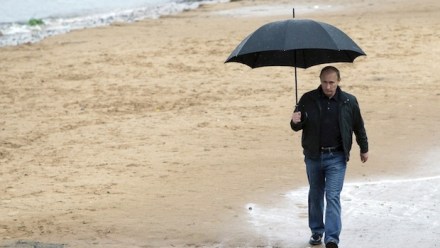
Off the shelf How do we boycott Putin? Some things we traded with Russia, by value, between March and May 2014: Export Mineral fuels £23m Nuclear reactors, boilers and machinery £164m Aircraft, spacecraft and parts thereof £46.6m Art, antiques etc £7.7m Fish, crustaceans and molluscs £3.25m Umbrellas, walking sticks and riding crops £170,925 Explosives and pyrotechnic products £11,998 Import Mineral fuels £1.36bn Nuclear reactors, boilers and machinery £1.37bn Aircraft, spacecraft and parts thereof £29.3m Art, antiques etc £11.6m Fish, crustaceans and molluscs £2.
Home Britain is to halve to three months the time that EU migrants without realistic job prospects can claim benefits, David Cameron, the Prime Minister, said in an article for the Daily Telegraph. Workers for the Passport Office who belong to the Public and Commercial Services Union went on strike ostensibly to ‘end staffing shortages that have caused the ongoing backlog crisis’. Driverless cars will be allowed on roads from next year. Newham council in east London approved a £1 billion scheme for an ‘Asian Business Port’ to be built by the Chinese at the Royal Albert Dock. The Gherkin office block in London was put up for sale, with expectations of its fetching £650 million. People in Tring complained of the smell of sewage sludge on fields.
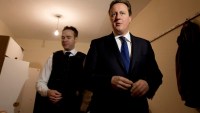
With Ukip snapping at the Conservatives’ heels, it is not difficult to see why David Cameron has hit upon the idea of limiting the entitlement of EU migrants to working-age benefits in the UK, so that they can claim only for three months, not six, as before. But it is a little harder to work out how the Prime Minister and his party will benefit politically from the change. No sooner had Cameron made his announcement than two obvious questions arose: if this proposal is legal, why didn’t he do something like it earlier? And if it is possible to limit eligibility to benefits to three months is there any reason he can’t go further and prevent EU migrants claiming benefits in Britain at all?


Hell, as one of Jean-Paul Sartre’s characters said, is other people. Unless, that is, you happen to be British and born after about 1980, in which case hell is the opposite: being alone for more than about five minutes. In this week’s View from 22 podcast, Ross Clark looks at the rise of crowd culture. We have succumbed to the lure of the crowd, he says. Lara Prendergast suggests social media is to blame. In this week’s Spectator, Melanie Phillips argues that anti-Israel protests over the Gaza war have convulsed Europe in the worst scenes of open Jew-hatred since the 1930s. The silence from the political class in the face of this is appalling.
In this week's Spectator, Melanie Phillips suggests that anti-Semitism is on the rise, fueled by the events in the Middle East. Douglas Murray and Ben Soffa, Secretary of the Palestine Solidarity Campaign, discuss whether this is the case in this week's View from 22 video special. Here's an extract from Melanie's piece. The full article will be available tomorrow: The mask has been torn away. Supposedly anti-Israel protests over the Gaza war have convulsed Europe in the worst scenes of open Jew-hatred since the 1930s. In Paris, predominantly Muslim mobs screaming ‘death to the Jews’ have repeatedly tried to storm synagogues, torched cars and burnt Jewish-owned shops to the ground.
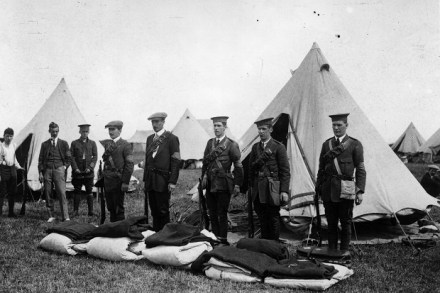
The outbreak of war between Austria-Hungary and Serbia in July 1914 forced British politicians to postpone the Amending Bill for Irish home rule. This was momentous because Nationalists and Unionists had been on the verge of civil war (see picture above) over the amendments, which concerned the exclusion of the six counties of Ulster. The Spectator noted, gravely, that a continental war appeared to be unavoidable, so the nation must pull together. ‘Unity at home and strength abroad,’ it demanded.