Richard Bratby

Richard Bratby is the chief classical music critic of The Spectator

Scent and sensibility

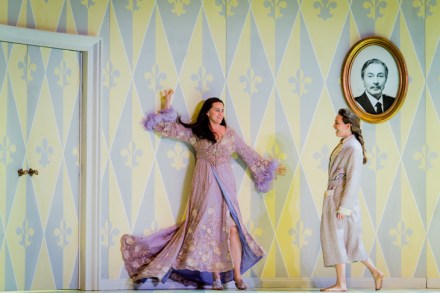
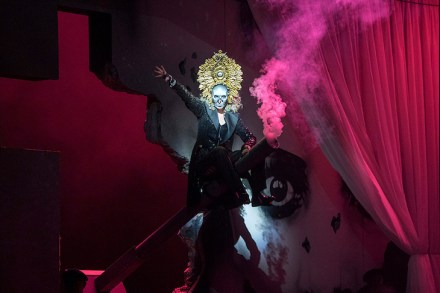
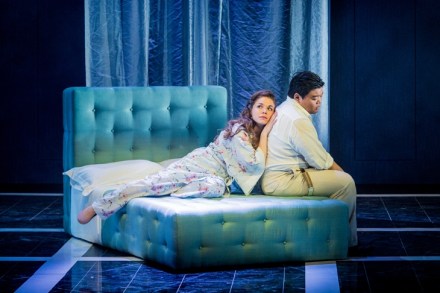
Patrick Mason’s new production of Gounod’s Roméo et Juliette reminded me of something, but it took a while to work out what. We saw shiny black walls with chrome Bauhaus details, and a swirl of mist through which beautiful people moved in black formal wear. Then Olena Tokar made her entrance as Juliette, and as she pirouetted about the stage, evening dress sparkling, it clicked. It’s a perfume advert. The artificiality, the chic, the sexy little hint of affluence with top notes of fascism: you half-expected billowing curtains to reveal a giant bottle of Chanel No. 5. It fitted right in at West Horsley, where the programme book contains adverts for private equity firms and first nights begin with an onstage shout-out to Laurent-Perrier.
Handel for hipsters

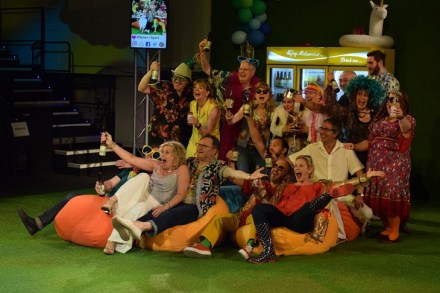
On a sward of AstroTurf somewhere off Silicon Roundabout, Mountain Media is hosting its summer party and, well, it’s the sort of bash you’d pluck your own eyes out to avoid. Hipsters sprawl on dayglo beanbags. Lads wearing fairy wings strike aftershave-advert attitudes as they swig bottled lager, while girls in vintage dresses pout into smart phones through cardboard Instagram frames. Naturally, it’s got its own hashtags: everything is flashed up on digital screens. The only thing that jars — though perhaps it’s some new straight-outta-Hoxton trend — is that instead of a DJ there’s a live band, and the music’s by Handel. Handel’s English-language tragedy Acis and Galatea was once one of his most bankable properties.

Johann Sebastian Bach

I don’t get Johann Sebastian Bach. I mean, I get that he was good — no Mozart, sure, but definitely up there in anyone’s top five 18th-century composers. But that’s not enough. Bach must be revered as the One: the supreme and universal musical genius. When John Eliot Gardiner celebrated the millennium by performing Bach’s complete cantatas, it wasn’t a cycle or a series but a ‘pilgrimage’, if you please. (He's back with more cantatas this weekend at the Barbican.) Playing Bach, we’re told, requires profound selflessness — though if you’ve ever witnessed a solo violinist hijacking an orchestral concert to saw through all 15 tortured minutes of the D minor Chaconne, you might call it something else entirely.

Darkness visible | 14 June 2018

Oh, what a beautiful morning! In Jo Davies’s production of Oklahoma! the audience spends the overture staring at the side of a barn. Then, as birdsong rises from the orchestra, corrugated-iron doors slide open on a dustbowl farm of the 1930s. Aunt Eller (Claire Moore) is fixing a tractor, and a wind pump spins slowly against an orange dawn sky. It’s mildly surreal: the light falls as if in one of those New Deal-era western landscape paintings, with a jagged, David Smith-like sculpture of pitchforks and shovels serving as a tree. And then, with throwaway ease, Dex Lee as Curly launches into that greatest of all Broadway opening numbers. Davies catches Rodgers and Hammerstein’s surge of hope on the upswing, and rides it in a single sweep from beginning to end.

The big chill | 7 June 2018

The picnic hamper’s open, the bubbly is chilled, and country house opera is starting to eat itself. When you arrive at the Wormsley Estate you enter a fantastic, baffling world. Figures in black tie stroll between topiary hedges in obedience to unstated rules, while serving staff hover a few paces behind, gliding silently in to reassert neatness and order. Children dressed in red (they’re from a local Scout group) pop up to help and guide. Then the new production of Die Zauberflöte begins and with a deft, surreal spin, the director Netia Jones bowls it all straight back at you. That’s a big part of the fun here. Jones has designed the production herself, and she clearly has quite a DVD collection.

Laughing matters

‘Comedy for music by Hugo von Hofmannsthal. Music by Richard Strauss.’ That’s what the creators of Der Rosenkavalier wrote on the score, but don’t expect to see it reprinted in any programme books. Their careful wording doesn’t fit modern assumptions about Der Rosenkavalier, and not merely because it gives the librettist first place. There’s that troublesome word ‘comedy’, too. Advertising blurbs tell us (I know, I’ve written a couple) that Rosenkavalier is a bittersweet meditation on love, transience and loss. Yet its creators meant it to be funny. ‘Don’t forget that the audience should also laugh!’ wrote Strauss to Hofmannsthal. ‘Laugh, not just smile or grin!

Natural selection | 17 May 2018

‘All fish in flood and fowl of flight/ Be mirthful now and make melody’ writes the poet William Dunbar in the verses that Sir Charles Hubert Parry set to music as Ode on the Nativity. In David Matthews’s new Ninth Symphony, one particular fowl does exactly that. The symphony’s central movement begins on strings: an idyll of grey skies and shivering leaves. Matthews gradually introduces blocks of woodwind and brass, including a heavily stylised burst of birdsong.

Hype and anti-hype

Apparently it’s called ‘expectation management’. Pollux, Esa-Pekka Salonen’s new work for the Los Angeles Philharmonic Orchestra, takes its name from Greek myth. But as Salonen explains in his programme note, there’s more: lots more. It’s intended to form a diptych with a second piece called (naturally enough) Castor. It’s also part-inspired by Rilke’s Sonnets to Orpheus, and an image (Salonen compares it to Salvador Dali) of a tree growing out of an ear. And finally there’s a ‘mantra rhythm’, which Salonen heard played by a post-grunge band ‘during dinner in a restaurant in the 11th arrondissement of Paris’, which all sounds very civilised.

By ’eck, petal, it’s gorgeous

The opening of Mark Simpson’s new Cello Concerto is pure Hollywood. A fanfare in the low brass, an upwards rush and suddenly the screen floods with lush orchestral sound — as confident in its onward sweep as Star Wars or ‘Tara’s Theme’. Waiting, poised, in the middle of it all was the soloist Leonard Elschenbroich, for whom Simpson has said that he wanted to write a concerto that celebrated the cello’s ‘expressive and lyrical force’. He has, too. From the instant Elschenbroich entered, it felt right. The cello soared over a chiming marimba, like in Walton’s Cello Concerto. It lingered over its farewells, like in Elgar’s.

Kid’s play

It’s been a good couple of weeks for cuddly toys in opera. A big floppy Eeyore is the only comfort for 11-year-old Coraline at the darkest moment of Mark-Anthony Turnage and Rory Mullarkey’s new opera. The teenage Composer in Antony McDonald’s production of Ariadne auf Naxos has a Beanie Baby panda as a sort of mascot: a tiny, limp emotional defence against a world that’s about to spin deliriously off kilter. Hansel and Gretel don’t have any toys, but the brattish siblings of Stephen Medcalf’s staging at the Royal Northern College of Music can at least cling to each other as the night closes in. Interestingly, the opera that came across as the most harmless was the only one that wasn’t created for children. Ariadne auf Naxos, then.

The last radical

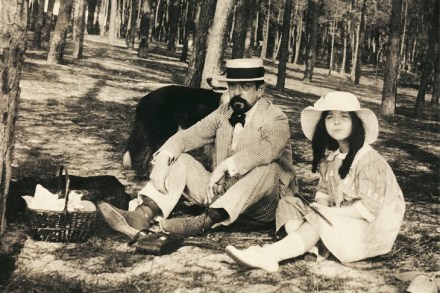
A spectre haunted the first weekend of the City of Birmingham Symphony Orchestra’s Debussy Festival: the spectre of Richard Wagner. Debussy’s relationship with Wagner began with infatuation, and ended (as so often) in open rebellion. The young decadent who declared Parsifal ‘one of the loveliest monuments of sound ever raised to the serene glory of music’ later ranted that ‘30 million Boches cannot destroy French thought’ even while, tormented by cancer, he laboured to complete three late sonatas of near-infinite subtlety and grace. But there’s always the sense, as Debussy put it as early as 1890, that ‘I don’t see what can be done beyond Tristan’.

Bat squeaks and red herrings

Blue Gadoo is one of those cats whose face looks like it’s been bashed flat with a wok. He lives in New York, apparently, and his bulging eyes goggle out from Gerald Barry’s programme note for his new Organ Concerto. Check him out: the Guardian published the full note a day before the performance, which is only right because a Gerald Barry world première really ought to be national news. ‘I saw a photograph of him with a book called Sex and the Sacred in Wagner’s Tristan und Isolde,’ explains Barry. ‘By his expression I knew he was mourning the loss of atonality.’ There’s heaps more like that.

It’s the music, stupid

‘Welcome to our hearts again, Iolanthe!’ sings the fairy chorus in Gilbert and Sullivan’s fantasy-satire, and during this exuberant new production by Cal McCrystal you could almost hear the assembled G&S fans sighing in agreement. Iolanthe is our trump card against the sceptics, and not merely because Gilbert’s digs at parliamentary politics are still so startlingly acute. No, we insist, it’s the music, stupid: just listen to it! Sullivan’s score gleefully assimilates Handel, Mendelssohn and Wagner (Tannhäuser, Rheingold; even Tristan und Isolde), and to fly that close to the magic flame of Bayreuth without getting frazzled is something that very few composers have achieved with such freshness and melodic grace.

Up the revolution

Spoiler alert: the final image of John Fulljames’s production of Monteverdi’s The Return of Ulysses at the Roundhouse is haunting. Ulysses (Roderick Williams) and Penelope (Christine Rice) stand facing each other at last, arms outstretched. But Penelope is on terra firma. Ulysses stands on the revolving walkway that has served as the stage throughout most of the evening. And though Monteverdi’s music has found stillness, the stage continues to revolve, carrying him away from his beloved — boats against the current, borne back ceaselessly into the past. Or something. Like many of this production’s most striking ideas, it’s poetic in the moment, but doesn’t really work once you step back. A metaphor for the alienating effect of war and exile?

Sonic youth

Everyone knows — don’t they? — that the National Youth Orchestra of Great Britain is the UK’s youngest world-class symphony orchestra — an ensemble of musicians aged 18 and under that’s the equal of any professional band (and better than some). But it’s also the largest, and we don’t hear enough about the sheer sonic impact of hearing 157 musicians moving with absolute precision. Even the smallest gesture by an 87-player string section has a sort of heft, a physical weight and depth that you can sense in the air around you. Overwhelming when the whole orchestra is playing at full power, it’s even more tangible in quiet passages, as if you’re in the vicinity of some vast, invisible living creature.

Hitting the high notes

Claude Debussy died on 25 March 1918 to the sound of explosions. Four days earlier, the Kaiser’s army had deployed its long-range Paris Gun, and as Debussy’s cancer entered its final hours, artillery shells were bursting in the streets around his home in Avenue du Bois-de-Boulogne. This quiet modernist — who’d transformed music into an art of almost limitless expressive subtlety — died amid the thunder of mechanised war. The funeral was poorly attended, and as the cortège halted, curious shopkeepers glanced at the wreaths: ‘It seems he was a musician.’ The classical music world is morbidly addicted to anniversaries of major composers.

Sugar rush | 7 December 2017

To get a flavour of Joseph Marx’s An Autumn Symphony, picture the confectionery counter in a grand Viennese café. Beneath the glass lies sweetness beyond imagining: towers of sponge cake, billows of whipped cream, and icing that shines red and orange. You wander down the display: there are Sachertortes, petits fours, candied angelica and glacé cherries. It goes on — dark chocolate glints over golden pastry and pink marzipan cushions swell beneath tangles of spun sugar. At which point you realise that what you really want is an espresso and a bread roll. And it looked like it would be such a treat, too.

Inviting Jansons to the Barbican was like pouring vintage Pol Roger into a throwaway plastic cup

Bavarian Radio Symphony Orchestra / Mariss Jansons Barbican NDR Radiophilharmonie Hannover / Andrew Manze Symphony Hall At the end of Prokofiev’s Fifth Symphony Mariss Jansons asked the Bavarian Radio Symphony Orchestra to stand up, and they refused. That’s not something that occurs in every concert; in fact, you might never see it happen. But this act of low-key mutiny is about the highest tribute an orchestra can pay to a conductor – to decline credit for the applause, handing it over in its entirety to the old maestro standing in their midst, looking shattered. A few moments later, Mitsuko Uchida presented Jansons with the Gold Medal of the Royal Philharmonic Society, but that gesture from the band was the real accolade.

Talking down to God

‘There is something enviable about the utter lack of inhibition with which Leonard Bernstein carries on,’ wrote the critic of the Boston Globe after the US première of Bernstein’s Third Symphony, Kaddish, in February 1964 — and looking at the forces arrayed at the Barbican, he had a point. In addition to the full LSO there was the London Symphony Chorus, a narrator, a solo soprano and the Tiffin Boys’ Choir. It barely fitted on stage. And if you thought the set-up was extravagant, a glance at Bernstein’s self-written text would probably have sent you screaming from the hall. ‘Lenny’ was classical music’s original bleeding-heart superstar: the man for whom Tom Wolfe coined the phrase ‘radical chic’.

Hearts and minds | 9 November 2017

Debussy’s Prélude à l’après-midi d’un faune begins with a sigh: a long, languorous exhalation played on the lower notes of a solo flute. The flute’s usual brightness and brilliance is gone. It’s a dusky, breathy sound, made of half-shades and velvet: the musical embodiment of luxe, calme et volupté. And it’s completely impossible to imitate on a piano. Not so much because of the tone-colour — the best pianists can create wonders — but because no piano in existence can play an unbroken melody. Wind and string players, like singers, produce and control a near-continuous stream of sound. A piano, though, is essentially a box of hammers. It hits notes, and then they decay.