Olivia Potts

Olivia Potts

Olivia Potts is the Guild of Food Writers’ Cookery Writer of the Year 2025. She hosts The Spectator’s Table Talk podcast and writes Spectator Life's The Vintage Chef column

With Professor Charles Spence

34 min listen

Professor Charles Spence is an experimental psychologist at the University of Oxford. His research focuses on how an in-depth understanding of the human mind will lead to the better design of multi-sensory foods and products. He is the author of several books including his most recent, Sensehacking: How to Use the Power of Your Senses for Happier, Healthier Living.On this episode he talks about how he started experimenting with food and the human senses, working with Heston Blumenthal, and how he doesn't understand ice-cream.

How to (correctly) make a Cornish pasty

When it comes to traditional food, there is always regional pride to contend with. Many recipes are intrinsically connected to the area from which they have sprung: Pontefract cakes, Chelsea buns, Lancashire hotpot, Welsh rarebit. They represent heritage and tradition – edible history. You must tread carefully to avoid offending regional heritage, or just making silly mistakes. I certainly feel on safer ground making pronouncements from my Salford home on Eccles cakes than I do on Ecclefechan tart. But when it comes to the Cornish pasty, the people of Cornwall have taken ownership a step further. In 2011, the Cornish pasty was granted Protected Geographical Indication by the EU, which dictates where – and how – a true classic Cornish pasty can be made.

With Edward Stourton

25 min listen

Edward Stourton is a broadcaster who has worked as foreign correspondent for the BBC, Channel 4 and ITN. He is the presenter of BBC Radio 4's Sunday Program, and presented the Today Program for ten years. He has authored eight books including his most recent, Sunday: A History of Religious Affairs through 50 Years of Conversations and Controversies which is available now.  On the podcast, he recalls chocolate-stuffed baguettes on Swiss ski slopes, reveals the disappointing breakfast options in the Today Program green room, and explains why heaven is eating oysters to the sound of trumpets.

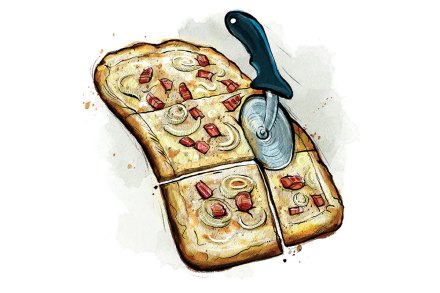
‘The perfect winter snack’: how to make flammekueche

There are times in the year that call for snacks. Rather than embracing the various diets and other forms of self-flagellation that sweep over us at the start of the year, we need every joy we can get during endless January, with its dark, short days and cold nights. Right now, we are in such territory. Open those posh crisps, order the triple-cooked chips, invite joy in. I have strong ideas about the platonic snack for winter: something hot, ideally, to accompany a glass of something cold as you while away the dark evenings. The ideal contrast between crisp and yielding, sweet and salty – something that can be picked up one-handed and is substantial enough to satisfy, but still leave you wanting more. Flamme-kueche fits the bill pretty well.

With Alexandra Collier

24 min listen

Alexandra Collier is a Melbourne-based writer who has written for theatre, screen and print. She is a MacDowell fellow and a recipient of the RE Ross Trust playwrites' award. Her memoir Inconceivable, about her journey to becoming a solo Mum by choice, is out now.  On the podcast she tells Lara and Liv why restaurants are inherently theatrical places, discusses her experience with IVF, and explains that it takes a village to raise a child.  Photo credit: Karin Locke.

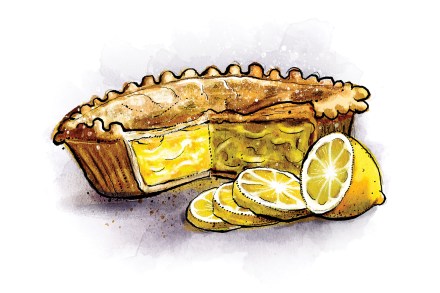
‘Unlike anything you’ve ever eaten’: how to make lemon Shaker pie

Cooking in January is a very different beast to cooking in December. I don’t just mean the flavours (the dried fruit and spice, and dark, boozy, rich flavours of the festive period are relegated to the backs of pantries and drinks cabinet) or even the sentiment, whereby many will look to lighter,simpler dishes to counteract the previous month’s excess. The process is different too. My January kitchen is quiet, the cooking or baking less frantic than that of the weeks that preceded it. It’s not performative, and there are no gargantuan grocery deliveries that require half an hour of fridge Tetris. There is no deadline and my days are less full, so baking is a pleasure which punctuates them, rather than an item on a to-do list. The baking becomes an end in itself.

With Philip Hensher

31 min listen

Philip Hensher is a novelist and regular contributor to The Spectator’s books pages. His books cover a variety of subjects and often deal with important historical change, such as the fall of the Berlin wall and the war in Afghanistan. His most recent novel is To Battersea Park.  On the podcast, he discusses how he developed an affection for offal as a small child, the secret to an ‘austerely perfect’ carbonara, and why food is a such a great character device for novelists.

With Michel Roux Jr

29 min listen

Michel Roux Jr. is an English-French chef and is the chef patron of Le Gavroche, the first restaurant in the UK to received one, two and then three Michelin stars. Earlier this year it was announced that Le Gavroche will close its doors in January.  On the podcast, he recalls how his father would hand churn vanilla ice cream, reveals his fondness for both traditional French custard and English packet custard, and tells Liv and Lara why Le Gavroche is closing.

‘Truly spicy and a delight to eat’: how to make Christmas gingerbread

The flavours of Christmas have changed a bit lately, haven’t they? If you wander around supermarkets right now, you’ll find peach bellini panettone, tiramisu mince pies, turkey gravy-flavoured crisps and Black Forest stollen. Even the classic Terry’s Chocolate Orange comes in a mint version this year. You could argue that Walkers crisps are standing up for tradition by selling a Christmas pudding flavour, but that might be pushing it. I’m all for innovation, but it does rather make me long for the traditional tastes of Christmas. I love peach bellini, tiramisu, and Black Forest gâteau – but I can enjoy these flavours at any time. The spice and warmth and booze that are prerequisites for our usual Christmas fare are really reserved for December.

Why terrine is the perfect Christmas starter

When you’re planning Christmas, the big event is the easy bit. No, hear me out. It’s obviously a production – a feast! – more of an exercise in logistics than it is complicated cooking, making sure all the many elements come together at the correct moment. I’m not trying to underplay the amount of effort that it takes, but in terms of the constituent parts, it’s relatively straightforward. Most of us are turkey families, but if you’re a goose or rib of beef or nut-roast household, chances are that you’re fully aware of this as soon as you sit down to write your Christmas grocery list.

With Tara Wigley

32 min listen

Tara Wigley is the in-house writer for the Ottolenghi Test Kitchen, she also has a weekly column in the Guardian and a monthly column in the New York Times which she shares with Yotam Ottolenghi. On the podcast she reminisces about her father's 'egg in the cup', the secret to a great Ottolenghi recipe, and takes Lara and Liv through her new book How to Butter Toast, which is written completely in verse.

Carbon capture: how China cornered the green market

30 min listen

On the podcast: In her cover piece for the magazine, The Spectator's assistant editor Cindy Yu – writing ahead of the COP28 summit this weekend – describes how China has cornered the renewables market. She joins the podcast alongside Akshat Rathi, senior climate reporter for Bloomberg and author of Climate Capitalism: Winning the Global Race to Zero Emissions, to investigate China's green agenda. (01:22) Also this week: Margaret Mitchell writes in The Spectator about the uncertainty she is facing around her graduate visa. This is after last week's statistics from the ONS showed that net migration remains unsustainably high, leaving the government under pressure to curb legal migration.

How doughnuts took over my life

For almost a decade, doughnuts ruled my life. When I first began baking professionally, I fell into doughnut-making. It was entirely my own fault: after graduating from culinary school, I decided the best thing I could do to improve my pastry skills was to bake regularly. So I knocked together a product and price list and went to my local café to tout my hypothetical wares. Unfortunately I offered up as one of my products big, fat, artisan doughnuts made from brioche dough and filled with custards and creams, jams and caramels, the kind that certain big bakeries are known for. You can guess which item on my natty little list caught the eye of the café owner.

No nonsense in the kitchen

I rather bristle at newspaper column collections. They strike me as a bit lazy, a cheat’s way of getting another book under the belt, often just in time for the gift-giving season. When it comes to Rachel Cooke’s Kitchen Person, however, I have to eat my words. It draws from the 14 years of monthly food columns Cooke wrote for the Observer from 2009. Each comes with a postscript from the author looking back on her thoughts at the time, ensuring that the pieces hold their own as a collection, as something cohesive. You sit down to read one essay, and look up 75 pages later. The tone, too, is instrumental in achieving this.

With Celia Walden

17 min listen

Celia Walden is a journalist, novelist and critic whose most recent novel, The Square, is out now. On the podcast she tells Lara and Liv why lentils are her ultimate comfort food, explains the joys of a buttered scotch pancake and discloses her husband Piers' signature dish, 'spaghetti Morganese'.

Be prepared to wait: how to make French onion soup like the French

Let me be clear: this week’s recipe is not a speedy little number. You can’t knock up a French onion soup for a quick supper. It’s not a 15-minute meal, or a roasting tray phenomenon that won’t require your input during its cooking. Just softening onions, despite what a lot of recipes tell you, takes up to 20 minutes in a pan. Caramelising them – really, truly caramelising them, bringing out their sweetness and complexity – takes literally hours. French onion soup is a labour of love. But if I lowball the cooking time, one of two things will happen: you won’t end up with the soup you signed up for, the soup you deserve; or you’ll have to ignore my timings, and never trust me again.

Dark, bold and perfect for autumn: how to make the perfect honey cake

I did not plan to cook a loaf cake when I embarked on concocting a traditional honey cake recipe. The original plan was to explore the Russian honey cake, or medovik, which dates back to the 19th century, and has a rich history. It is the War and Peace of the cake world: thick and a real undertaking. A long, careful assembly process, with up to a dozen layers of thin sponge – flavoured with honey and baked ever so briefly – interleaved with honey-flavoured buttercream, followed by a long chill, and then covered in more buttercream and cake crumbs. It is what we cookery writers like to euphemistically call ‘a project bake’.

With John Nichol

35 min listen

John Nichol is a former RAF Tornado navigator who, during the first Gulf War in 1991, was famously shot down, paraded on television and held prisoner by Saddam Hussein. John wrote movingly about his experience in his first book, 'Tornado Down', and has gone on to write fifteen more best-selling books. His latest, 'Eject, Eject', is out now. He also loves food, is very fond of cooking and often posts pictures on social media of his many and varied culinary creations. Presented by Olivia Potts.Produced by Linden Kemkaran.

Glorious and nostalgic: how to make corned beef pie

A few weeks ago I was at the super-market juggling a toddler, several heavy bags and, it transpired, no pound coin to insert into a trolley. A kind employee came to my rescue: on her key ring was one of those little keys you use to open tins of corned beef, which she deftly inserted and released, and lo, the trolley was mine. What a nifty trick! I immediately resolved to add one to my own key ring, and then almost as quickly forgot. But also, what a peculiar thing: we’ve very much accepted ring pulls, or even just using tin openers, as the standard way to open tin cans. As a system it works very well.

With Ewan Venters

37 min listen

Ewan Venters is the former chief executive of Fortnum & Mason and is now the CEO of Artfarm and Hauser & Wirth. Ewan is launching Artfarm’s first London venture combining food, drink and art which will also mark the revival of the historic Mayfair landmark, The Audley. Presented by Olivia Potts.Produced by Linden Kemkaran.