Olivia Potts

Olivia Potts

Olivia Potts is the Guild of Food Writers’ Cookery Writer of the Year 2025. She hosts The Spectator’s Table Talk podcast and writes Spectator Life's The Vintage Chef column

Hunter’s chicken: the ultimate cheer-me-up-quickly recipe

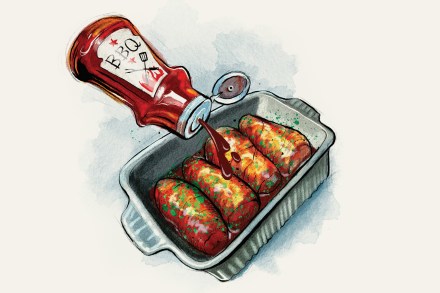
Pub food in Britain has had a mixed reputation over the years. For a long time, the most a pub would have to offer as food would be some pork scratchings or a pickled egg. There certainly wasn’t a brigade of chefs in white coats in a shiny chrome kitchen. This is midweek-teatime cooking, it’s sling-it-in-an-oven cooking, it’s cheer-me-up-quickly cooking Pub grub started to appear in the 1970s, but it was simple, filling and predictable. It was the sort of unpretentious, low-priced food that was suitable for a worker’s lunch break. So up and down the country pub menus all hit the same beats: steak and kidney pie, ham with egg and chips, chilli con carne, fish and chips, even lasagne – and hunter’s chicken.

With Julian Baggini, on the ‘philosophy of food’

31 min listen

Julian Baggini is a philosopher, journalist and author. He has served as the academic director of the Royal Institute of Philosophy and is a member of the Food Ethics Council. His new book, How the World Eats: A Global Food Philosophy, is out now. On the podcast, Julian tells Liv about why he used to insist that shepherd’s pie was served at his birthday parties, the philosophical view of veganism and why it’s worth getting the expensive hazelnuts.

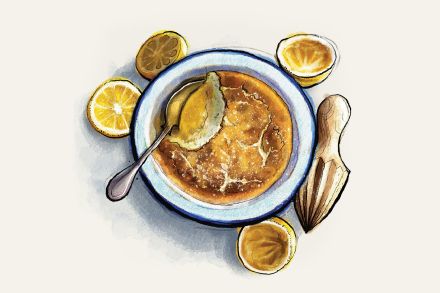
January deserves lemon pudding

January kitchens are my favourite. This isn’t anything against Christmas – I love the spice, the frenzy, the ritual of festive cooking, but I also love the aftermath. There’s something calming about the kitchen once it’s all over – nothing is made through obligation, or with a deadline. I embrace the cosiness of autumn and the sparkle of Christmas, but I find the bright, cool light of January reviving and renewing. At this time of year my kitchen is a place to take stock and make stock. To steady and sustain. Proper puddings, hot and sweet and served with cream, are a non-negotiable part of late winter It’s also full of puddings, among other things. Proper puddings, hot and sweet and served with cream, are a non-negotiable part of late winter for me.

With ‘Caviar Queen’, Laura King

32 min listen

Laura King is affectionately known as the 'Caviar Queen' and is widely regarded as the UK's foremost caviar expert. In this special episode of the podcast Laura takes Liv and Lara through a caviar tasting: from Beluga to Oscietra. Join the Spectator's caviar masterclass and tasting – hosted by drinks editor Jonathan Ray – in collaboration with King's Fine Food: https://shop.spectator. Click here for tickets.

With Elif Shafak

29 min listen

Elif Shafak is a novelist, political scientist and essayist. She has published 21 books – 13 of which are novels – and her books have been translated into 58 languages. Her most recent novel There Are Rivers in the Sky, is out now.  On the podcast, Elif tells Liv about the significance of food and drink in her writing, the many places she takes culinary inspiration from and reveals her love of heavy metal music.

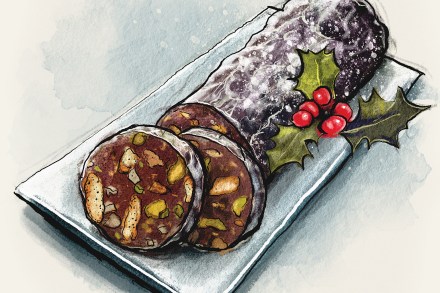
How to make chocolate salami

For as long as we’ve been serving food, we’ve been unable to resist a bit of culinary deception. Making one thing look like another thing – especially if it makes a sweet thing look savoury or vice versa – seems to have universal comedic value. There’s something Willy Wonka-ish about the visual wrong-footing, the surprise – we find it delightful. I’m not even going to stop you slinging some mini marshmallows in there – it is Christmas, after all There’s a long history here. At medieval and Tudor banquets, the food was entertainment as much as it was sustenance: huge pastries made to look like life-size stags and swans stood alongside carefully carved marzipan fruits, both imitating the real thing as closely as possible.

With Richard Madeley

28 min listen

Richard Madeley is a presenter, author and journalist who has been on our screens since the 1980s, most notably presenting This Morning with his wife Judy and more recently on Good Morning Britain. On the podcast, he discusses his early memories of Heinz tomato soup, implores Lara and Liv to try 'tuna casserole' – his mother’s speciality made from tinned tuna, canned soup and crisps – and makes the case for fish paste as the 'food of the gods'.

Kate Andrews, Mark Galeotti, Adrian Pascu-Tulbure, Michael Hann and Olivia Potts

31 min listen

On this week’s Spectator Out Loud: Kate Andrews examines the appointment of Scott Bessent as US Treasury Secretary (1:20); Mark Galeotti highlights Putin’s shadow campaign across Europe (7:10); Adrian Pascu-Tulbure reports on the surprising rise of Romania’s Calin Georgescu (15:45); Michael Hann reviews Irish bands Kneecap and Fontaines D.C. (22:54); and Olivia Potts provides her notes on London’s Smithfield Market, following the news it may close (27:28).  Produced and presented by Patrick Gibbons.

The rise and fall of Smithfield Market

Smithfield has been the beating heart of London’s meat industry for more than 800 years. Located at the middle point of Farringdon, Barbican and St Paul’s, the capital’s only remaining wholesale meat market has survived bombings and fire, public criticism and a waning butchery industry; it has been pulled down and rebuilt, and adapted to changing times. In continuous operation since medieval times, to call it an institution is an understatement. But this week it was announced that it will be forced to close its shutters for the final time. The City of London Corporation was granted the right to run Smithfield meat market by Edward III in 1327.

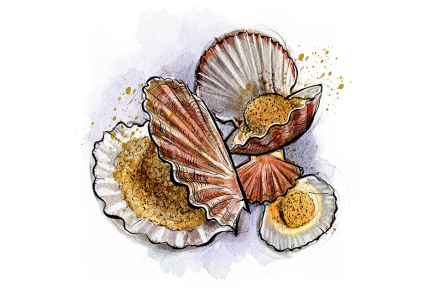
The glamour of the scallop

There is a gentle irony to the dish coquilles St Jacques: a decadent, rich preparation of one of our most luxurious seafoods takes its name from a saint who has inspired centuries of pilgrimage, and whose emblem came to symbolise modesty. The eponymous St Jacques is St James the apostle, or James the Great. The scallop shell has long been associated with him, one legend being that St James once rescued a knight covered in scallops; another that when the remains of the saint were retrieved from a shipwreck, the ship – or perhaps even the body itself – was covered in the shells.

Would we even notice a farmers’ strike?

You might think that, as a country, we have had our fair share of food security wobbles over the last few years: first with pre-Brexit panic, and the hoarding that went along with it, and then the empty supermarket shelves that few of us will forget during the height of the pandemic. But this time, the call is coming from inside the house: British farmers are threatening to stop supplying supermarkets in protest against the government’s plans to apply inheritance tax to family farms. What we might be able to cook in a few weeks is as expansive as ‘almost anything’ or as limited as ‘almost nothing’ What does that mean for the average person doing the weekly shop? Are we returning to the days of rationed eggs and powdered milk? Not quite.

With Julian Metcalfe, founder of Itsu

28 min listen

Julian Metcalfe is a British entrepreneur and one of the most influential individuals on the London high street. He revolutionised the grab-and-go lunchtime food industry in 1986 by co-founding Pret and did the same again in 1997 when he commercialised Japanese cuisine with the first Itsu. On the podcast, he tells Liv and Lara about the influence of his Ukrainian mother; why he decided to start Itsu, in many ways a competitor to Pret; what he thinks is the future of the grab-and-go industry; and why uni is the ultimate comfort food.

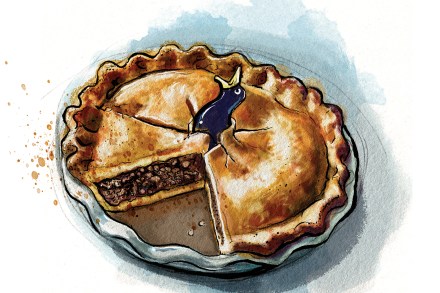
Mince, glorious mince

Sometimes, when it comes to culinary history, Britain is its own worst enemy. For a long time, British food has been seen as a joke among other nations, but also nearer to home. Even when the dishes are near indistinguishable, we’re still happy to poke fun at our own fare: we love panna cotta but laugh at blancmange; we cringe at stew but revere boeuf Bourguignon. They’re the same, but that doesn’t stop us. Where better to showcase the unsung hero braised beef mince than in a beautiful short-crust pie? Mince gets the worst of our inward-turned opprobrium, a leitmotif in our national food anthem. A pot of stewed mince speaks to all that is wrong with British food: staid, bland, brown, probably overcooked and definitely stuck in the 1950s.

With Terry Wiggins, Parliament Chef

18 min listen

Terry Wiggins is a chef who led the catering team at Westminster’s Portcullis House. During his time, he served 13 prime ministers and received an MBE for services to Parliament. He has recently retired. On the podcast, Terry reminisces about 50 years of service in Parliament, reveals some of the weirdest requests he has received and gives the inside scoop on the eating habits of some of the House of Commons’ most recognisable names.

Brown bread ice cream: a delicious use for stale bread

I often think of the first time I ate brown bread ice cream. I know how that sounds: it’s the exact sort of pretentious nonsense a food writer would say if they were about to press a recipe for brown bread ice cream on you. But it was long before I became a food bore, and it’s true. I really do think about that first time a lot. Using leftover bread or stale breadcrumbs is the basis for some of our finest puddings I had just moved to London to study law after university, and was about to train as a barrister. I was living in a small flat and surviving on pesto pasta, bowls of cereal and crisps. At that point, going out for dinner probably meant a McDonald’s at the end of a night out. I knew next to nothing about food.

The secret to making great oysters Rockefeller

There’s nothing more intriguing than a closely guarded secret recipe. Coca-Cola and KFC are two famous examples, with the precise ingredients for the soda syrup and special coating kept in guarded vaults: the story is that those who hold the information aren’t allowed to travel on the same plane in case of disaster. Lea & Perrins, Angostura Bitters and Chartreuse all keep their products’ make-up secret. Making sure the butter is the brightest of greens is as important as any of the individual components Nobody knows the recipe for oysters Rockefeller – or at least nobody knows the original recipe. It was created in 1889 at Antoine’s restaurant in New Orleans, which still stands today, serving the same classically French food it did back in the 19th century.

Potato crisps and the British character

Pickled fish. Lemon tea. Cucumber. Doner kebab. Stewed beef noodles. Salted egg. Soft shell crab. Coney island mustard. Smoked gouda. Hamburger seasoning. Honey butter. Roasted garlic oyster. Spicy crayfish. Finger-licking braised pork. Sesame sauce hotpot. Rose petal. Numb and spicy hotpot. Roasted fish. Blueberry. The world of crisps has changed almost unrecognisably since the snack was first commercially produced in the early 20th century. Now the possibilities are enough to make the head spin. In Crunch, Natalie Whittle takes us on a whistlestop tour of the flavours we can now find across the world. The mind-boggling list gives an idea of the scope of this seemingly simple snack that goes far beyond the humble cheese and onion.

With Claire Dinhut

26 min listen

Claire Dinhut is known to thousands on social media as CondimentClaire. Raised in a European household in Los Angeles, her upbringing and her background studying history have influenced her other passion, for cooking. Her book The Condiment Book: a brilliantly flavourful guide to food's unsung heroes is out now. On the podcast, Claire tells hosts Lara Prendergast and Olivia Potts about how Anthony Bourdain was her inspiration, the impact of covid on her career, and her French and Greek culinary influences. She also answers important questions such as: should we pair branston pickle with avocado; is cereal a soup; and what's the deal with pumpkin spice? Produced by Oscar Edmondson and Patrick Gibbons.

The joy of tarte Tatin

When it comes to traditional recipes, there are few things we love more than an unlikely origin story, ideally one born out of clumsiness or forgetfulness. The bigger the kitchen pratfall, the more delicious the product. Setting pancakes on fire? Accidental crêpe Suzette! Nothing in the restaurant apart from lettuce and some pantry ingredients? The Caesar salad is born! Muck up a cake you’ve made hundreds of times and end up with a squidgy mess? The St Louis gooey butter cake is even more popular than the original recipe! There are few bungling origin stories neater than that of the tarte Tatin But there are few bungling origin stories neater than that of tarte Tatin, the upside-down caramelised apple tart.

With Charlie Bigham

31 min listen

Charlie Bigham founded his eponymous ready to cook meals over 25 years ago. Having left a career as a management consultant, his company has gone on to report annual sales in the tens of millions, with a focus on ‘creating delicious dishes for people who love proper food’. His first cookbook ‘Supper with Charlie Bigham’ is out now.    On the podcast, Charlie tells hosts Lara Prendergast and Olivia Potts about recovering from ‘revolting’ school food, the difference between packaged meals and ready meals, and how he views cooking as alchemy. Produced by Oscar Edmondson and Patrick Gibbons.