Olivia Potts

Olivia Potts

Olivia Potts is the Guild of Food Writers’ Cookery Writer of the Year 2025. She hosts The Spectator’s Table Talk podcast and writes Spectator Life's The Vintage Chef column

What to do with the last of the summer’s apples

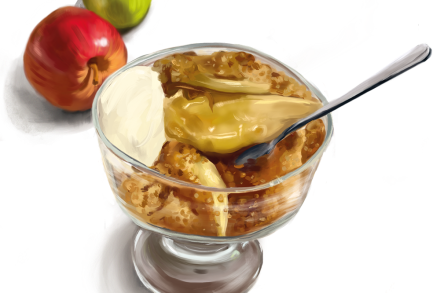
The double-edged sword of eating with the seasons is the glut. A blunt, un-pretty word, which is a joy in theory and delicious in result, but which can feel daunting when you’re facing down a bench full of berries to be picked over, or countless apples to be processed. My husband and I were once given an apple tree as a present. It’s a multi-graft, meaning each of the three branches produces a different type of apple: russets, for storing, bramleys, for cooking, and tart eating apples. This is the first year that it’s thrown up more than three measly apples. Well, it’s made up for lost time; we are, to put it mildly, drowning in apples.

With Brett Graham

30 min listen

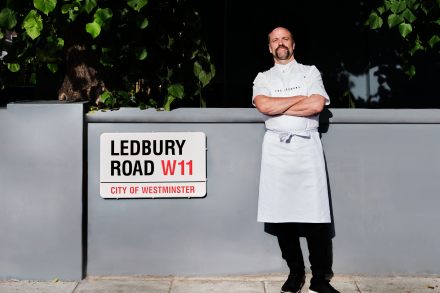
Brett Graham is the man behind the Michelin-starred The Ledbury in Notting Hill, which is celebrating 20 years this year. He’s also the director of The Harwood Arms in Fulham, London’s only pub with a Michelin star. On the podcast, Brett tells hosts Lara Prendergast and Olivia Potts about why being in the kitchen is like being in the army, what it was like for The Ledbury to receive its third Michelin star and the trials and tribulations of learning food production – including ending up with 127 piglets.

The glorious richness of rillettes

I admit to feeling a little intimidated by charcuterie. I have a clutch of books on my shelf all laying out in step-by-step detail how to craft your own salami or whip up a perfect pancetta. They’re well-thumbed, but not a single one has a cooking stain on it. I’m just too nervous when it comes to the scary stuff. I’m talking about the drying-sausages-hanging-from-the-rafters kind of charcuterie. I’m talking about jerry-rigging anti-pest guards to protect your hams. I can’t quite get past the fact that charcuterie requires hanging meat somewhere in my house, which feels at best frightening and at worst like I’m actively inviting botulism into my home. I’ll say it: I’m a charcuterie coward.

With Charlotte Ivers

35 min listen

Charlotte Ivers is the restaurant critic for the Sunday Times; most recently she reviewed Lupa, Fenix and Home SW15. Charlotte started her career as a media adviser in Theresa May’s Number 10, before she moved into the world of radio. She was a political correspondent at talkRADIO and Wireless Group before joining Times Radio.  On the podcast, Charlotte tells hosts Lara Prendergast and Olivia Potts about chasing the high she felt from tasting risotto for the first time, how a second date unwittingly converted her from vegetarianism and what she thinks makes a good restaurant critic.

The magic of Danish dream cake

I am, for the most part, a rule follower and a people pleaser. It’s one of the reasons I love baking, which essentially amounts to a set of instructions designed to make something to be shared and bring joy. But if someone recommends something to me, I can be resistant to it for ages. The farcical element is that once I capitulate and try out the novel, TV show, restaurant or biscuit recipe, I inevitably discover that my tastes are extremely mainstream, and I love whatever it is. It took me years to listen to Taylor Swift before immediately accepting her greatness and becoming her no. 1 fan. There’s no good reason for this.

With Candice Chung

33 min listen

Candice Chung is a food writer whose work has been featured in many publications, including the Guardian. Her first book, Chinese Parents Don’t Say I Love You, is out now. On the podcast, she tells Liv about her earliest memories of food growing up in Hong Kong, why trying lasagne for the first time was a magical experience, and how Chinese parents show their love through food.

Sophia Falkner, Roger Lewis, Olivia Potts, Aidan Hartley and Toby Young

27 min listen

This week: Sophia Falkner profiles some of the eccentric personalities we stand to lose when Keir Starmer purges the hereditary peers; Roger Lewis’s piece on the slow delight of an OAP coach tour is read by the actor Robert Bathurst; Olivia Potts reviews two books in the magazine that use food as a prism through which to discuss Ukrainian heritage and resistance; Aidan Hartley reads his Wild Life column; and Toby Young reflects on the novel experience of being sober at The Spectator summer party. Hosted and produced by Oscar Edmondson.

The importance of bread as a symbol of Ukrainian resistance

When Russia invaded Ukraine three years ago, the chef Olia Hercules lost the will to cook. With food so deeply connected to pleasure and to her Ukrainian roots, it somehow felt like an unbearable frivolity to be thinking about recipes while family members were under fire. ‘How,’ she asked, ‘can I cook while my brother is running with a gun in a forest defending Kyiv and my mum and dad are living under occupation?’ When her parents finally managed to leave the country and meet her in Italy, she began cooking again to welcome them. First she made borscht, following her mother’s recipe; then pasta. She could have just bought the dough ready-made – ‘but the gates are now open wide, and I can’t stop’, she writes in Strong Roots.

Salad cream is more than a poor man’s mayonnaise

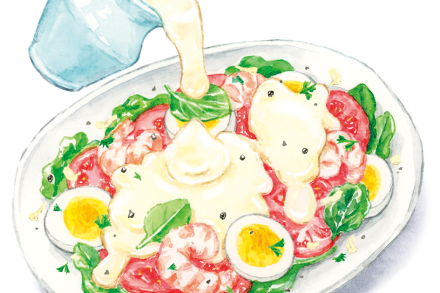
Salad cream makes me feel oddly patriotic. It’s one of those products that is so distinctively British that it has not travelled. Elsewhere, it is eschewed as a poor man’s mayonnaise. Its chief ingredients are hardboiled egg yolks, English mustard, vinegar and thick cream, and it was, in fact, the first product that Heinz produced exclusively for Great Britain, in Harlesden, north-west London, from 1914 onwards. The Heinz version is, frankly, a wartime mayonnaise, constrained by shelf life and made with the cheaper ingredients available at the time, a little looser and distinctively sweeter than its mayonnaise equivalent. It really came into its own in the second world war during rationing.

The key to a great American key lime pie

A few years ago, a friend wrote a cookery book for the UK market, full of gorgeous dishes, many of them esoterically British. It was snapped up by an American publisher who, as well as converting my friend’s careful metric measurements into loosey-goosey volume-based cup measures, queried a couple of her more British ingredients, one being golden syrup. My friend had a recipe for treacle tart which – as anyone who has made it knows – is just a whole tin of golden syrup held together with a handful of breadcrumbs and an egg. But golden syrup is hard to get hold of in the US. Her American publishers wanted to replace it with corn syrup. Now, corn syrup may look similar to golden syrup – they are both inverse sugars of a blond hue – but the taste is completely different.

Sean Thomas, John Power, Susie Mesure, Olivia Potts and Rory Sutherland

22 min listen

On this week’s Spectator Out Loud: Sean Thomas reflects on the era of lads mags (1:07); John Power reveals those unfairly gaming the social housing system (6:15); Susie Moss reviews Ripeness by Sarah Moss (11:31); Olivia Potts explains the importance of sausage rolls (14:21); and, Rory Sutherland speaks in defence of the Trump playbook (18:09).  Produced and presented by Patrick Gibbons.

Porn Britannia, Xi’s absence & no more lonely hearts?

47 min listen

OnlyFans is giving the Treasury what it wants – but should we be concerned? ‘OnlyFans,’ writes Louise Perry, ‘is the most profitable content subscription service in the world.’ Yet ‘the vast majority of its content creators make very little from it’. So why are around 4 per cent of young British women selling their wares on the site? ‘Imitating Bonnie Blue and Lily Phillips – currently locked in a competition to have sex with the most men in a day – isn’t pleasant.’ OnlyFans gives women ‘the sexual attention and money of hundreds and even thousands of men’. The result is ‘a cascade of depravity’ that Perry wouldn’t wish on her worst enemy.

Should family history, however painful, be memorialised forever?

Be under no illusions: this is not a food memoir. Chopping Onions on My Heart is a linguistic exploration of belonging; a history of the Jewish community in Iraq; and an urgent endeavour to save an endangered language. Above all, it is a reckoning with generational trauma. The subjects of Samantha Ellis’s previous books include the life of Anne Brontë, heroines of classic literature, feminism and romantic comedy. She is the daughter of Iraqi Jewish refugees, and the language she grew up around, the language of her people and culture, is dying. Judeo-Iraqi Arabic ‘came out of the collisions of Hebrew-speaking Jews and Aramaic-speaking Babylonians, and then absorbed linguistic influences from all the other people who conquered Iraq’.

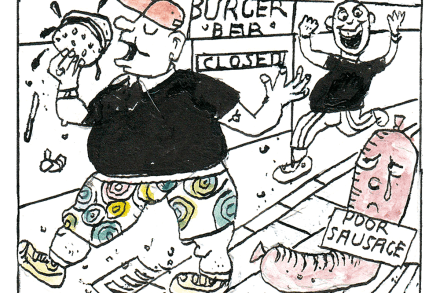
I love sausages!

‘Sausages,’ my son says to me, leaning forward from the back of the car, with the authority and confidence only a three-year-old can truly muster. ‘Sausages?’ I reply distractedly, while navigating a particularly awkward roundabout. We’ve been talking about my job, but I assume his train of thought has taken a lunchier direction. ‘Yes, sausages. You write about sausages. And… things like sausages.’ He sits back, satisfied in his career analysis, probably contemplating whether lunch can indeed also feature sausages.

It’s time to reclaim tapioca pudding

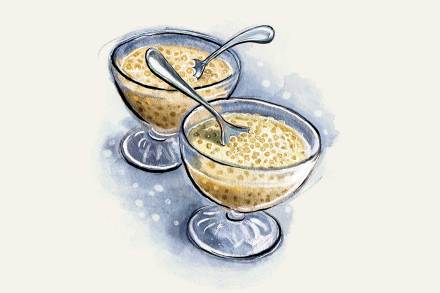
‘Nothing will surely ever taste so hateful as nursery tapioca,’ wrote Elizabeth David. She’s not alone in her hatred of the stuff: tapioca pudding has become a shorthand for those childhood dishes we look back on with horror. It’s exactly those dishes that I’m trying to restore to their former glory – if such a glory ever existed. In fact, the first recipe I wrote in these pages was about blancmange, an attempt to persuade readers that that school dinner staple was worth a revisit. From there, rice pudding was a similar challenge and made way for jam roly-poly, spotted dick and cornflake tart. Though I’ve had tapioca pudding on my dish list for some time, I haven’t been brave enough to give it a go.

With Daria Lavelle, on her breakout novel ‘Aftertaste’

33 min listen

Daria Lavelle was born in Kyiv, Ukraine, and raised in New York. Her work explores themes of identity and belonging and her short stories have appeared in The Deadlands, Dread Machine, and elsewhere. Daria is the author of the critically acclaimed new novel Aftertaste which explores food, grief and the uncanny.  On the podcast she tells Liv about her 'inexplicable' love of olives as a child in Ukraine, trying to make it as a writer in New York and how to write about food without it feeling contrived.

Devilled kidneys: a heavenly breakfast 

Iam standing in my kitchen preparing kidneys for devilling. Snipping their white cores away piece by piece until they come free and I’m left with just the wibbly, burgundy kidney, ready for their spiced flour, I pause. There is no denying that even fresh raw kidneys can smell a little… challenging. And for one moment I consider skipping the whole thing and just having an unchallenging slice of toast instead. I’m so glad I didn’t. Because once cooked, kidneys are not challenging at all: they’re luscious and tender, with an earthy, gamey flavour which is almost compulsive. That robustness is actually their strength: kidneys can take bold flavours – feisty seasonings and rich sauces – which is why they are so suited to devilling.

With Mary-Ellen McTague

25 min listen

Mary-Ellen McTague is a chef based in Manchester. She is the culinary driving force behind Aunbury, 4244, the Creameries and her newest venture, Pip at the Treehouse Hotel. Mary-Ellen is also the co-founder of Eat Well MCR, which has delivered almost 100,000 meals across Greater Manchester since 2020 to those sidelined by poverty. On the podcast, she tells Liv and Lara why, as a child, she would only eat orange cheese, why Lancashire hotpot is so nostalgic, her Eureka moment when she decided to become a chef – and where you should eat in Manchester.

The gobsmacking brilliance of baked Alaska

I have never seen a baked Alaska in the wild. Have you? I knew what they looked like, of course, all meringue cheekbones and technicolor interior, but I haven’t actually come across one. For whatever reason, they seem to be an endangered species – so I took to making them myself. The pudding was invented in the 18th century by Sir Benjamin Thompson (also known as Count von Rumford), a physicist who invented the double boiler, the modern kitchen range and thermal underwear too. Thompson realised that the tiny bubbles created when you aerate egg whites to make meringue provided so much insulation that you could torch the meringue and leave ice cream intact, unmelted, beneath.

The story of food in glorious technicolour

Have you ever suffered from museum blindness? A complete overwhelm at the sheer amount of stuff – often quite similar stuff – that prevents you from focusing on any one item? I know I have. Two-thirds of the way around a museum, even one I have true enthusiasm for, I find my eyes sliding off exhibits, reading the captions but not taking anything in. I have discovered the antidote in Repast by Jenny Linford. Produced in conjunction with the British Museum, using its collection and curators, it explores the global history of cooking, eating and drinking. At first glance it could simply be a coffee-table book. A thing of beauty, it is heavy to hold, with gorgeous full-page illustrations. But it is far more than that. ‘Food is universal, yet particular,’ Linford begins.