Olivia Potts

Olivia Potts

Olivia Potts is the Guild of Food Writers’ Cookery Writer of the Year 2025. She hosts The Spectator’s Table Talk podcast and writes Spectator Life's The Vintage Chef column

Sean Thomas, John Power, Susie Mesure, Olivia Potts and Rory Sutherland

From our UK edition

22 min listen

On this week’s Spectator Out Loud: Sean Thomas reflects on the era of lads mags (1:07); John Power reveals those unfairly gaming the social housing system (6:15); Susie Moss reviews Ripeness by Sarah Moss (11:31); Olivia Potts explains the importance of sausage rolls (14:21); and, Rory Sutherland speaks in defence of the Trump playbook (18:09).  Produced and presented by Patrick Gibbons.

Porn Britannia, Xi’s absence & no more lonely hearts?

From our UK edition

47 min listen

OnlyFans is giving the Treasury what it wants – but should we be concerned? ‘OnlyFans,’ writes Louise Perry, ‘is the most profitable content subscription service in the world.’ Yet ‘the vast majority of its content creators make very little from it’. So why are around 4 per cent of young British women selling their wares on the site? ‘Imitating Bonnie Blue and Lily Phillips – currently locked in a competition to have sex with the most men in a day – isn’t pleasant.’ OnlyFans gives women ‘the sexual attention and money of hundreds and even thousands of men’. The result is ‘a cascade of depravity’ that Perry wouldn’t wish on her worst enemy.

Should family history, however painful, be memorialised forever?

From our UK edition

Be under no illusions: this is not a food memoir. Chopping Onions on My Heart is a linguistic exploration of belonging; a history of the Jewish community in Iraq; and an urgent endeavour to save an endangered language. Above all, it is a reckoning with generational trauma. The subjects of Samantha Ellis’s previous books include the life of Anne Brontë, heroines of classic literature, feminism and romantic comedy. She is the daughter of Iraqi Jewish refugees, and the language she grew up around, the language of her people and culture, is dying. Judeo-Iraqi Arabic ‘came out of the collisions of Hebrew-speaking Jews and Aramaic-speaking Babylonians, and then absorbed linguistic influences from all the other people who conquered Iraq’.

I love sausages!

From our UK edition

‘Sausages,’ my son says to me, leaning forward from the back of the car, with the authority and confidence only a three-year-old can truly muster. ‘Sausages?’ I reply distractedly, while navigating a particularly awkward roundabout. We’ve been talking about my job, but I assume his train of thought has taken a lunchier direction. ‘Yes, sausages. You write about sausages. And… things like sausages.’ He sits back, satisfied in his career analysis, probably contemplating whether lunch can indeed also feature sausages.

It’s time to reclaim tapioca pudding

From our UK edition

‘Nothing will surely ever taste so hateful as nursery tapioca,’ wrote Elizabeth David. She’s not alone in her hatred of the stuff: tapioca pudding has become a shorthand for those childhood dishes we look back on with horror. It’s exactly those dishes that I’m trying to restore to their former glory – if such a glory ever existed. In fact, the first recipe I wrote in these pages was about blancmange, an attempt to persuade readers that that school dinner staple was worth a revisit. From there, rice pudding was a similar challenge and made way for jam roly-poly, spotted dick and cornflake tart. Though I’ve had tapioca pudding on my dish list for some time, I haven’t been brave enough to give it a go.

With Daria Lavelle, on her breakout novel ‘Aftertaste’

From our UK edition

33 min listen

Daria Lavelle was born in Kyiv, Ukraine, and raised in New York. Her work explores themes of identity and belonging and her short stories have appeared in The Deadlands, Dread Machine, and elsewhere. Daria is the author of the critically acclaimed new novel Aftertaste which explores food, grief and the uncanny.  On the podcast she tells Liv about her 'inexplicable' love of olives as a child in Ukraine, trying to make it as a writer in New York and how to write about food without it feeling contrived.

Devilled kidneys: a heavenly breakfast 

From our UK edition

Iam standing in my kitchen preparing kidneys for devilling. Snipping their white cores away piece by piece until they come free and I’m left with just the wibbly, burgundy kidney, ready for their spiced flour, I pause. There is no denying that even fresh raw kidneys can smell a little… challenging. And for one moment I consider skipping the whole thing and just having an unchallenging slice of toast instead. I’m so glad I didn’t. Because once cooked, kidneys are not challenging at all: they’re luscious and tender, with an earthy, gamey flavour which is almost compulsive. That robustness is actually their strength: kidneys can take bold flavours – feisty seasonings and rich sauces – which is why they are so suited to devilling.

With Mary-Ellen McTague

From our UK edition

25 min listen

Mary-Ellen McTague is a chef based in Manchester. She is the culinary driving force behind Aunbury, 4244, the Creameries and her newest venture, Pip at the Treehouse Hotel. Mary-Ellen is also the co-founder of Eat Well MCR, which has delivered almost 100,000 meals across Greater Manchester since 2020 to those sidelined by poverty. On the podcast, she tells Liv and Lara why, as a child, she would only eat orange cheese, why Lancashire hotpot is so nostalgic, her Eureka moment when she decided to become a chef – and where you should eat in Manchester.

The gobsmacking brilliance of baked Alaska

From our UK edition

I have never seen a baked Alaska in the wild. Have you? I knew what they looked like, of course, all meringue cheekbones and technicolor interior, but I haven’t actually come across one. For whatever reason, they seem to be an endangered species – so I took to making them myself. The pudding was invented in the 18th century by Sir Benjamin Thompson (also known as Count von Rumford), a physicist who invented the double boiler, the modern kitchen range and thermal underwear too. Thompson realised that the tiny bubbles created when you aerate egg whites to make meringue provided so much insulation that you could torch the meringue and leave ice cream intact, unmelted, beneath.

The story of food in glorious technicolour

From our UK edition

Have you ever suffered from museum blindness? A complete overwhelm at the sheer amount of stuff – often quite similar stuff – that prevents you from focusing on any one item? I know I have. Two-thirds of the way around a museum, even one I have true enthusiasm for, I find my eyes sliding off exhibits, reading the captions but not taking anything in. I have discovered the antidote in Repast by Jenny Linford. Produced in conjunction with the British Museum, using its collection and curators, it explores the global history of cooking, eating and drinking. At first glance it could simply be a coffee-table book. A thing of beauty, it is heavy to hold, with gorgeous full-page illustrations. But it is far more than that. ‘Food is universal, yet particular,’ Linford begins.

With Roger Pizey, Head of Pastry at Fortnum and Mason

From our UK edition

20 min listen

Roger Pizey is a baker, chef and one of the most influential pâtissiers in the UK. He started his culinary journey as an apprentice at La Gavroche under Albert Roux before taking on the role of head of pastry at Marco Pierre White’s Harveys, during the time it achieved three Michelin stars. He has since worked at a number of London institutions and now serves as the head of pastry at Fortnum and Mason. On the podcast he tells Liv and Lara about childhood memories of Manchester tart, what he learnt from Albert Roux and Marco Pierre White, and why Fortnum’s rose éclair is the perfect dessert.

Paul Wood, Katy Balls, Olivia Potts, Benedict Allen, Cosmo Landesman and Aidan Hartley

From our UK edition

40 min listen

On this week’s Spectator Out Loud: Would Trump really bomb Iran, asks Paul Wood (1:38); Katy Balls interviews Health Secretary Wes Streeting on NHS reform, Blairism and Game of Thrones (8:38); Olivia Potts examines the history – and decline – of the Easter staple, roast lamb (18:25); the explorer Benedict Allen says Erling Kagge and Neil Shubin were both dicing with death, as he reviews both their books on exploration to earth’s poles (22:13); Cosmo Landesman reflects on what turning 70 has meant for his sex life (28:46); and, Aidan Hartley takes us on an anthropomorphic journey across Africa (33:55).  Produced and presented by Patrick Gibbons.

Why Easter eggs are getting more expensive

From our UK edition

While the US continues to use the price of chicken eggs as a political (American) football, closer to home our concern is with eggs of a sweeter kind. This year has seen chocolate prices rise dramatically. The price of cocoa had remained stable for decades, but in November 2023 it rocketed and has remained high ever since: it is currently almost three times what it was 18 months ago. The sudden increase came about after particularly poor harvests in West Africa, where more than 80 per cent of the world’s cocoa is grown. Extreme weather, in the form of both record-breaking high temperatures and then very heavy rains, have ravaged the cocoa plantations in Ghana and Côte d’Ivoire.

Lamb is for life, not just for Easter

From our UK edition

Roast lamb is as expected on the Easter table as turkey is at Christmas. But as a nation, we are falling out of love with lamb. Meat consumption in Britain is at its lowest level since records began, and according to the Agriculture and Horticulture Development Board (AHDB), lamb has been in particular decline for the past 20 years. We may feel we are supporting the sheep-farming industry, but the truth is a little more complicated There are a number of reasons for this: some people are trying to eat less meat for environmental or ethical reasons, while others don’t enjoy the richer taste of lamb compared with other meats. Perhaps most importantly, after a long period of rising in price more drastically than other meats, the cost of lamb reached record highs last year.

The simple elegance of fondant potatoes

From our UK edition

In 1999, a relatively unknown American chef wrote an essay in the New Yorker uncovering the secrets of restaurants. ‘Don’t Eat Before Reading This’ lifted the lid on both the underworld of professional kitchens and the mentality of chefs. In it, the writer meticulously took down ordering fish on a Monday (old), eating steak well done (for ‘philistines’), brunch as a concept (despised) and vegetarians in general (‘Enemies of everything that’s good and decent in the human spirit’). The no-punches-pulled writing, which was both lyrical and graphic as well as funny and forthright, was the first published essay by Anthony Bourdain, who would go on to become one of the most influential and beloved personalities in the food world.

The hot cross bunfight

From our UK edition

There’s a well-known clip from daytime TV show This Morning where celebrity chef Gino D’Acampo is cooking a classic Italian pasta dish. Holly Willoughby, one of the presenters, tastes it and says: ‘Do you know, if it had, like, ham in it, it’s closer to a British carbonara?’ D’Acampo, in his Italian-accented perfect English, looks at her in horror before replying: ‘If my grandmother had wheels, she would have been a bike.’ This phrase goes round and round in my head as I stand agog in my supermarket’s bakery aisles. Where once there might have been one choice of hot cross bun as we hurtle towards Easter – perhaps one ‘standard’ and one ‘luxury’ in the bigger shops – our options now extend as far as the eye can see.

Trump shock, cousin marriage & would you steal from a restaurant?

From our UK edition

39 min listen

This week: Trump’s tariffs – madness or mastermind?‘Shock tactics’ is the headline of our cover article this week, as deputy editor Freddy Gray reflects on a week that has seen the US President upend the global economic order, with back and forth announcements on reciprocal and retaliatory tariffs. At the time of writing, a baseline 10% on imports stands – with higher tariffs remaining for China, Mexico and Canada. The initial announcement last week had led to the biggest global market decline since the start of the pandemic, and left countries scrambling to react, whether through negotiation or retaliation.

Would you steal from a restaurant?

From our UK edition

‘You wouldn’t steal a car…’ began the early noughties anti-piracy video. ‘You wouldn’t steal a television… You wouldn’t steal a handbag.’ No, but it seems from reports from restaurants, you might slip some silverware into a handbag if you’re out for dinner. In February, Gordon Ramsay revealed that nearly 500 cat figurines had been stolen in one week from his latest restaurant, Lucky Cat. The maneki-neko cat models – said to bring good luck – cost £4.50 each, which makes that a loss of more than £2,000 for the restaurant in just seven days. What is it about dining out that means we think pocketing property is acceptable?

With Gok Wan

From our UK edition

25 min listen

Gok Wan is a renowned stylist and television presenter. Over the years, Gok has transformed the way we think about style and body image with his much-loved series How to Look Good Naked and Gok’s Fashion Fix – his focus on body positivity was the antidote to the crash-dieting fads which dominated the 2000s. Later in his career, Gok drew upon his Chinese heritage to author books on Chinese cooking. On the podcast he tells Liv and Lara about growing up in a Chinese restaurant, why hosting is more like ‘theatre’ and why he always abides by the five-second rule.

Golden syrup dumplings: the perfect comfort food

From our UK edition

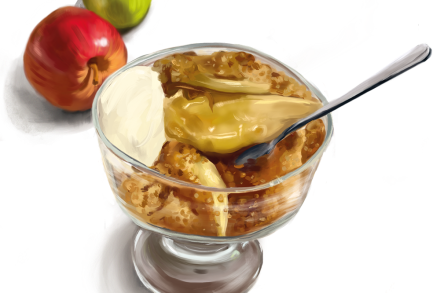
The Italians have a phrase: ‘brutti ma buoni’. It means ‘ugly but beautiful’, and it’s the name they give to their nubbly hazelnut meringue biscuits, which – as the name suggests – taste lovely but aren’t lookers. The phrase came to me the other day when I lifted the lid on my pan of golden syrup dumplings. Because they’re ugly little buggers. They look a little like soggy apple fritters, or even chicken nuggets – am I selling them to you yet? But focus on the buoni, not the brutti: they are absolutely delicious. Golden syrup dumplings sound as British as queueing.