Michael Simmons

Michael Simmons

Michael Simmons is The Spectator's economics editor. Contact him here.

Lockdown’s impact on children is only beginning

Children who started school in the early days of the pandemic will have worse exam results well into the next decade. That’s according to a study released this morning by the London School of Economics, the University of Exeter and the University of Strathclyde. Researchers predict that 60 per cent of pupils will achieve worse than a grade five in their English and Maths GSCEs in 2030, considerably more than the numbers achieving poor marks today. The study, which looked at the effect of school closures on childhood development, is the first to look at both ‘cognitive’ skills as well as ‘socio-emotional’ skills, finding the latter to be just as important.

Sunak declares a crackdown on Britain’s ‘sick note culture’

10 min listen

Rishi Sunak has returned to one of his pet bugbears: getting the unemployed back into work. His speech to the Centre for Social Justice this morning was peppered with his favourite facts about the post-pandemic welfare crisis embroiling Britain. Lucy Dunn speaks to James Heale and Michael Simmons.  Produced by Oscar Edmondson.

Worklessness hits eight-year high

Britain already has the worst post-pandemic workforce recovery in Europe. New figures out today show the problem is getting even worse. The number of those ‘economically inactive’ (not in work or looking for it) rose by a remarkable 150,000 in the last three months to 9.4 million – equivalent to the adult population of Portsmouth and some 850,000 since the first lockdown. Taken as a share of the working-age population, it’s now at an eight-year high – and significantly worse than it was during Covid or its aftermath. What’s driving the worklessness? The biggest single factor is long-term sickness, also at an all-time high. Is this just economic long-Covid, the after-effects of the virus that struck four years ago?

Should the ‘Waspi women’ be compensated?

13 min listen

The Parliamentary Ombudsman's report on raising women's state pension age in line with men's has been published. It details that women born in the 1950s hit by the state pension age change are owed compensation and has advised that the government should 'do the right thing'. Will the 'Waspi women' end up disappointed?  Michael Simmons speaks to Isabel Hardman and Louise Perry, host of the Maiden Mother Matriarch podcast.

Has the jobs market cooled enough to cut interest rates?

Is the Bank of England about to cut interest rates? Today’s labour market statistics might just give them the room to do so. The latest data, released by the Office for National Statistics (ONS) this morning, shows that the number of payrolled employees is up, the unemployment rate is up, vacancies are down and pay growth is slowing. But is it enough? Job vacancies fell for the 20th consecutive time between December and February – and by twice as in last month's release. Vacancies were down to 908,000 on the quarter, a decrease of 43,000 – though they remain far higher than pre-lockdown levels. More data released yesterday by the Reed recruitment agency supports this too: job adverts are at their lowest level in more than three years.

Britain’s worklessness disaster

Whilst Jeremy Hunt’s cut to National Insurance may grab the headlines, the real story of today’s Budget was hidden in the official forecasts accompanying it. These forecasts point to a disaster for Britain's labour force. The UK already had one of the worst post-lockdown workforce recoveries in the world, with a record 2.8 million people off work due to long-term sickness. But today the OBR said things are only going to get worse. Spending on welfare now makes up the second biggest portion of your tax bill –  narrowly pipped to the post by our NHS The OBR gave the Chancellor credit for expanding childcare provision, attempting to reform welfare and reducing personal tax rates – which it says will boost the labour supply by 300,000 people.

Too many people in Britain aren’t working

Britain’s worklessness crisis is getting worse. This morning the ONS released figures showing that 1.3 million are on unemployment. But that figure masks a welfare crisis that politicians are doing little to address. Unemployment only covers those actually looking for a job – the real problem is how few are. The true benefits figure goes unpublished and is buried in a password protected DWP database. Every three months the database is updated and we track the results on The Spectator data hub. It was updated this morning and shows the number claiming out-of-work benefits has hit some 5.6 million people. The increase is being driven by those in the Universal Credit (workless) category who are not required to find work. Many will be classified as too sick to work.

Full extent of sick-note Britain revealed

We already know that Britain has a massive sick-note problem but we did not, until today, know just how large. Every three months, the ONS surveys 35,000 people and uses the results to guess how many (for example) are not working due to long-term sickness. That figure had been 2.6 million. But it has today been revised upwards by 200,000 – equivalent to the population of Norwich or Aberdeen – to 2.8 million. The chart of those too sick to work, already one of the most alarming in UK economics, now looks even worse.

Sturgeon paints herself as perfect at Covid Inquiry

10 min listen

Nicola Sturgeon became emotional during her evidence at the Covid inquiry today – a highly anticipated part of the inquiry given the issue of deleted Whatsapp messages. How did the former first minister come across today? And what else can the evidence tell us about how the Scottish government operated? Katy Balls speaks to Isabel Hardman and Michael Simmons.

McMafia: inside the SNP’s secret state

40 min listen

On the podcast: gangsterism or government?  The Covid Inquiry has moved to Scotland and, in his cover story for the magazine, our editor Fraser Nelson looks at the many revelations uncovered by Jamie Dawson KC. Fraser describes how civil servants were enlisted into what he calls an ‘SNP secret state’ and how SNP corruption is threatening devolution. Joining us to discuss is the Coffee House Scots team: Times columnist Iain Macwhirter, The Spectator’s data editor Michael Simmons and The Spectator’s social media editor Lucy Dunn who coordinates our Scotland coverage.

Sobriety isn’t worth it

Absolutely nobody feels better at the end of Dry January. Mornings are still a struggle, you’re as tired as ever, and if anything the neurotic voice in your head is even louder. Yes, you may have gone to the gym every Sunday, but how has your life improved? It hasn’t. My own Dry January was forced on me by antibiotics. Though the NHS guidelines said the pills are alcohol compatible, my doctor (who has a record of my alcohol intake) took the liberty of writing ‘NO alcohol’ followed by five exclamation marks. This has allowed me to experience sobriety firsthand.

Has Britain’s jobs market bounced back?

The jobs market has turned a corner. Vacancies have fallen again to 934,000, down 49,000 in the last three months of the year, the longest continuous fall on record. Wage growth slowed to 6.5 per cent in cash terms – which will please the Bank of England – but luckily for workers inflation is falling faster, meaning those rises translate into real terms pay bumps (of about 1.3 per cent). Employment climbed slightly while unemployment remained flat.  The next inflation figures are out tomorrow but the wage data are a sure sign of the direction of travel. Take out bonuses and average pay rose 6.6 per cent (1.4 in real terms). Hotels and restaurants saw the largest growth in pay excluding bonuses at 7.2 per cent.

There’s another dodgy data scandal brewing

The government is reeling from the Post Office Horizon scandal. ‘Lessons must be learnt’, goes the cry around Westminster. But a computer scandal with striking similarity to the bugs in the Horizon system has been brewing under the Department for Work and Pension and HMRC’s noses for over a decade.  When Universal Credit was introduced to reform and modernise the benefits system in 2013 it needed a data system to drive it. HMRC came up with the solution. The taxman billed its new ‘Real Time Information’ system as the ‘biggest change’ to the tax system since PAYE began in 1944. Employers were mandated to report their worker’s pay every time they ran payroll.

Have we really lost hundreds of thousands of workers since Covid?

The jobs market appears to be slowing down, but can we trust the figures? Vacancies have fallen for the longest continuous period on record, according to data published by the Office for National Statistics (ONS). But there are still just under 950,000 jobs on offer which is well above the pre-lockdown norm. Meanwhile, despite British workers receiving real-terms pay rises in the three months to October, wage growth seems to have peaked. This will please Bank of England rate setters who feared that spiralling wage demands could worsen inflation. Average weekly earnings (including bonuses) fell slightly to 7.2 per cent on the year, down from 8 per cent. Because of lower inflation (now at 4.6 per cent) that translated to real-terms pay increases of 1.3 per cent.

James Heale, Michael Simmons and Mary Wakefield

18 min listen

This week: James Heale reads his politics column on Sunak's migration minefield (00:55), Michael Simmons says that Scotland's 'progressive' teaching methods have badly backfired (05:53), and Mary Wakefield asks: why can't I pray in Westminster Abbey? (11:40) Produced and presented by Oscar Edmondson.

Boris faces the music at the Covid inquiry

12 min listen

It was a big day in the Covid inquiry as Boris Johnson gave evidence for the first time. Just as Johnson launched into an apology during his opening statement, protestors off-camera made their presence known. There were also revelations concerning the attention he paid to Sage minutes and Cobra meetings and the former prime minister defended his decision not to lock down sooner. What else did we learn? Was this a turning point in the perception of the inquiry?  Oscar Edmondson speaks to James Heale and Michael Simmons.

When it comes to education, Scotland is an example of what not to do

Scots have, in the past, bragged about having the best education system in the world. Scottish sixth-formers study a broader range of subjects and aren’t forced to specialise too early. And look at our history: the literature, the Enlightenment, our universities, all due to world-class schools. But however true this may once have been, it’s hard to make the same claim now. Scottish education is in crisis. Confirmation came this week with the PISA international league tables for school pupils in 81 different countries. Up to 10,000 pupils in each system sit tests in maths, reading and science, and the results are a gold standard in comparing schools. Scotland has traditionally come close to England and once led the UK in scores for maths.

Carbon capture: how China cornered the green market

30 min listen

On the podcast: In her cover piece for the magazine, The Spectator's assistant editor Cindy Yu – writing ahead of the COP28 summit this weekend – describes how China has cornered the renewables market. She joins the podcast alongside Akshat Rathi, senior climate reporter for Bloomberg and author of Climate Capitalism: Winning the Global Race to Zero Emissions, to investigate China's green agenda. (01:22) Also this week: Margaret Mitchell writes in The Spectator about the uncertainty she is facing around her graduate visa. This is after last week's statistics from the ONS showed that net migration remains unsustainably high, leaving the government under pressure to curb legal migration.

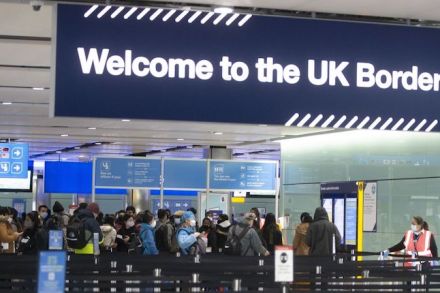
Net migration hits 672,000 – with 2022 figures revised up

Has migration to the UK peaked? Net migration in the year to June hit 672,000, down from 745,000 in 2022. Some 1.2 million people came to Britain whilst 508,000 moved overseas. The ONS says it’s too early to call this a downward trend, but that immigration seems to be slowing whilst emigration is increasing. Perhaps the biggest story though is the size of some of the revisions. The ONS had previously put the net migration figure for 2022 at just over 600,000. Today they found 140,000 more people and revised it up to 745,000. This is a staggering change. Taken with today’s figure, that new peak suggests numbers are coming down. But how much can we trust the ONS’s estimates? Will today’s number be revised up in six months’ time?