Martin Vander Weyer

Martin Vander Weyer

Martin Vander Weyer is business editor of The Spectator. He writes the weekly Any Other Business column.

Don’t believe the Tory grumbling: HS2 is on the way

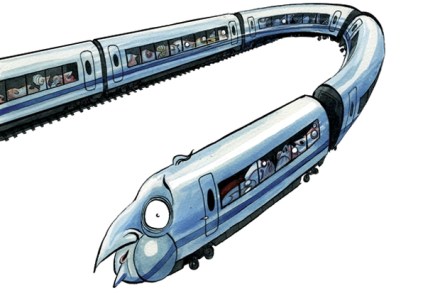
There’s a lot of negativity around HS2, and I sniff a Brexit connection. You might think Leave campaigners whose aim is to boost British self-belief would promote the idea that we have a talent for grands projets such as the Olympic Park and Crossrail, rather than a propensity to deliver half what’s promised at double the cost. But there’s also an overlap between Tory MPs opposed to the northbound high-speed rail link, usually because it bisects their constituencies, and Tory MPs opposed to the government on the EU referendum. So I suspect that’s where the trouble lies. The spin is that cabinet secretary Sir Jeremy Heywood is reviewing the project ‘as fears grow’ that it will bust its already inflated £55 billion budget.

Despite rumours to the contrary, the high-speed loco has left the drawing board

There’s a lot of negativity around HS2, and I sniff a Brexit connection. You might think Leave campaigners whose aim is to boost British self-belief would promote the idea that we have a talent for grands projets such as the Olympic Park and Crossrail, rather than a propensity to deliver half what’s promised at double the cost. But there’s also an overlap between Tory MPs opposed to the northbound high-speed rail link, usually because it bisects their constituencies, and Tory MPs opposed to the government on the EU referendum. So I suspect that’s where the trouble lies. The spin is that cabinet secretary Sir Jeremy Heywood is reviewing the project ‘as fears grow’ that it will bust its already inflated £55 billion budget.

The prospect of Brexit is already damaging growth, but Osborne doesn’t care

Has the shadow of Brexit already cost us a slice of GDP — and if so, is it a blip or an omen? The Office for National Statistics says UK growth was 0.4 per cent in the first quarter of this year, down from 0.6 per cent in last year’s final quarter. And we can’t blame the neighbours, because the eurozone upped its game from 0.3 per cent to a positively breathless 0.6 per cent — with even France trotting in ahead of us at 0.5 per cent. We still look stronger on the jobs front, mind you, with our unemployment rate, at 5.1 per cent, well down on a year ago and at half the rate for the eurozone. And our service sector continues to perform quite well.

Spectator Money: The legacy issue. How to plan ahead for what you’ll leave behind

The new issue of Spectator Money is out on Thursday 19 May, and there’s a fantastic array of articles to look forward to. Here’s the editor, Martin Vander Weyer, on what you can expect. The magazine will come free with your next copy of The Spectator, and will also be available to read online at spectator.com/money. Times of political change are also times to think about ‘legacy’. What will Barack Obama be remembered for: his nuclear deal with Iran, his ‘Obamacare’ health programme, or simply his symbolic status as America’s first black president?

Have we sacrificed a quarter’s growth to answer the European question?

Has the shadow of Brexit already cost us a slice of GDP — and if so, is it a blip or an omen? The Office for National Statistics says UK growth was 0.4 per cent in the first quarter of this year, down from 0.6 per cent in last year’s final quarter. And we can’t blame the neighbours, because the eurozone upped its game from 0.3 per cent to a positively breathless 0.6 per cent — with even France trotting in ahead of us at 0.5 per cent. We still look stronger on the jobs front, mind you, with our unemployment rate, at 5.1 per cent, well down on a year ago and at half the rate for the eurozone. And our service sector continues to perform quite well.

My top tip for predicting whether a business is doomed

It’s a useful rule of thumb that any business which reduces its name to its initials is heading for trouble. Having gone that way under Goodwin, RBS almost doubled down last year by becoming the lower-case ‘rbs’, before apparently thinking better of it. British Petroleum became ‘BP’ after its 1998 merger with Amoco, tried to claim a greener image by suggesting that the B might stand for ‘Beyond’, and has never really been stable since. ‘British’, like Scottish, was evidently an unsuitable tag for a global player. Likewise BG, the former exploration arm of British Gas, was an unhappy ship for years before its recent takeover by the robustly unabbreviated Royal Dutch Shell.

Scrapping RBS’s toxic brand should be a step towards a final break-up

Royal Bank of Scotland is at last about to dump the ‘RBS’ logotype promoted by its fallen chieftain Fred Goodwin, who thought ‘Scotland’ too parochial for a bank with global ambitions, though he was famously keen on royal connections. The wonder is that this decision has taken seven-and-a-half years since the bank was saved by £46 billion of taxpayers’ money.I suppose Goodwin’s successors, now led by Ross McEwan, have had too many other fires to fight, what with losses piling upon losses (first-quarter results twice as bad as last year’s), delays in the spin-off of the Williams & Glyn subsidiary, computer problems, and a looming scandal in the Swiss branch of Coutts, the group’s wealth arm.

A tale of two Ranieris

The world now has two famous managers called Ranieri. One is Lew Ranieri, the corpulent monster of Salomon Brothers’ 1980s New York trading floor. Thanks to Michael Lewis’s Liar’s Poker, that Ranieri is forever associated with ‘Food Frenzy Fridays’ — vast pig-outs of Mexican and Italian takeaway — and the observation by a fellow trader that ‘Lewie would piss on your desk’. He was eventually fired by Salomon and withdrew into sulky seclusion before returning to become even more notorious as the progenitor of the mortgage-backed securities market that nearly destroyed the global banking system. He was named by Time as one of ‘The 25 People to Blame for the Financial Crisis’.

The death of investment banking as we know it? Bring it on

Oh woe. Investment bank profits are evaporating after a disastrous contraction of trading revenues reflecting zero-to-negative interest rates, weak commodity prices and worries about China and other emerging markets. Not to mention the stagnant eurozone, the possibility of Brexit, increased capital requirements (which will rise further for banks that must ‘ringfence’ their trading operations) and the demoralising impact of regulatory moves to cap and force clawback of bonuses. Across the Atlantic, Goldman Sachs, Morgan Stanley, Citi and Bank of America have felt the chill, as have Credit Suisse, UBS and Deutsche in Europe.

The death of investment banking will lead to the rebirth of something better

Oh woe. Investment bank profits are evaporating after a disastrous contraction of trading revenues reflecting zero-to-negative interest rates, weak commodity prices and worries about China and other emerging markets. Not to mention the stagnant eurozone, the possibility of Brexit, increased capital requirements (which will rise further for banks that must ‘ringfence’ their trading operations) and the demoralising impact of regulatory moves to cap and force clawback of bonuses. Across the Atlantic, Goldman Sachs, Morgan Stanley, Citi and Bank of America have felt the chill, as have Credit Suisse, UBS and Deutsche in Europe.

The Tories are doing the unthinkable to save Port Talbot steel

Ministers from 34 countries met in Brussels this week in the vain hope of a quick fix for the steel crisis that everyone blames on dumping by China — which responded, through a state news agency, by calling its critics ‘lame and lazy’. Our own Sajid Javid, desperate to avert the fallout from a closure of Tata’s Port Talbot steelworks before the referendum, claimed to have observed ‘a very positive step forward’ in Chinese attitudes, but perhaps someone had locked him in his hotel room.

If you’re riding the FTSE rebound you might still want to sell in May

When the FTSE100 fell close to 5,500 in February, we all said ‘Mr Bear is back’. On Tuesday the index hit a high for this year of 6,400, and we all wondered whether Mr Bear had done what I said he wouldn’t, and shuffled back to hibernation. But the truth is that shares have lately moved in parallel with the oil price, which has perked up partly for technical reasons including temporary curtailment of supply from Kuwait; and a major element of the FTSE recovery is in commodity stocks that had been wildly oversold. So we shouldn’t read any great swing of confidence into a market still 600 points down on a year ago.

Brexit forecasting is futile – and both sides should just admit it

The most striking thing about the Treasury’s forecast of the impact of Brexit is the relative modesty of its claim that by 2030, assuming a UK-EU trade deal akin to the one negotiated by Canada, ‘our GDP would be 6.2 per cent lower’ while ‘families would be £4,300 worse off’. Since those quotes come from the foreword signed by George Osborne, many voters will distrust the whole document — in which case they might prefer the even more modest ‘worst case’ of a 2.2 per cent GDP hit by 2030 predicted by non-partisan think-tank Open Europe alongside what it calls ‘a far more realistic’ range of possible outcomes ‘between a 0.8 per cent permanent loss to GDP… and a 0.6 per cent permanent gain’.

Let’s refocus the Panama story on the bad stuff that really matters

There were moments last week when I was ready to give up journalism and retrain in a less unsavoury profession — chiropody, perhaps. It might have been Jon Snow’s bushwhacking of arts minister Ed Vaizey on the subject of the prime minister’s tax affairs, or Snow’s colleague Cathy Newman shrieking questions about offshore companies at Boris Johnson as she chased him in the street. Or one of dozens of reports and articles oozing malice, self--righteousness, hypocrisy and wilful ignorance of the distinction between tax planning as practised by anyone with a sense of obligation to provide for their family and the dirty business of hiding ill-gotten gains.

Forget David Cameron – I want to know about Wayne Rooney’s tax return

While we’re on the subject of taxes, what about footballers? That’s a question often put up by bankers accused of being overpaid, but the comparison works as well with politicians. Cameron’s tenure at the top has coincided with that of Wayne Rooney, a role model for millions who is said to earn more in a week than the Prime Minister earns in a year: Cameron’s tax rate turns out to be 38 per cent, but what’s Wayne’s? More broadly, the annual wage bill for the Premier League is £1.9 billion. Two thirds of the players, including most of the highest paid, are foreign. A survey for 2013–14 found players earning an average of £2.

Credit where it’s due to Tata, our greatest inward investor

If asked to pick the UK’s inward investor of the century so far I would, without hesitation, name Ratan Tata, the anglophile former patriarch of the eponymous Indian conglomerate that bought Tetley the tea-maker for £271 million in 2000, Corus the Anglo-Dutch steel-maker for £6.2 billion in 2007, and Jaguar Land Rover — from Ford — for £1.3 billion in 2008.

We’re probably all on Mossack Fonseca’s books

Let me make this perfectly clear: I have never asked Mossack Fonseca of Panama to set up a company for me in the British Virgin Islands or anywhere else. At least I don’t think I have: I mean, who reads the small print of all that boring paperwork from wealth managers and accountants these days? Among 11 million leaked Mossack Fonseca documents, we will probably all find our own names somewhere, plus those of Elvis and Lord Lucan. Even so — and leaving aside, for today, the morality of offshore tax structures — we can admire the breadth of the Panamanian law firm’s client list, stretching as it reportedly does from ‘senior Tory peers’ and a cousin of Bashar al-Assad to the brother-in-law of the Chinese president and the friends of Vladimir Putin.

In defence of George Osborne’s ‘left-wing’ Living Wage

It was unfashionable of me to write in praise of George Osborne on Budget day. I did so, you may recall, because ‘at least we have a finance minister who’s always on the front foot’: I wanted to make a contrast between our Chancellor’s relentless activism in pursuit of his political goals, and the supine performance of eurozone leaders — who continue failing to offer any strokes at all while hoping for Mario Draghi to knock up a few runs with monetary trick-shots from the other end. Within 48 hours, however, our Chancellor seemed to be very much on the back foot, one hand clutching his protective box, as bouncers rained down from the unlikely combination of IDS and John McDonnell.

Osborne’s on the back foot but his Living Wage deserves praise

It was unfashionable of me to write in praise of George Osborne on Budget day. I did so, you may recall, because ‘at least we have a finance minister who’s always on the front foot’: I wanted to make a contrast between our Chancellor’s relentless activism in pursuit of his political goals, and the supine performance of eurozone leaders — who continue failing to offer any strokes at all while hoping for Mario Draghi to knock up a few runs with monetary trick-shots from the other end. Within 48 hours, however, our Chancellor seemed to be very much on the back foot, one hand clutching his protective box, as bouncers rained down from the unlikely combination of IDS and John McDonnell.

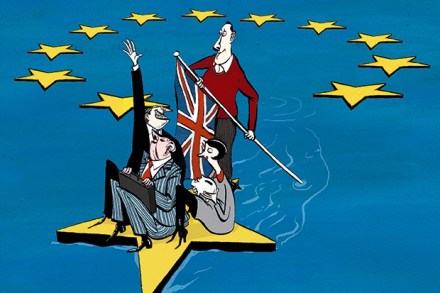
My straw polls say the ‘leave’ campaign is failing to make a clear economic case

In every gathering, someone — often me — calls for a show of hands on Brexit. And I have to report that, in the varied circles in which I move, ‘leave’ may have the best tunes but isn’t winning the argument. At a Mayfair fundraiser for a Jewish charity, the crowd of mostly thirty-to-fortysomething men in suits (and many in yarmulkes) was 90 per cent for ‘remain’; a former Tory minister was spotted waving both arms in a desperate bid to boost the ‘leave’ minority. In a more mixed crowd of business people at a Budget briefing in Newcastle, the balance was much the same.