Luke McShane

Luke McShane is chess columnist for The Spectator.

Twelve questions for Christmas – answers

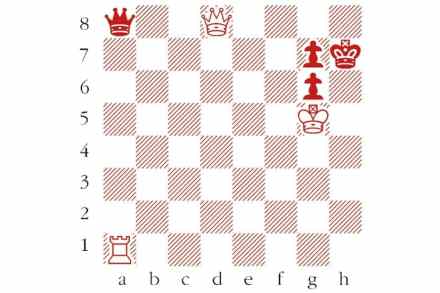
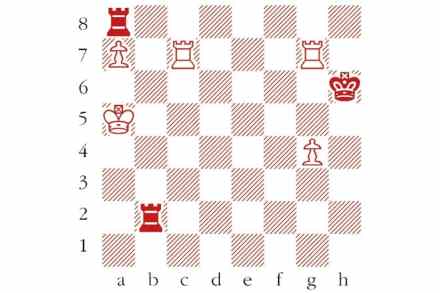
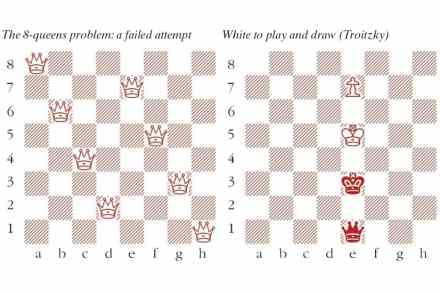
1. Anish Giri 2. Nona Gaprindashvili 3. Jamie Njoku-Goodwin 4. Alireza Firouzja 5. Magnus Carlsen–Hikaru Nakamura 6. 2 Qf4+! gxf4 3 Rb7+ Kc8 4 Rc7+ Kd8 5 Rd7+ etc with a draw. The rook is immune due to stalemate. 7. Abhimanyu Mishra 8. Ian Nepomniachtchi 9. Garry Kasparov 10. Trafalgar Square, London 11. Yuri Averbakh 12. 1 Ra3! and 2 Ra5#, or in case of 1…e3 2 Rxe3 is mate.

Puzzle | 11 December 2021

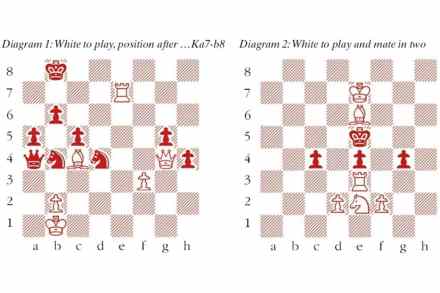
White to play and mate in 2. Composed by W.A. Shinkman, Montreal Spectator, 1880. As things stand, White has no immediate mate in answer to 1…Ka3 or 1…a3. The key move offers an ingenious way to meet these moves. Please note that owing to Christmas printing deadlines there is no prize for this puzzle. Last week’s solution 1…Qxh3+ 2 Kxh3 Rh6+ 3 Kg4 Reg6# Last week’s winner C.

Carlsen’s breakthrough

Game 6 of the Carlsen–Nepomniachtchi world championship match was one for the ages. After draws in the first five games, the world champion broke the deadlock with a 136-move victory — the longest in world championship history. It lasted almost eight hours, and Nepomniachtchi made the final mistake in an endgame with a lone queen against rook, knight and two pawns. In a balanced middlegame, ‘Nepo’ took a risky decision at move 25, offering an exchange of two rooks for Carlsen’s queen, creating winning chances for both sides. Magnus Carlsen–Ian Nepomniachtchi World Championship Game 6, Dubai 25… Rac8 26 Qxc8 Rxc8 27 Rxc8 Qd5 Attacking the pawn on b3. It’s important that 28 Nf4 Bxf2+ wins.

No. 682

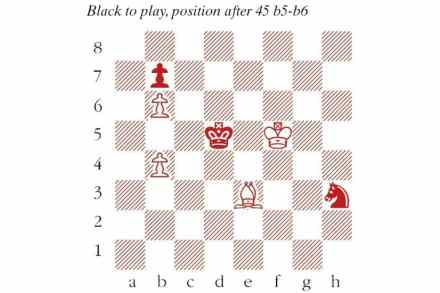
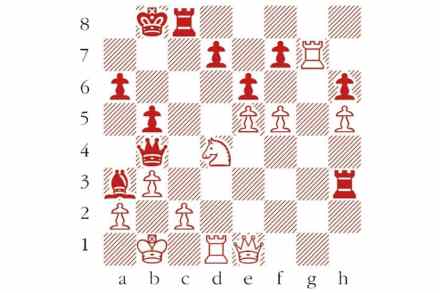
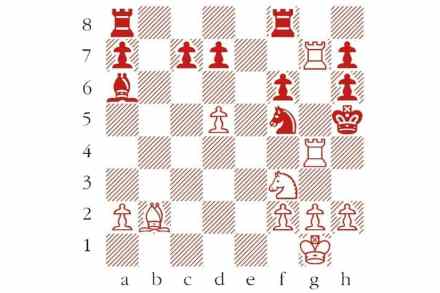
Black to play. Plat-Esipenko, European Team Championship, 2021. The 19-year-old Russian playing Black found a way to force mate in three moves. What did he play next? Answers should be emailed to chess@spectator.co.uk by Monday 6 December. There is a prize of £20 for the first correct answer out of a hat. Please include a postal address and allow six weeks for prize delivery. Last week’s solution 1 Qb8+!

Mar del Plata

Alireza Firouzja produced a momentous performance for France at the European Team Championships, held in Slovenia last month. The 18-year-old, originally from Iran, had taken first place at the Fide Grand Swiss in Latvia just a few days earlier. In Slovenia, his seven wins and two draws was a staggering achievement, earning him an individual gold medal and propelling him to second place in the world rankings. In the overall team standings, it was Ukraine that took gold, finishing narrowly ahead of France on tiebreak. The England team got off to a shaky start, and we didn’t come close to repeating our bronze-medal-winning performance from the previous edition in 2019.

No. 681

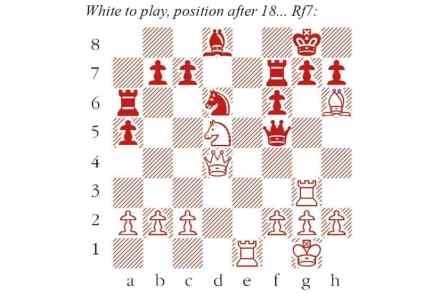
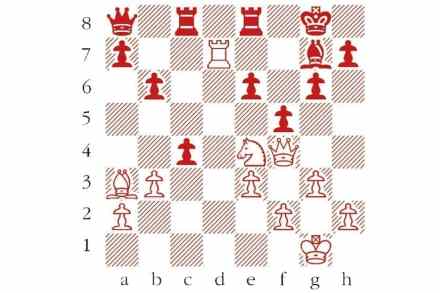
White to play. Erigaisi–Liem, Tata Steel Rapid, 2021. Here 1 Rxf6? Qd1+ sees White getting mated on the back rank. The 18-year-old Indian grand-master found a much stronger move. What did he play? Email answers to chess@spectator.co.uk by Monday 29 November. There is a prize of £20 for the first correct answer out of a hat. Please include a postal address. Last week’s solution 1 Bg5!

The world championship

‘Time to say Dubai,’ tweeted Magnus Carlsen, like some wry Bond villain, when he learned that the Russian Ian Nepomniachtchi would be his next challenger for the world championship title. Hosted at the Dubai Expo, battle will commence on Friday 26 November. Carlsen wrested the title from Viswanathan Anand in 2013, and since then has defended his title against Anand (again), Sergey Karjakin and Fabiano Caruana. But the Norwegian downplayed his match experience in appraising his prospects against the new challenger: ‘My biggest advantage is that I am better at chess.’ Still, world championship matches have an intensity all of their own, in which nerves and stamina are as indispensable as good moves.

No. 680

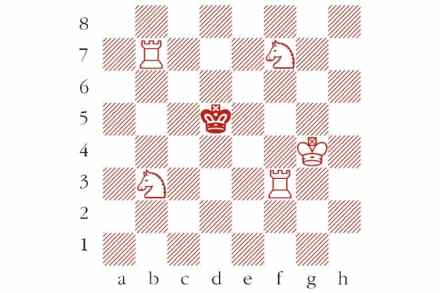
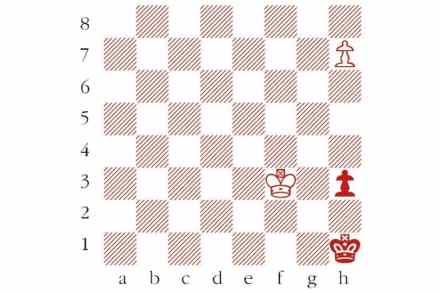
White to play and win. The conclusion of an endgame study by Henri Rinck. The imminent promotion of the g-pawn makes White’s situation look desperate, but there is one way to win the game. What is White’s winning move? Email answers to chess@spectator.co.uk by Monday 22 November. There is a prize of £20 for the first correct answer out of a hat. Please include a postal address. Last week’s solution 1 Qxf6+!

Sacrificing the queen

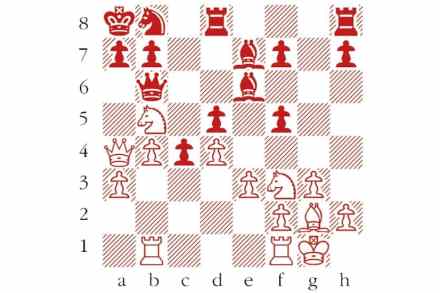
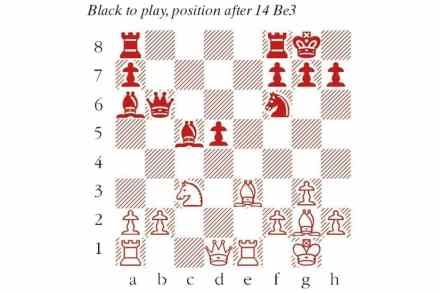
One of the most eye-catching games from the recently concluded Fide Grand Swiss in Riga saw an early sacrifice of queen for knight, bishop and pawn. This exotic balance of material usually favours the queen, based on the rule of thumb that pawn = 1, knight = 3, bishop = 3, rook = 5, queen = 9. But when the minor pieces coordinate well, particularly with rooks alongside, they can be more than a match for the queen. A queen’s greatest strength is her ability to attack, and perhaps fork, any pieces that are not nailed down. So when you jettison your queen for a miscellany of pieces, they had better resemble a florentine more than a fruit salad. It helps when the minor pieces have a clear target of their own. That is the situation that occurred after 14 Be2 (see diagram 1).

No. 679

White to play. Trisha Kanyamarala–Roderick Mckay, EJCOA Forest Hall Invitational, 2021. White found a brilliant strike on the kingside, forcing a quick mate. What did she play? Answers should be emailed to chess@spectator.co.uk by Monday 15 November. There is a prize of £20 for the first correct answer out of a hat. Please include a postal address. Last week’s solution 1 Qxh7+!

Fide Grand Swiss

Alireza Firouzja, just 18 years old, was the clear winner of the Fide Grand Swiss, which concluded in Latvia last weekend. Originally from Iran but now settled in France, Firouzja already looks like a credible future contender for the world championship, and his victory in the Grand Swiss has earned him a spot in the 2022 Candidates tournament, which will select the next challenger for the world title. The current challenger, Ian Nepomniachtchi, who won the Candidates tournament in April, will face the world champion Magnus Carlsen in Dubai later this month. Play begins on 26 November. England’s David Howell also produced an outstanding performance in Riga, finishing in a tie for fourth place.

No. 678

White to play. Short-Ye, Sanjin Hotel Cup 2004. A snappy finish from a game in Winning. Which move allowed Short to force a quick checkmate? Answers should be emailed to chess@spectator.co.uk by Monday 8 November. There is a prize of £20 for the first correct answer out of a hat. Please include a postal address and allow six weeks for prize delivery. Last week’s solution 1…Ne4+ 2 Nxe4 a4 and the a-pawn cannot be stopped.

Short fights

If you play chess like a wet rag, sooner or later you will be made to regret it. In Nigel Short’s new book Winning (Quality Chess, 2021), that precept pops up in countless guises, and nobody is above criticism. Peter Leko ‘infamously offended the gods by attempting to draw his way to the title’ in his world championship match against Vladimir Kramnik in 2004. Mikhail Gurevich pursued a ‘craven objective’ in trying to draw his way to qualification at the 1990 Manila Interzonal. (He was undone by Short himself.) Bronstein’s chances against Botvinnik in 1951 perished with his ‘abject capitulation’ in game 23. Russian grandmaster Aleksey Dreev was punished for a ‘wanton act of timidity’.

No. 677

Black to play. Turner–Jackson, Hull 4NCL GM Tournament 2021. Which move did James Jackson play to ensure a decisive advance of his passed a-pawn? Answers should be emailed to chess@spectator.co.uk by Monday 1 November. There is a prize of £20 for the first correct answer out of a hat. Please include a postal address. Last week’s solution 1 Rg8+ Kxg8 2 Qxf7+ Kh8 3 Qg8# (or 3 Qf8#). Not 1 Qxf7+ Kh6 2 Qf4+ Rg5 3 Qh4+ Rh5 which only leads to a draw.

The Varsity match

Anyone who has attended the Varsity chess match knows that an online version just wouldn’t be the same. The annual event is held in great style at the Royal Automobile Club in London’s Pall Mall, and has tradition at its heart. This year’s, the 139th edition, could not be held at the usual time in March, but it took place last weekend, to coincide with the RAC Chess Circle’s Annual Dinner. Since the 2020 edition also took place just weeks before the onset of the first national lockdown, the mighty tradition of the Varsity match remains uninterrupted by the pandemic. (The last year without a contest was during the second world war.

No. 676

White to play. Bjerre–Maiwald, Bundesliga 2021. Black has menacing counterplay, so White’s attack needs an accurate conclusion. What did he play next? Answers should be emailed to chess@spectator.co.uk by Monday 25 October. There is a prize of £20 for the first correct answer out of a hat. Please include a postal address and allow six weeks for prize delivery.

Eaten by a bear

I don’t like losing at chess. It feels bad in the moment, whether my position subsides like a failed pudding, or crashes like a severed tree. It feels bad right afterwards too, staring at a big fat zero on the scorecard. But worst of all is the lingering knot of disgust, because usually one’s mistakes are echoes of shortcomings one knew about already, and there is no hiding from them. The chorus from Radiohead’s ‘Just’ (from The Bends) could as well be an anthem for sulking chess players. You do it to yourself, you do And that’s what really hurts Is you do it to yourself Just you, you and no one else You do it to yourself… But last week I lost a game and felt, well, pretty much fine.

No. 675

White to play and mate in one. I found this puzzle online, composed by someone with the pseudonym ‘Illion’. I was stumped for several minutes before the solution dawned on me. Answers should be emailed to chess@spectator.co.uk by Monday 18 October. There is a prize of £20 for the first correct answer out of a hat. Please include a postal address and allow six weeks for prize delivery. Last week’s solution 1 Qxf8+!

The sudden mate

The hero pauses, plays the move, and announces ‘Checkmate!’ The villain crumples in shock. It’s a scene played out countless times on screen, but it so often looks ludicrous. In slow games between skilled players, checkmate on the board is much rarer than resignation. Occasionally, when the denouement is brisk and elegant, it will be played out to a finish. But in those cases, volunteering for the guillotine is a sporting gesture from the vanquished party. More often, the final phase of a chess game isn’t much of a spectacle. Extra piece, mop up some pawns, promote a pawn, hunt down the king, yadda yadda yadda. There’s no harm in playing it out, particularly if you think your opponent might stumble into a stalemate.

No. 674

White to play. Mamedyarov–Artemiev, MeltwaterChampions Final 2021. Black’s last move, was Ra8-a4, attacking the pawn on g4. But it allowed Mamedyarov a decisive tactical opportunity. What did he play? Answers should be emailed to chess@spectator.co.uk by Monday 11 October. There is a prize of £20 for the first correct answer out of a hat. Please include a postal address and allow six weeks for prize delivery. Last week’s solution 1 Ng4+!