Luke McShane

Luke McShane is chess columnist for The Spectator.

No. 692

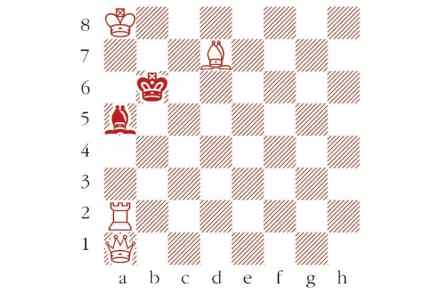
White to play and win. A gem discovered by the Ukrainian composer Vladislav Tarasiuk with Israeli composer Amatzia Avni. How does White avoid stalemate and secure the win? Answers should be sent to ‘Chess’ at The Spectator by 7 March or via email to victoria@spectator.co.uk. There is a prize of £20 for the first correct answer out of a hat. Please include a postal address and allow six weeks for prize delivery. Last week’s solution 1...Rb3! Then 2 Rxa5 Rxb1+ leads to mate, while 2 Qd1 Rxb1 3 Qxb1 Qxf5 leaves Black a rook up.

Russia in check

The Champions League final has been moved from St Petersburg to Paris and the Russian Grand Prix in Sochi cancelled. It was obvious that the Chess Olympiad, to take place in Moscow in July and August, could not continue as planned. Last week, this was confirmed by Fide, the international federation, and it is reported that the Indian federation has put forward a bid worth $10 million to host the event. Russia’s invasion of Ukraine has repercussions for chess that go well beyond the Olympiad. Fide Council released a significant statement at the weekend expressing condemnation of Russian military action and resolving to terminate sponsorship agreements with ‘any Belarusian and Russian sanctioned and/or state-controlled companies’.

No. 691

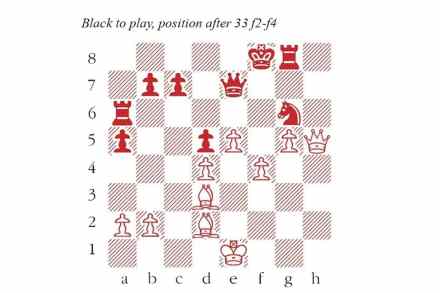
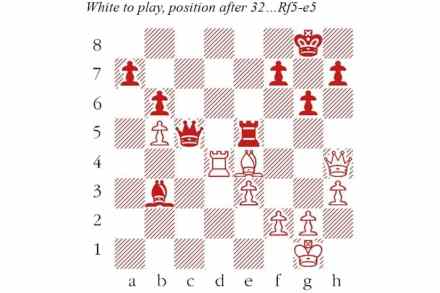
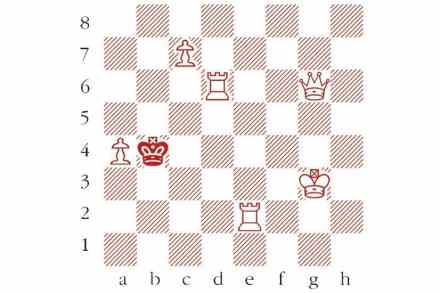
Black to play. Maric-Gligoric, Belgrade 1962. White has offered to exchange the rooks on f5 and c3. But Gligoric found a much stronger shot, prompting instant resignation. What did he play? Answers should be emailed to chess@spectator.co.uk by Monday 28 February. There is a prize of £20 for the first correct answer out of a hat. Please include a postal address. Last week’s solution 1…Rxa7+ 2 Rxa7 Rb5+ Capturing the rook leads to stalemate, while otherwise it can check along the b-file forever.

Nakamura the wildcard

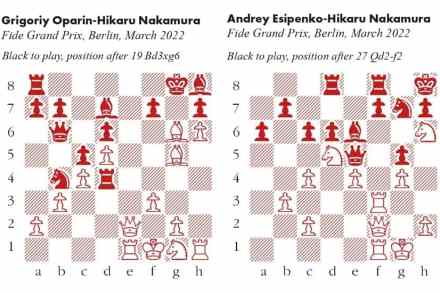
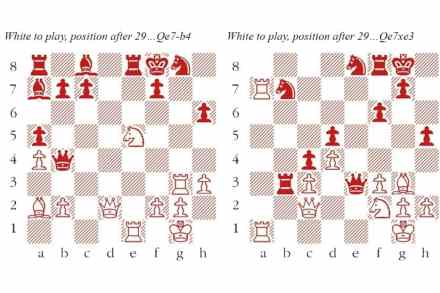
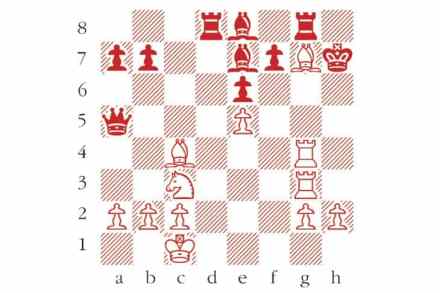
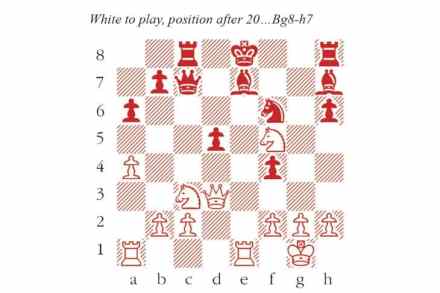
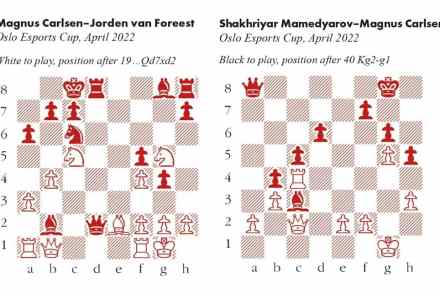
Hikaru Nakamura justified his wildcard invitation by taking first place at the Fide Grand Prix in Berlin this month. The American grandmaster has become the world’s most popular chess streamer, and had not played a slow game in more than two years. But he looked fresh and relaxed, and evidently the steady practice of elite online speed events have kept his skills sharp. Facing a rising Russian star, I suspect Nakamura’s eye was quickly drawn to 29 Qb4, hoping to deflect Black’s queen or win the Bb5. But after 29…Qxb4 30 Rxd8+ Qf8! 31 Rxf8+ Kxf8 the endgame is likely to end in a draw. So you keep the idea, shake things up a bit, and see what drops out: Hikaru Nakamura-Andrey EsipenkoFide Grand Prix, Berlin 2022 (See left diagram) 29 Bxf6!

No. 670

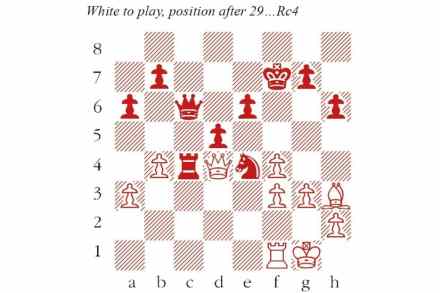
Black to play. Shuvalova–Pavlidou, Women’s World Blitz Championship, 2021. White was winning, but has just played 89 g3-g4? No resignation here: Pavlidou seized her opportunity to save the game. What did she play? Email answers to chess@spectator.co.uk by Monday 21 February. There is a prize of £20 for the first correct answer out of a hat. Please include a postal address. Last week’s solution 1 Rd3+. Then 1…Kc6 2 Nd8# or 1…Kc4 2 Ne5#, or 1…Ke4 2 Nc5#, or 1…Ke6 2 Rd6#.

Contemplating loss

Contemplating a lost position is a bit like having sauce down your shirt. It is annoying in itself, but worse, it often comes with a sting of embarrassment. We chess players are a proud lot, and losing is an affront to our dignity. And what do your dining companions make of it? You might jokily draw attention to the stain, to pre-empt the suspicion that you hadn’t noticed or didn’t care. It is one thing to be clumsy, but quite another to be thought dopey as well. The chess player wrestles with a similar urge. A true poker-face is a rarity, and I suspect that is because most of us don’t even try. A vigorous shaking of the head, besides expressing genuine despair, is also an oblique way of saving face. It says ‘Touché! Yes, I am undone, but I know it now!

The battle of the sexes

One tradition at the annual Gibraltar Masters is a high-spirited skittles match played in the evening between teams of men and women, dubbed the ‘Battle of the Sexes’. In 2020, to much amusement, the women won a playful miniature after the flamboyant 3…f5 quickly backfired: 1 e4 e5 2 Nf3 Nc6 3 Bc4 f5 4 d3 fxe4 5 dxe4 Nf6 6 Ng5 Qe7 7 Bf7+ Kd8 8 Ne6+ Black resigns. This year, Gibraltar hosted a real ‘Battle of the Sexes’ event with a £100,000 prize fund. It featured the unusual Scheveningen format where players in teams (ten women and ten men respectively) faced each member of the opposing team over ten days. The teams (with one reserve on each side) were carefully selected to ensure a balanced match.

No. 689

White to play and mate in two moves. Composed by Touw Hian Bwee, Schakend Nederland 1976. The first move allows Black’s king to run in any of four directions, with a different mating response to each one. What is it? Email answers to chess@spectator.co.uk by Monday 14 February. There is a prize of £20 for the first correct answer out of a hat. Please include a postal address. Last week’s solution 1 Qxa7+ Qxa7 2 Nc7 mate.

No. 688

White to play. Dardha–Shuvalova, Tata Steel Challengers 2022. The 16-year-old grandmaster from Belgium found a crisp way to finish the game. What did he play? Answers should be emailed to chess@spectator.co.uk by Monday 7 February. There is a prize of £20 for the first correct answer out of a hat. Please include a postal address and allow six weeks for prize delivery. Last week’s solution 1…Rh1! 2 Qxh1 Qc3 and Qc3-b2 mate is unstoppable.

Magnus’s tasks

World championship match play has a stony logic, where there are no prizes for glorious endeavour. It calls to mind the old joke about two hunters who encounter a bear. One puts on his running shoes. ‘You can’t outrun a bear,’ objects his friend. ‘I don’t have to outrun the bear, I only have to outrun you.’ After beating Ian Nepomniachtchi in December, Magnus Carlsen reflected on his experience of winning five world championship matches. ‘I managed to stay relatively process- and passion-driven against Anand in 2013, while in the last four matches it has been all about results.’ Those months consumed by a single opponent surely take a toll on the psyche.

No. 687

Black to play. Grandelius–Rapport, Tata Steel Chess 2022. With a bishop resting on a3, the White king can never sit comfortably. Rapport’s next move was a crushing blow. What did he play? Answers should be emailed to chess@spectator.co.uk by Monday 31 January. There is a prize of £20 for the first correct answer out of a hat. Please include a postal address.

Pixel this

When Magnus Carlsen won last year’s Meltwater Champions Tour, they made two trophies. One was for Carlsen, and the second was auctioned online, fetching a sum in digital currency of around $25,000. The trophy only exists as a video showing a stack of rotating gold squares, like a Donald Trump skyscraper from the future. If you bought it, you’d be right on trend. Earlier in 2021, the winning bid at Christie’s for a digital artwork named ‘Everydays: the First 5000 Days’ came in at $69 million. That was for an elaborate collage created by graphic designer Mike Winkelmann, using the pseudonym ‘Beeple’. The pixels aren’t worth diddly squat, since anyone can download a copy.

A multitude of queens

Here’s a challenge which appeared in a German chess magazine in 1848: place eight white queens on an empty chessboard so that no two queens occupy the same file, rank or diagonal. In other words, none of the queens may defend each other. Perhaps you start with a queen in the top left corner, on a8. The next might be placed on the adjacent file, nearby but not touching, on the b6 square, a knight’s move away from the first. Following the pattern, you put another on c4, and a fourth one on d2. For the e-file, we need to break the pattern, so let’s revert to near the top of the board, on e7. Flushed with success, you see that the ‘knight move’ pattern still works, and plonk two more queens on f5 and g3.

No. 686

White to play. Gelfand–Karjakin, Tal Memorial Blitz 2008. Gelfand’s pawn is pinned, and moving the king runs into more checks. But here he missed a surprising shot. What should White play? Email answers to chess@spectator.co.uk by Monday 24 January. There is a prize of £20 for the first correct answer out of a hat. Please include a postal address and allow six weeks for prize delivery. Last week’s solution 1 Qh6!

No. 685

White to play. Maxime Lagarde-Thai Dai Van Nguyen, Reykjavik 2021. Lagarde found a brilliant finish, forcing mate in just a few moves. What was his next move? Answers should be emailed to chess@spectator.co.uk by Monday 17 January. There is a prize of £20 for the first correct answer out of a hat. Please include a postal address and allow six weeks for prize delivery.
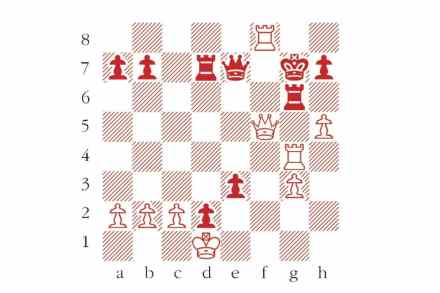
When travel unravels

Recently, with some regret, I declined an invitation to play chess in the Netherlands. I fancied the trip, but alas it made little sense to commit to what would have been a fleeting visit. Travel hurdles have become a Rumsfeldian ‘known unknown’, and sure enough, that country was in lockdown not a week later, requiring quarantine on entry from the UK regardless of vaccination status. Would they ease restrictions in time? It was a relief not to have to think about it. I was mildly bitten last summer, when my plans to play in Germany were left in limbo a couple of months before the start. Owing to what was then called the ‘Indian variant’, travel from the UK was temporarily verboten. But how long would it last?

No. 684

White to play. Abdusattorov–Rakhmatullaev, Uzbek Championship 2021. How did White deliver a pretty mate in two moves? Answers should be emailed to chess@spectator.co.uk by Tuesday 10 January. There is a prize of £20 for the first correct answer out of a hat. Please include a postal address and allow six weeks for prize delivery. Last week’s solution 1 h8=R! Then 1…h2 2 Ra8 Kg1 3 Ra1#, or 1…Kg1 2 Rxh3 Kf1 3 Rh1# or 1…Kh2 2 Kf2 Kh1 3 Rxh3# But not 1 h8=Q Kg1 2 Qxh3 with stalemate.
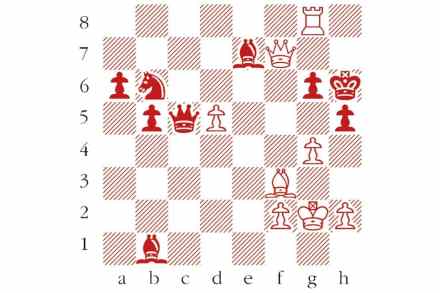
Fresh start

Chess offers one ultimate consolation in defeat: the opportunity to set the pieces up and start again. At least in theory, a new game is a clean slate, and a release from past tribulations. But in practice, sometimes one simply cannot manage to air out the miasma of what came before. In the second half of the world championship match held in Dubai last month, Ian Nepomniachtchi was unrecognisable. Magnus Carlsen had landed a devastating blow in the sixth game, in a match hitherto tied at 2.5-2.5. His win, lasting 136 moves and almost eight hours (see my article of 11 December), seemed to utterly demoralise the challenger. A cascade of blunders in subsequent games allowed Carlsen to retain his title with a 7.5-3.5 victory.

No. 683

White to play and mate in 3. Composed by Albert Barbe, 1861. Only the first move is required, but it’s not as obvious as it looks! Answers should be emailed to chess@spectator.co.uk by Tuesday 4 January. There is a prize of £20 for the first correct answer out of a hat. Please include a postal address and allow six weeks for prize delivery. Last week’s solution 1 Qf3, e.g.
Twelve questions for Christmas

1. ‘I like the game, the money, and the fame.’ Which Twitter-loving top grandmaster said that, in response to an interviewer’s question: ‘What three things do you absolutely love about chess?’ 2. Which former women’s world champion chose to sue Netflix, seeking damages of ‘at least $5 million’ for her portrayal in The Queen’s Gambit? 3. Who described recently, in The Spectator, his experience of being stopped at airport security in Beirut, when his chess set and clock set off the baggage scanner? 4. Which 18-year-old became, at the start of this month, the second ranked player in the world, behind Magnus Carlsen? 5.