Luke McShane

Luke McShane is chess columnist for The Spectator.

No. 702

White to play. Averbakh-Zita, Szczawno-Zdroj 1950. Black has just interposed Rb6-g6, so White needs an accurate finish before e3-e2 mate arrives. What did Averbakh play next? Answers should be emailed to chess@spectator.co.uk by Monday 16 May. There is a prize of £20 for the first correct answer out of a hat. Please include a postal address and allow six weeks for prize delivery.

Remembering Averbakh

Yuri Averbakh had a wry explanation for why he was made chairman of the USSR Chess Federation in 1972. There was a feeling that Boris Spassky, the Soviet world champion, would lose his title to Bobby Fischer in Reykjavik that year. Nobody else wanted to deal with the fallout, so Averbakh got the job. Whatever the truth of that, Averbakh had been deputy chairman for ten years already, and throughout his life showed a tireless appetite for almost every role that chess has to offer. He left his mark on the game as a player, politician, writer, analyst, editor, researcher, historian and arbiter. Yuri Lvovich Averbakh died in Moscow on 7 May, just a few months after celebrating his 100th birthday. He was born in Kaluga, a small city 100 miles from Moscow.

No. 701

White to play. Reshevsky-Savon, Petropolis 1973. Reshevsky played the awful 1 Qxg6+, and resigned after 1…Bxg6. Many moves win, but which one forces mate in just three moves? Email answers to chess@spectator.co.uk by Monday 9 May. There is a prize of £20 for the first correct answer picked. Please include a postal address. Last week’s solution 1 Nf4+! Rxf4 2 h8=B and stalemate follows. Not 1 Ne7+ Bxe7 2 h8=B Bf6!

Gorilla tactics

There is a video in which a small group of students amble about passing a basketball back and forth. The instruction at the start is to count how many times the players pass the basketball. Then comes the punchline – did you see the gorilla? Halfway through, a figure in a gorilla suit walks through the middle of the scene, beats its chest and walks off. It was designed as a psychological experiment, with the startling outcome that about half the viewers missed the gorilla altogether. One explanation is obvious – they were focused on the basketball. But how can you miss a gorilla? Blunders at the chessboard can be just as perplexing. True, some are easily ascribed to nervousness or carelessness. Those are often the ones where you kick yourself right after making the move.

No. 700

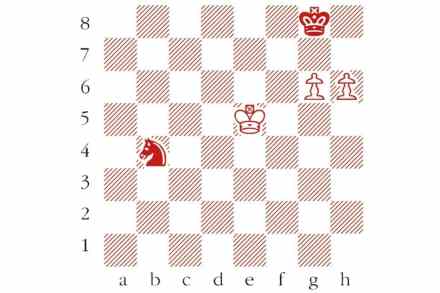
White to play and draw. Composed by Jan Timman, 2011. 1 h8=Q Rxd5 wins for Black, so how does White escape? Answers should be emailed to chess@spectator.co.uk by Tuesday 3 May. There is a prize of £20 for the first correct answer out of a hat. Please include a postal address and allow six weeks for prize delivery. Last week’s solution: 1...Qxe2+ 2 Kxe2 Bg4 is mate.

Ordination

In the dying seconds of an online blitz game, I promoted a pawn and instantly regretted it. There was nothing wrong with the move, but the extra second spent on choosing and clicking the queen was more than I could spare. A few flailing moves later, my time ran out. Of course, I had forgotten to switch on ‘Always Queen’, a handy setting offered by all decent chess websites. Some 99 per cent of the time, a queen is what you want. But just occasionally, a knight, rook or bishop is superior. A knight may land with check, where a queen does not. To see a rook or bishop trump a queen is rarer still, as neither piece has any obvious point in its favour. But it can happen in scenarios where a queen would stalemate the opponent, but a lesser piece would not.

No. 699

Black to play. Sukandar-Niemann, Reykjavik Open 2022. In this preposterous position, Black found a quick forced mate. What did he play? Answers should be emailed to chess@spectator.co.uk by Monday 25 April. There is a prize of £20 for the first correct answer out of a hat. Please include a postal address and allow six weeks for prize delivery. Last week’s solution 1 Rg1!

What is possible

There are lessons in chess that cannot be learned from a book. One lands, from time to time, in a position which amounts to a trial by fire – a test of conviction as much as skill. The experience of such a game can stay with you for ever, radically altering your sense of what is possible at the chessboard. At least, I suspect that is what 13-year-old Shreyas Royal went through last month, when he faced the Georgian grandmaster Baadur Jobava in the first round of the European Individual Championship in Slovenia. Jobava’s peak rating placed him in the world’s top 20, so this was a David and Goliath pairing where at the outset the youngster had nothing to lose.

No. 698

White to play. A variation from Esipenko-Nakamura, Fide Grand Prix Berlin 2022. Which move would allow White to force a win? Email answers to chess@spectator.co.uk by Monday 18 April. There is a prize of £20 for the first correct answer out of a hat. Please include a postal address and allow six weeks for prize delivery. Last week’s solution 1 Nxa5+! Qxa5 2 b4 traps the queen. Black chose 1…bxa5 2 Rb3 and resigned a few moves later.

Nakamura’s place

Wesley So won the final Fide Grand Prix, which was held in Berlin earlier this month. But it was Hikaru Nakamura, his defeated opponent in the final, who had the most to celebrate. Since he won the opening leg in February, in reaching the semi-final Nakamura secured a coveted spot in the Fide Candidates tournament, whose winner will become Magnus Carlsen’s next challenger. The second qualifying spot went to Richard Rapport, who won the second Grand Prix leg in March. The Candidates event will begin in Madrid in June, when the two will be joined by previous qualifiers Ian Nepomniachtchi, Alireza Firouzja, Fabiano Caruana, Jan-Krzysztof Duda and Teimour Radjabov. The final place looks likely to go to Ding Liren, in light of Sergey Karjakin’s disqualification.

No. 697

White to play. Duda-Anton Guijarro, Charity Cup, March 2022. Black’s last move, 21…Qe7-b4 was an unforced error. Which move did White play to exploit it? Email answers to chess@spectator.co.uk by Monday 11 April. There is a prize of £20 for the first correct answer out of a hat. Please include a postal address and allow six weeks for prize delivery. Last week’s solution 1 Rd2! e.g.

Career moves

Sergey Karjakin won’t be playing much chess for a while. Last month, the Russian grandmaster’s Twittering jingoism in support of the invasion of Ukraine drew such universal scorn that his international invitations were bound to run dry. Karjakin challenged Magnus Carlsen for the World Championship in 2016, and had earned a spot in Fide’s forthcoming Candidates tournament, which will begin in Madrid in mid-June 2022. Perhaps he assumed that was one invitation which could not get lost in the post. But then Karjakin’s conduct was brought before the Fide Ethics Commission, which bared its teeth and resolved to ban him from competitive play for six months – long enough to make him forfeit his chance in the biggest tournament of the year.

No. 696

White to play and mate in two. Philip Hamilton Williams, Birmingham News, 1897. Answers should be emailed to chess@spectator.co.uk by Monday 4 April. There is a prize of £20 for the first correct answer out of a hat. Please include a postal address and allow six weeks for prize delivery. Last week’s solution 1 Rd4+! e.g. 1…Ka5 2 Re5#, or 1…Kc5 2 Qd6# or 1…Kc3 2 Qd3# Last week’s winner N.

Varsity battle

The 140th edition of the Varsity Match took place last month at the Royal Automobile Club in London’s Pall Mall. This one was as tense as they come: Cambridge grabbed an early point, but Oxford built a significant lead by winning the next three. On the four boards which remained, Oxford’s situation looked precarious, so Cambridge could still entertain hopes of victory. In the end, Cambridge pulled back a single win, but the remaining games fizzled into draws. That made for a 4.5-3.5 win in Oxford’s favour. The overall series now stands at 60-58 to Cambridge, with 22 matches drawn. The RAC Chess Circle which organises the event has a generous custom of awarding both a best game prize and a brilliancy prize.

No. 695

White to play and mate in 2. Composed by Bo Lindgren, Probleemblad 1969. Answers should be emailed to chess@spectator.co.uk by Monday 28 March. There is a prize of £20 for the first correct answer out of a hat. Please include a postal address and allow six weeks for prize delivery. Last week’s solution 1 Bh6+!

England-Sweden Challenge

Three summers ago, I was invited to the Swedish city of Eskilstuna, for a brief but exciting match against their top player, the affable Nils Grandelius. Earlier this month, Grandelius visited London, this time to play a match against my England team-mate David Howell. The England-Sweden Challenge match was staged as part of the 30th anniversary celebrations of the founding of the London Chess Centre and the relaunch of Chess magazine. It was held in refined surroundings at the residence of Sweden’s ambassador to the United Kingdom, Mikaela Kumlin Granit. Seeing the photos, one yearns to play more chess in rooms with library ladders. The ten-game match saw a striking contrast between Grandelius’s active approach and Howell’s supremely patient brand of chess.

No. 694

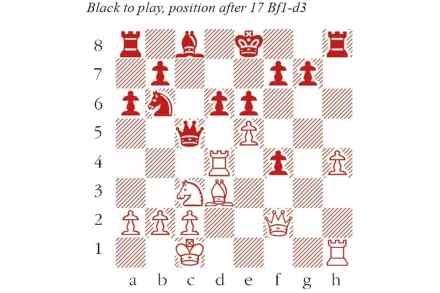
White to play. Rapport-Rogic, Austria 2010. Black threatens Qa1+ and then Rxf2+, so Rapport must strike at once. Which move did he play? Email answers to chess@spectator.co.uk by Monday 21 March. There is a prize of £20 for the first correct answer out of a hat. Please include a postal address and allow six weeks for prize delivery. Last week’s solution 1…Qxc3! Then 2 bxc3 Ba3+ 3 Kb1 Rd1 mate, or 2 Rxc3 Rxg7 and Black should win with the extra bishop.

Establishing Rapport

Richard Rapport took first place at the Fide Grand Prix in Belgrade last weekend. The Hungarian grandmaster is now almost assured of a place in the Candidates tournament in Madrid later this year, which will determine a challenger for the World Championship. Only a very unlikely outcome at the final Grand Prix event (which begins in Berlin next week) would see him knocked out of the cycle. Rapport is popular with fans for his rich imagination and penchant for offbeat openings. In the past, that sometimes made for erratic results, but a newfound consistency has propelled him into the world’s top ten. The diagram position shows the critical moment from the final match. Rapport could repeat moves with 30 Qe3, leading to a draw by repetition in light of the previous moves.

No. 693

Black to play. Shirov-Kramnik, Groningen 1993. Shirov threatens Rg3-h3+ so Kramnik forced a draw: 1…Rxg7+ 2 Rxg7+ Kh6 3 Rg8 Kh7 etc. Which move would have won Kramnik the game? Email answers to chess@spectator.co.uk by Monday 14 March. There is a prize of £20 for the first correct answer out of a hat. Please include a postal address. Last week’s solution 1 Qg8+! Qxg8 2 Rh1# or 1…Kxg8 2 Rxa8+ wins. Other tries lead to stalemate or perpetual check e.g. 1 Qd4 Qd8+ 2 Qxd8 stalemate or 1 Qd1 Qg2+ etc.

Taking risks | 12 March 2022

I do not, as a rule, go looking for a fight on a Sunday morning. Chess, if it must be played at all, should be approached with due caution. My game plan tends to be pretty simple: deploy the pieces onto sensible squares and hope that the coffee kicks in before anything interesting happens. Usually the opponent observes similar norms. Vincent Keymer, 17, is one of Germany’s brightest talents, and he took me by surprise when we met last weekend in the Bundesliga. The opening moves were familiar, so I was looking forward to some stodgy manoeuvring while digesting my breakfast. But his pawn sacrifice with 14…Nf6 forced me to think. Taking it would grant him a mobile pawn centre and strong pair of bishops, but even on a Sunday morning, declining looked a bit too supine.