Luke McShane

Luke McShane is chess columnist for The Spectator.

The Generation game.

The latest flashpoint in the Carlsen-Niemann saga took place in the sixth round of the preliminaries at the Julius Baer Generation Cup, one of the online events in the Meltwater Champions Chess Tour. Ten days earlier, 19-year-old Hans Niemann had beaten Magnus Carlsen over the board at the Sinquefield Cup. Carlsen’s shock withdrawal from that event got the rumour mill spinning, which only accelerated after Niemann’s admission that he had cheated online at ages 12 and 16, although he insisted that those incidents are behind him. In the Generation Cup, Carlsen made just one move against Niemann before resigning, clearly in protest.

No. 722

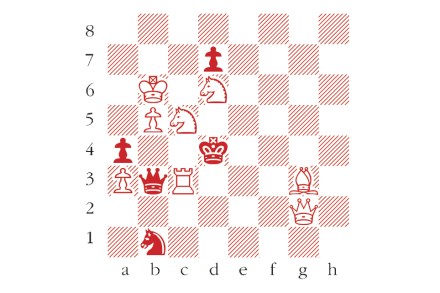
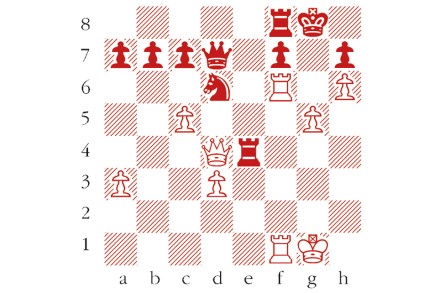
Black to play and win. A variation from the game Aronian-Ivanchuk, Julius Baer Generation Cup, September 2022. Ivanchuk could have reached this position, where he can now win at least a knight by force. What should Black’s next move be? Email answers to chess@spectator.co.uk by Monday 3 October. There is a prize of £20 for the first correct answer out of a hat. Please include a postal address and allow six weeks for prize delivery. Last week’s solution 1 Qa6! Then 1...Kxd2 2 Qh6#, or 1...cxd2 2 Qa1# or 1...

No. 721

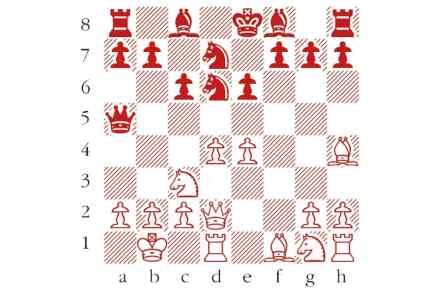
White to play and mate in two moves. Composed by Carl Schlechter, Allgemeine Sport-Zeitung, 1908. What is White’s first move? Answers should be emailed to chess@spectator.co.uk by Monday 26 September. There is a prize of £20 for the first correct answer out of a hat. Please include a postal address and allow six weeks for prize delivery. Last week’s solution 1 Be8! and 2 Bb5 mate cannot be stopped.

Royal’s success

The London Mindsports Centre in Hammersmith opened its doors in 2021, after it was converted from a Salvation Army building. The centre now hosts lectures and tournaments in Chess, Go and Bridge, besides other events. The Mindsports Masters all-play-all events, held earlier this month, were designed with title aspirants in mind. Among them was 13-year-old Shreyas Royal, one of England’s brightest prospects. His international rating has already crossed the 2400 threshold required for an international master title, and at Hammersmith he earned a ‘norm’ – one of three tournament results he will need to qualify for the title. He scored an important win against a grandmaster in the third round.

No. 720

White to play and mate in two moves. Composed by Edith Baird, for The Chess Amateur, 1923. Answers should be emailed by Tuesday 20 September to chess@spectator.co.uk. There is a prize of £20 for the first correct answer out of a hat. Please include a postal address and allow six weeks for prize delivery. Last week’s solution 1 Qxe6+!

Pique or cheat?

In the third round of the Sinquefield Cup in St Louis, Magnus Carlsen was beaten by 19-year old Hans Niemann, the lowest seeded player in the event. The result was surprising, particularly since Niemann played Black, but certainly not inconceivable. The next day, Carlsen announced his withdrawal from the tournament on Twitter, appending a short clip of José Mourinho saying: ‘If I speak I am in big trouble.’ It was widely taken to mean that Carlsen suspected foul play, but was wary of making a direct accusation. So far, he has made no further statement, leaving pundits to fill in the gaps. But the patchwork of evidence remains threadbare.

No. 719

White to play. Cornette-Feller, French Champion-ship, August 2022. Black has just played 13...h7-h6. How did White capitalise on this mistake? Email answers to chess@spectator.co.uk by Monday 12 September. There is a prize of £20 for a correct answer out of a hat. Please include a postal address and allow six weeks for prize delivery. Last week’s solution 1 c3! Qxf4 2 g3! wins.

Chess speaks for itself

‘Plug the fucking laptop in!’ Hans Niemann, the lively 19-year-old from the US, was left fuming – understandably – after his loss to Jan-Krzysztof Duda at the FTX Crypto Cup in Miami. The organisers set up the equipment, but Duda’s laptop ran out of juice at a tense moment when both players had about a minute remaining. By the time it was resolved, Duda had gained several minutes to think and found an accurate continuation, posing difficult problems in the endgame. An exasperated Niemann lost the game, and collapsed in the next two as well, losing a clean 3-0 sweep in the four-game match. The technical mishap was all the more absurd since the players were all at the same venue in Miami, and could just as well have played mano a mano.

Match of the half-century

They called it the Match of the Century. A full 50 years has passed since Bobby Fischer defeated Boris Spassky in Reykjavik, thereby becoming the 11th world champion. On 1 September 1972, Fischer won game 21 to win the match by 12.5-8.5. I enjoyed the perspective of a new book, The Match of All Time by Gudmundur G. Thorarinsson. (New in Chess, 2022, though first published in Iceland in 2020). Indeed, it is hard to imagine that the exceptional dramatic backdrop – an American against a Soviet in the midst of the Cold War – will ever be equalled. In 1972, Thorarinsson was president of the Icelandic Chess Federation, and one of the key figures in the organisation of the match, which was so nearly derailed many times over.

No. 718

White to play and win. Composed by Alexey Troitsky, Novoye Vremya, 1895. Trapping Black’s queen looks unimaginable on such an open board, but it can be done. What is White’s first move? Answers should be emailed to chess@spectator.co.uk by Monday 5 September. There is a prize of £20 for the first correct answer out of a hat. Please include a postal address. Last week’s solution 1 Qg6! threatens Qxg7 mate.

No. 717

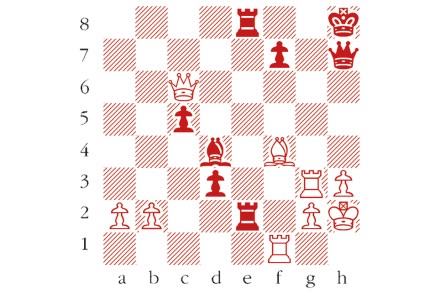
White to play. Gormally–Claridge-Hansen, British Championships 2022 Black’s last move, Ra8-a7,was a fatal mistake. Which move won the game for White? Answers should be emailed to chess@spectator.co.uk by Monday 29 August. There is a prize of £20 for the first correct answer out of a hat. Please include a postal address and allow six weeks for prize delivery. Last week’s solution 1…Rg3! 2 Qxg3 Rxf1+ 3 Kh2 Ng4+ 4 Kh3 Rh1+ 5 Kg2 Rg1+ wins. But not 1…Qc8 2 Rf3!

A week in Torquay

Hats off to Harry Grieve, who took clear first place at the Chessable British Championships which concluded in Torquay last Sunday. I am in awe of the courage he showed in the final round game, against the international master Matthew Wadsworth. Grieve set the tone in the opening, sacrificing rook for bishop, but gaining long-term compensation. Wadsworth reacted well, but let his advantage slip, whereupon Grieve doubled up his investment. After several hours’ play, they reached the murky position shown below. Matthew Wadsworth–Harry Grieve Chessable British Championship, Torquay 2022 50...Qb7 The mate threat on b1 forces White’s hand. 51 Rxd3 cxd3 52 Qc3 Qa6 53 Qb3 Ke4! This move looks right, when I see it, but it takes real guts to play it.

No. 716

Black to play. A variation from McShane-Hamitevici, Chennai 2022. I avoided this position, but lost in a different way. White would be three pawns up, but facing a fierce attack. Which move wins the game for Black? Answers should be emailed to chess@spectator.co.uk by Monday 22 August. There is a prize of £20 for the first correct answer out of a hat. Please include a postal address and allow six weeks for prize delivery. Last week’s solution 1 Qxh7+!

The first Olympiad

Everyone remembers their first Olympiad. As I boarded the flight to Chennai last month, it struck me that two full decades have passed since my Olympiad debut in Bled, 2002. Respectable in the seniority stakes, though one of the charms of this biennial team event is that you can count on meeting someone excited to reminisce about Dubai 1986, or perhaps Lugano 1968, and who hasn’t missed one since. This year, teams from around 200 nations – perhaps 2,000 players in all – made the trip to India. The event was moved from Moscow with just a few months’ notice, but any fears about the hasty organisation were quickly allayed.

No. 715

White to play. Navara – Batsuren, Chennai Olympiad 2022. In this strange position Czech grandmaster David Navara found an elegant way to conclude the game. Which move did he play next? Answers should be emailed to chess@spectator.co.uk by 16 August. There is a prize of £20 for the first correct answer out of a hat. Please include a postal address and allow six weeks for delivery. Last week’s solution 1...Qxg2+ White resigned, as 2 Bxg2 Nxe2+ and 3...Nxc3 leaves Black with a winning advantage.

India’s young stars

At the Chennai Olympiad, the Indian team began as second seeds, even with former World Champion Vishy Anand absent from the lineup. But it is the host country’s privilege to field more than one team, and India used its second team to showcase the next generation of talent. This team, which included three 16-year-olds, even won bronze, narrowly ahead of the first team. The gold medals went to another team of exceptionally talented youngsters from Uzbekistan, while Armenia took silver. Dommaraju Gukesh, who was born in Chennai, produced an astonishing performance on board 1 for the second team. He began with eight consecutive victories, including a victory over former World Championship challenger Fabiano Caruana.

No. 714

Black to play. Smirnov – Duda, Chennai Olympiad 2022. With his next move, Duda forced a decisive gain of material. What did he play? Answers should be emailed to chess@spectator.co.uk by 9 August. There is a prize of £20 for the first correct answer out of a hat. Please include a postal address and allow six weeks for prize delivery. Last week’s solution Last week’s solution: 1 Qh8! Depending on Black’s response, mate follows with Qb8, Qf8, Qe5 or Qd4. Last week’s winner Richard Booth, Cheltenham, Glos.

A lucky escape

I chatted to a spectator after one of my games at the Sparkassen Chess Trophy in Dortmund. ‘A close shave today, wasn’t it?’ he began. ‘Yes, I can’t believe my opponent escaped with a draw.’ ‘No, I think you were losing.’ ‘Oh, but didn’t you see my beautiful mating idea with b5?’ ‘There’s a fly in the ointment – have another look,’ he said. [The penny drops, eventually.] ‘Oops. Ah well, better lucky than good!’ Fortunately, my opponent shared my delusion during the game. And doubly so, in that my misplaced confidence spared me the need to conduct an arduous defence. My opponent has just snatched a pawn on a3. After 39 Rf4 Re8 40 Rff7 Rb8 my rooks would hit a brick wall.

No. 713

White to play and mate in two. Composed by Henri Rinck, La Strategie, 1892. Answers should be emailed to chess@spectator.co.uk by Monday 2 August. There is a prize of £20 for the first correct answer out of a hat. Please include a postal address and allow six weeks for prize delivery. Last week’s solution 1 Rc2!

Heavy is the head

On International Chess Day, 20 July, Magnus Carlsen announced that he will not defend his world championship title next year. The Norwegian won the title in 2013 by beating Viswanathan Anand in Chennai, and went on to defend his title against Anand once more, then Sergey Karjakin, Fabiano Caruana and most recently Ian Nepomniachtchi. Carlsen stressed that he has no intention of retiring. In fact, his stated goal is to keep improving, unencumbered by the grind of preparing for a new world championship match. (Each one might easily demand six months of preparation.) Reaching an international rating of 2900 is still a target he has in mind, though that Everest remains a long way off.