Isabel Hardman

Isabel Hardman

Isabel Hardman is assistant editor of The Spectator and author of Why We Get the Wrong Politicians. She also presents Radio 4’s Week in Westminster.

Tory policy chief: party needs Beveridge-style commission to survive

The Conservative Party appears rather burnt-out at the moment. At its conference - even before Theresa May’s disastrous speech - it seemed to be the Knackered Party rather than the Nasty Party that the Prime Minister herself had warned about so many years ago. But it is still in government, and desperately needs to find new ideas and reasons to exist while also negotiating Brexit and dealing with unexpected scandals, such as the allegations swirling around Westminster at the moment of impropriety from Cabinet ministers. When parties are knackered, they often find a period of opposition to be a comfort, a chance to have the sort of debate about policy that you just don’t have time for in government.

Why the Westminster ‘sex pest list’ has existed secretly for so long

Westminster is agog with whispers about who the Tory MPs are on a list of men and women alleged to be guilty of inappropriate sexual behaviour, sexual harassment and worse. Some names have been circulating for years, with many women across the Parliamentary Estate saying they have their own story about this MP or that minister. So why is it only now that there’s a threat to make the list public? The Harvey Weinstein allegations have prompted women - and men - in every industry to realise that they don’t have to just grin and bear bad behaviour as though it’s just an unfortunate side-effect to having your dream job.

Theresa May can’t just expect employers to solve the mental health crisis

Theresa May made mental health one of her key policy issues when she became Prime Minister, and it was supposed to be a key part of her relaunch after the snap election too. So far, though, the Prime Minister has done a fair bit of talking, and not a huge amount of doing. The big mental health launch in January involved very little money and a lot of worthy words about lifting the stigma. Worthy words are handy, given some people do still encounter a great deal of stigma when they are mental, rather than physically, ill. But the thing about being Prime Minister is that you can do a lot more than talk if you want.

The Tories are playing a risky game with Jared O’Mara

Why do politicians constantly bring plagues on their own houses? This week, the Tories have embraced the Jared O’Mara allegations with gusto, prompting Theresa May to speak about it at Prime Minister’s Questions, calling for emergency debates and writing letters about the matter. Some Labourites have been responding by pointing out that it’s highly unlikely the Tories will be entirely clear of sexists themselves. Of course, the Labour point is being deployed as whataboutery to distract from the party’s own nightmare with its Sheffield Hallam MP.

Did the Labour whips know about the Jared O’Mara allegations?

How did Jared O’Mara end up in Parliament, and will he remain there for much longer? Today he was suspended from the Labour whip, and an investigation was launched into the allegations about his online posts and conversations, including an allegation that he used misogynistic and transphobic language to a constituent this year. The suspension happened just before Prime Minister’s Questions, and after the session, Jeremy Corbyn’s spokesman said the party had acted today because the latest claims, which O’Mara disputes, related to more recent behaviour.

Tory whips in a quandary over Labour social care challenge

If ministers are going to offer any concessions in the row over Universal Credit, they’ve decided to keep them back for a little while longer. This afternoon MPs have been holding an emergency debate on the reform, with Employment Minister Damian Hinds defending the reform and the roll-out, rather than suggesting that the government is going to accept the suggestions of Tory and Labour MPs on delayed payments. The emergency debate was called after Conservative MPs were whipped to abstain on Labour’s Opposition Day debate on the benefit reform last week.

Will Universal Credit conform to the normal pattern of policy disasters?

How far is the government going to row back on Universal Credit? This afternoon an emergency debate has been granted on the matter in the Commons tomorrow. Two of the pilot councils in the roll-out of the new benefit have warned that the new system could be a catastrophe once implemented fully, predicting rent arrears in ‘many hundreds of millions of pounds’ and reporting a huge surge in referrals to food banks. Southwark and Croydon Councils warned of ‘major flaws’ in UC, and urged the government to fix the policy immediately. The pressure, which grew last week with Labour’s Opposition Day debate on the roll-out, hasn’t diminished since ministers said they would make the helpline for claimants a free number, rather than one that charged 55p a minute.

Theresa May discovers the perfect answer to difficult Brexit questions

Theresa May has the perfect answer to all difficult questions: we don’t want to give away anything that will harm our position in the Brexit negotiations. No matter whether the information an MP is requesting has anything to do with Britain’s negotiating position: it’s a handy line to use when the answer is in fact ‘I don’t actually know’. The Prime Minister deployed this argument about not wanting to undermine the negotiations several times as she took questions from MPs in the Commons following her statement on last week’s European Council summit.

Ceci n’est pas une no deal, says Macron

This post is from tonight's Evening Blend email, a free round-up and analysis of the day's politics. Sign up here. Is the government really changing its policy on planning for a no deal? That question isn’t simple to answer, not least because it’s not entirely clear what the government’s policy is on this matter: Philip Hammond has said the government won’t spend the necessary money until it needs to, while Theresa May says whatever money needs to be spent will be spent. But the pressure has been rising from Brexiteers for ministers to make real plans and produce real money to ensure that those plans are implemented.

Tory MPs threaten to rebel and vote for government policy

The talk of the Commons tearoom today is last night’s Opposition Day vote on Universal Credit. This is unusual: Opposition Day votes are non-binding and have recently been used largely for Labour to bang on about pet projects rather than hold the government’s feet to the fire. But the Opposition has sharpened up its act, and used growing Conservative concerns about the roll-out of the new benefit to good effect in yesterday’s debate.

Ministers may have to withdraw the EU Withdrawal Bill for a long time

So the EU (Withdrawal) Bill has been delayed once again, with Andrea Leadsom confirming a ‘pause’ to MPs this morning. The legislation is so weighed down with hundreds of hostile amendments that the whips daren’t take it anywhere near the Commons, and are trying to work on compromises with the many different groups of rebels in order to avoid a series of embarrassing defeats. Leadsom told the Chamber that ‘out of respect for this House, the Government are doing justice to the very significant concerns that have been raised about procedures and policy in the EU (Withdrawal) Bill, and it will come back to the House just as soon as the Government are prepared to do justice to the new clauses and amendments that have been tabled by Members’.

Hunt the lady’s slipper

Who would want to read a whole book about a teenage boy’s gap year? When most 18-year-olds take time off before university, they either head for Thailand to experience middle-class Western culture in warmer climes with more drugs, or spend six months shelf-stacking and six months ‘finding themselves’ at a Ugandan orphanage. A tedious evening in the pub during freshers’ week when all the gap year students bore one another into submission about how much better Mexico made them is normally enough. Leif Bersweden thought so much of his year off, though, that he wrote 360 pages about it.

There’s plenty to be suspicious about in the Weinstein row

Why are all the women involved in the Harvey Weinstein allegations only speaking out now? That question has been asked repeatedly - including on this blog - since the accusations against the film mogul first emerged. Why now? Ross Clark suggested on Coffee House yesterday that women who had achieved what some of the actresses and UN goodwill ambassadors had managed should be brave enough to speak out about someone who appears to have been a serial predator over many years - but that they failed to do so because their allegations date back to when they were ‘on the make’. It’s a fair point, isn’t it? But isn’t it just a little odd that a slightly different species of fair point tends to appear whenever any sort of woman complains about abuse and assault?

Theresa May’s bid to sound authoritative at PMQs falls flat

Today’s Prime Minister’s Questions wasn’t exactly comfortable for Theresa May, but neither was it catastrophic. The session has been running along the same lines since the snap election result: Jeremy Corbyn has plenty of material to play with in terms of a government in disarray that isn’t confronting some of the most important domestic issues, but he never really manages to leave May looking less authoritative than when the session started. Today he focused on the problems with the roll-out of Universal Credit, which is spreading from being the concern of welfare policy specialists in parliament to being a political row.

Brexit could ensure social care gets the reform it badly needs

Theresa May had planned to move the political focus this autumn from Brexit to domestic priorities. That was always a tall order when the next round of negotiations and this month’s EU council are looming, but it’s particularly difficult given the Prime Minister managed to lose, not gain, authority with her conference speech. It's also made harder given that her statement in the Commons yesterday seems to have enraged Brexiteer MPs, who were willing her on before the conference speech fiasco. One senior eurosceptic MP told Coffee House after the admission that the European Court of Justice would still have a role during the Brexit transition that he and colleagues were ‘extremely surprised as this was quite the opposite of what we had been led to believe’.

Theresa May needs to promote new ideas, not just new names

Theresa May is threatening a reshuffle - and would be wise to threaten it for as long as possible as the only thing more problematic than naughty ministers you need to move is angry ex-ministers who didn’t want to be moved. Katy looks at who the Prime Minister could move in this post here, and points to a desire for new talent in the government. Promoting the next generation would achieve two things. Firstly it would energise a rather grey government (impressive, given the grey government is opposed by a party led by Jeremy Corbyn and John McDonnell).

How powerful can the Tory Universal Credit rebellion really be?

One of the brewing Tory rows of the autumn looks to be over Universal Credit, with Heidi Allen now claiming she has 25 Conservatives prepared to rebel on the matter. They are worried about a number of aspects of the fiendishly complicated reform which is supposed to make the benefit system less, er, fiendishly complicated. Chief among their worries is the six weeks that claimants have to wait for their benefits, which is a long period in itself, but almost a quarter of claimants have had to wait even longer than that to receive their money, leaving many of them unable to buy food.

Andrew Mitchell to speak at plotter Grant Shapps’ dinner tonight

Grant Shapps isn’t the most popular man in the Tory party at the moment, but at least he has a friend to keep him company this evening. By sheer coincidence, Andrew Mitchell has long been booked to speak at the Welwyn Hatfield MP’s Conservative Association annual dinner tonight. But Mitchell is very keen not to appear to be a fellow plotter, having given a speech at the Cambridge Union last night in which he praised the Prime Minister’s ‘courage of high order’ for completing ‘what was an important and interesting speech in impossible circumstances, and I think all of us in politics should recognise that’.

Whether Theresa May survives depends on two things

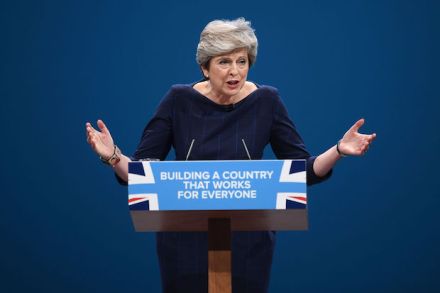
Is Theresa May now doomed after her conference speech went so badly wrong? Tory MPs were yesterday so shocked by all the mishaps that it took them a few hours to realise that underneath all the things that weren't May's fault – such as the P45 stunt and the set falling apart – were a lot of things that the Prime Minister really was responsible for. The speech was not the bold, re-energising address that May needed to give. It contained pale policies which seemed pale red, not true blue. There are ministers who see this as an opportunity to move against their leader. There are Boris allies who have recovered their bewilderment at what their man was up to this week sufficiently to start calling privately for a leadership election before Christmas.

Theresa May’s British Nightmare

Theresa May is not the first political leader to try to pitch the idea of a 'British Dream' when most British people aren't even sure if it exists in our culture. Michael Howard spoke about it in 2004, while Ed Miliband adopted the 'Promise of Britain' temporarily while he was trying to find his feet as Labour leader. So it's not just the first time that a party leader has tried to talk about the British Dream, it's also not the first time a leader whose authority is shaky has tried to talk about it. As Miliband and Howard showed, the British Dream doesn't seem to stick as a political idea. It certainly didn't work as a theme in May's speech, which turned into one of the unluckiest political nightmares in recent history.