Isabel Hardman

Isabel Hardman

Isabel Hardman is assistant editor of The Spectator and author of Why We Get the Wrong Politicians. She also presents Radio 4’s Week in Westminster.

Joint Ukip candidates is Farage’s second best option

Nigel Farage has stirred up talk again this morning of joint Conservative/Ukip or Labour/Ukip candidates. This has been doing the rounds ever since the Ukip leader mooted it in an interview with James in the Spectator, but neither main party is keen. The reason is that this would effectively outsource candidate selection to someone outside the Conservative or Labour party: only candidates Ukip considered sufficiently 'sound' according to its own standards would get the Farage kitemark, and therefore local parties with Ukip breathing down their necks might be tempted to choose a more Ukippish type to stand for them than otherwise. But there's another point worth making about the joint ticket.

Carnival of the Ukippers

Ukip's we're-not-racist ethnic minority carnival in Croydon always looked as though it was going to provide plenty of material for sketchwriters and critics. It was another attempt by the party to showcase its non-white members and candidates, with local candidate Winston McKenzie on hand too. But the event aimed at spinning a line about the party's open-mindedness spun out of control. The steel band told journalists they didn't know they'd been booked by Ukip, and were pretty unhappy about it too. Then a group of protesters accused the party of being Nazis. Then McKenzie, explaining why Nigel Farage had pulled out of attending the event, described the town he is standing for election in as a 'dump' and 'unsafe' because it had been failed by successive governments.

Exclusive: Leading Tory eurosceptic calls for Cameron to ditch net migration target

The next set of net migration figures are, conveniently, released on the day of the European and local elections. Some wonder whether this will add grist to the mill of those on the Tory Right who want to cause trouble for Cameron as they can demand that he crack down further on immigration. But I've discovered that if there is one demand eurosceptics will make, it will be for the Prime Minister to scrap the target, rather than try harder to meet it. The reasoning behind this is that the Prime Minister could argue that freedom of movement in the European Union makes it impossible for the Conservatives to have any real chance of meeting this target, save by introducing ever-tougher restrictions on non-EU immigration.

Inflation rises – should the coalition be worried?

Inflation has risen for the first time in ten months, with the consumer prices index growing by 1.8 per cent in the year to April 2014, up from 1.6 per cent in March. [datawrapper chart="http://static.spectator.co.uk/09O5L/index.html"] On the surface, this looks like bad news for the Coalition, which has boasted that falling inflation shows that Ed Miliband's cost-of-living crisis is coming to an end. And certainly Labour has tried to capitalise on the rise already, with Shadow Treasury Minister Catherine McKinnell saying: 'These figures underline why this Tory-led government is wrong to be so complacent about the cost-of-living crisis.

Is he or isn’t he a racist? Why politicians don’t want to give a straight answer about Farage

Mainstream politicians, never known for giving a straight answer, have been giving particularly wibbly and unclear responses to one particular question today. Is Nigel Farage a racist and was what he said about Romanians moving in next door racist? Ed Miliband did pick a particularly tortured definition of what Nigel Farage had said when asked about it on the Today programme. It was a 'racial slur' but Farage is not a racist, or at least, Miliband didn't want to make politics more 'disagreeable' by accusing Farage of being a racist. But he did say that Farage was right to apologise. Helpfully, Nick Griffin pitched in to tell BBC News that Farage wasn't racist, presumably on the basis that it takes one to know one.

The danger for Miliband of being too confident about his anti-business stance

Why is Ed Miliband so content with accusations that he's anti-business and a bit of a lefty? The Labour leader was grilled this morning on his relations with business leaders when he appeared on the Today programme, and while he did an adequate job of defending himself, he didn't seem too perturbed by the questions levelled at him, nor the suggestion that his party is bleeding votes to Ukip. Why is he displaying such zen-like calm? listen to ‘Miliband: UK 'one of worst developed countries' over low pay’ on Audioboo The reason is not just the Labour leader's intellectual self-confidence but also because the former is a way of solving the latter.

On the road with the Tories

The Conservatives are holding another one of their road trips tomorrow, this time to Chester and Cheadle, where about 120 activists and MPs will hold a 'day of action' where they canvass and campaign in the constituency. The last one was in Enfield a few weeks ago, where the sitting MP Nick de Bois is fighting to hold onto his 1,692 majority. The City of Chester is held by Conservative MP Stephen Mosley with a 2,583 majority, while Cheadle is currently a Lib Dem seat, with Mark Hunter sitting on a 3,272 majority and the Tories in second place. Obviously these campaign days help those MPs or candidates fighting in the respective constituencies.

MPs on holiday: the truth about what they really get up to

MPs are now in recess. Again. Cue plenty of moans about them escaping the zombie parliament and jetting off on holiday. There's not much you can do about the former, but the latter is not, as any MP will angrily remind you, quite true. If you're a type with a big majority who is a bit fonder of the Westminster game than you are of your constituents, then a holiday might be an option. But at this time of year, MPs are more likely to be found canvassing for the European and local elections, or holding extra constituency surgeries to catch up on time lost to Parliament. The Conservative whips have told MPs, via one of their many text messages that they send throughout each day, that they are expected to visit Newark three times before the by-election, and that few exemptions will be allowed.

Pfizer boss Ian Read introduces MPs to his ’empowerment coin’

Who gets the best deal from Pfizer's proposed takeover of AstraZeneca? On the basis of today's Business, Innovation and Skills select committee hearing with some of the key players, the answer is probably Conservative MP Brian Binley. He was very much enjoying his role in the hearing as he interrogated the boss of Pfizer, Ian Read, and his colleagues Frank D'Amelio and Jonathan Emms. Binley managed to get the best one-liners out of the session (he's got form: this is the MP who has in the past few years managed to describe his Prime Minister as a 'chambermaid' and a 'janitor'), telling the panel that they offered 'a lot of sales talk, but short on facts', and accusing Read of being a 'salesman'.

Whitehall is falling in on Nick Clegg

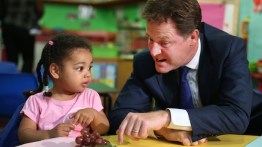
The Cold War that everyone in Westminster thought would never kick off is well and truly under way. Time was when ministers and advisers imagined that the letters and internal briefing documents detailing the dirty laundry of this government would stay firmly locked in Whitehall desks. But in the past few weeks, the leaks have increased, and they seem to be spreading around the village. Nick Clegg was confronted with the latest on the World at One this afternoon: a document showing that the Cabinet Office has given the Deputy Prime Minister's favourite free school meals policy a red rating, meaning it is at risk of failing.

Labour poll blow: party anger could focus on shadow cabinet

What will the Labour fallout, if any, from today's polls, be? Generally when this sort of bad news befalls to the Conservative party, the gossip turns quickly to David Cameron's standing as leader. But in the Labour case, it's a bit more complicated. This is partly because the party tends to feel far more loyal to Miliband than Conservative MPs do. They feel as though he tends to invest in them personally - even those who didn't support his leadership or are unhappy with his policies. And so they're less likely to turn on him. The knives have already been out for Douglas Alexander for some time, with shadow cabinet members talking more and more about their frustration with key aspects of the party's campaign for the European elections and for the general election.

Second poll lead is perfectly- timed gift for Tories

The inconvenience of the Newark by-election notwithstanding, the Tories have had the perfect preparation for a drubbing in next week's European elections. They've told everyone who even stops for a second on the pavement next to them that they're expecting a difficult time and thus have managed the expectations of the party both at a parliamentary and grassroots level. They've seen the increased media scrutiny of Ukip as a sign it is ok to attack the party, albeit not using insulting language. They've tried to keep MPs busy with campaign days, rather than plotting in Portcullis House. And now they've reached the point Labourites feared, when the two parties have crossed over in the polls.

Knives still out in Coalition sentencing fight

What will become of the other big coalition row that's burning away alongside free schools? David Cameron was asked today about the plans to introduce mandatory sentences for repeat knife offences, and made some very supportive noises again, which the Tories signed up to Nick de Bois' amendment to the Criminal Justice and Courts Bill think is a sign that they've made the right decision. He suggested that Nick Clegg could change his mind about it - and some have taken this as a sign that there's a compromise on the cards. The Conservatives tell me they are 'looking carefully' at de Bois' amendments, but the Lib Dems say they haven't heard of any compromise being offered and they will only accept a deal that has evidence behind it that it would cut knife crime.

Gove uses urgent question on free schools to trumpet his achievements

Even though the row over free schools has nothing to do with the Labour party, it took a reasonable bet that it would benefit from joining the fray by asking an urgent question on the allegation that Michael Gove diverted £400 million from basic need funding to the free schools project. In the Commons this afternoon, Tristram Hunt accused the Education Secretary of lacking 'self-control and focus' and paying for 'pet political projects in expensive, half-empty, underperforming free schools'.

The Lib Dems no longer support school choice

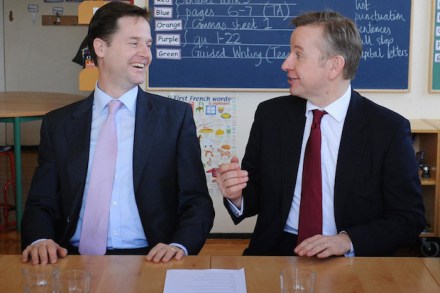
Throughout this latest, blazing Coalition row over Michael Gove - which is spreading like fire over dry heath and has now ignited the normally harmonious Treasury - the Liberal Democrats have insisted that they support free schools. They argue that it is simply Gove's 'zealotry' in transferring £400 million from the basic need allocation to the free schools project, not the principle of free schools. They are indeed mostly needled by years of working with a man who they find difficult to work with, and whose enthusiasm for certain aspects of education, whether it be free schools or the history curriculum, irritates them.

Will voters feel Cameron’s confidence about European reform?

Why is David Cameron so confident that he'll get what he wants from his renegotiation of Britain's relationship with Europe? Today on the Andrew Marr Show he managed to advocate Britain voting 'yes' in the 2017 referendum before he's even started changing the terms of the membership voters would be backing. His reasoning for this was firstly that 'I'm someone who has a very positive, optimistic plan for this country' (a convenient contrast with Ukip), and secondly because he has a good track record of getting what he wants in Europe.

Where is Labour’s intellectual self-confidence?

What a funny, contradictory week it has been for Labour's campaign machine. First Ed Miliband told the Evening Standard that he had greater intellectual self-confidence than the Prime Minister - and won praise in the Spectator's leading article for being someone who does indeed have the courage of their political convictions these days. Then he seemed so confident of his policies that he chose to needle David Cameron with one of them at Prime Minister's Questions. But then he seemed to have a crisis of confidence and decided to produce a party-political broadcast that, er, didn't mention anything Labour is up to at all. When I blogged about this latest offering from Labour on Wednesday, I said it was an example of class war with wit and panache.

Tories and Lib Dems will want to break the rules if there’s another Coalition

The Coalition has been much more of a success than anyone could have predicted when it formed in 2010. It hasn't just held together for spending cuts, but has passed important reforms to welfare and education. It's important to repeat that now, when the partnership is growing increasingly tired and snappy. The parties spent yesterday pecking at one another over whether or not to introduce tougher mandatory sentences for repeat knife offences. They won't produce a Queen's Speech bursting with legislative excitements, either. But one of the things that this Coalition has shown us is that it's not just the policy red lines that make a difference to whether a government of more than one party can be radical: it's the plumbing too.

David Cameron gets bullish on European elections: but what’s his clean-up plan?

David Cameron has now decided that rather than pretend Ukip don't exist, he's going to attack them, and do so repeatedly. This morning on BBC Breakfast, the Prime Minister remarked that 'we've seen some extraordinary statements from Ukip financial backers and candidates and I think it does go to the issue of the competence of the party: what on earth are they doing selecting people and allowing people like this to be in their party'.

It’s not up to Cameron whether he survives a ‘Yes’ vote in Scotland

David Cameron may well have privately resolved that there is no cause for him to step down if Scotland votes for independence in a few months' time, as per James Chapman's scoop today. But the problem is that it is not in the Prime Minister's gift to make that decision. He may well say that he isn't going to resign, but that would have no effect on the number of letters that would be sent to 1922 Committee chairman Graham Brady demanding a leadership contest. It's not as though the Tory party will reel from the shock of Scotland leaving, then wait to see what the Prime Minister says and then if he says he's staying, they all get back to their day jobs.