Douglas Murray

Douglas Murray

Douglas Murray is associate editor of The Spectator and author of The War on the West: How to Prevail in the Age of Unreason, among other books.

Hague’s misplaced optimism

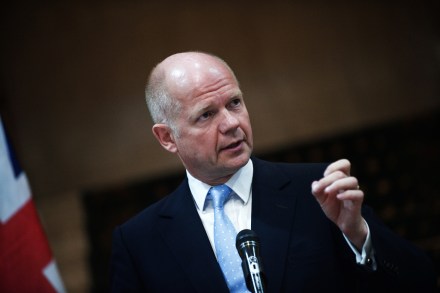
William Hague has an article in the Times today arguing against what he refers to as the ‘pessimism’ of those who have expressed concerns about the direction of the ‘Arab Spring’. As somebody who cannot see the virtue of either optimism or pessimism as policy, and preferring facts to moods, I think the Foreign Secretary’s central points should be answered. Particularly as he chose so injudicious a day to publish his piece. Mr Hague’s argument against pessimism is that ‘such pessimism misses the extraordinary opportunities that popular demand for freedom and dignity bring’. Certainly the government of which Mr Hague is a part is not missing any opportunities.

How democracy fared in 2011

Even before we were a month in, 2011 was an historic year. Principally because in a region of the world where governments shift through military coup or foreign intervention, dictators fell — and others tottered — thanks to local popular uprisings. Whatever the outcome of those events (and I have expressed my fears elsewhere, here) they remain a landmark worth observing. Whether or not the coming years are any good at all for them, 2011 was a great year for democrats in the Middle East. In the older democracies of the West, however, 2011 was more disconcerting.   If anyone doubts this, consider the following experiment. It is the beginning of any year other than this one over the last two decades.

Remembering Christopher Hitchens

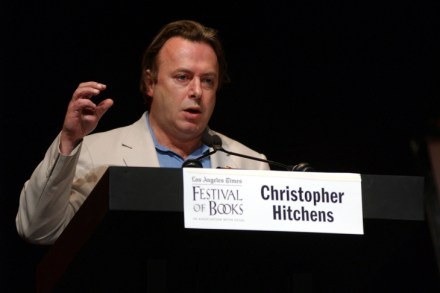
Just one of Christopher Hitchens’ talents would have been enough for most people. In him those talents — like his passions — all melded into each other: as speaker, writer and thinker. Yet he was more than the sum even of these considerable parts, for he possessed another talent that was even rarer — a talent for making us, his readers, want to be better people. He used his abilities not to close down questions and ideas, but to open them up. In the process he made you, the reader, aware that you needed to do more, engage more, think more and know more. Writers often feel a need to impress their readers. Christopher made his readers want to impress the writer. I remember the exact moment I first heard his name. It was the summer of 2000.

After spring, winter

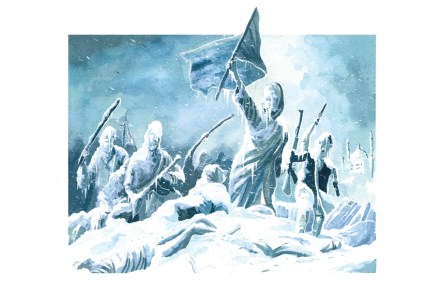
Spring was a long time coming in the dictatorships of the Middle East and North Africa. But when it arrived it was unhesitatingly welcomed by western leaders. William Hague declared the Arab Spring more important than 9/11 and the financial crisis. Barack Obama delivered one of his most mellifluous speeches on the subject. Everyone hoped for the best. But hope, we were reminded, is not quite enough. The shooting of protestors in Tahrir Square by the Egyptian army is the latest sign of something the West seems in no mood to admit: the Arab Spring is giving way to an Arab winter. In the last year we saw uprisings topple regimes in Tunisia, Egypt and Libya. But it is far, far too early to celebrate.

The worst form of censorship

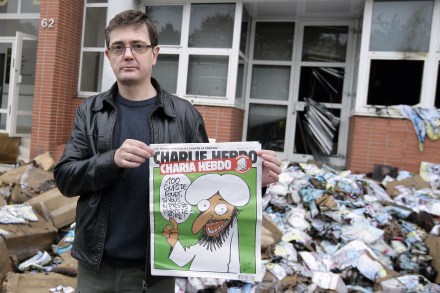
A week ago, the offices of the French satirical paper Charlie Hebdo were burned down. This attack came after it advertised the founder of Islam, Muhammad, as 'editor-in-chief' of the new issue. The move was a light-hearted response to the very serious matter of the election of an Islamist party (the Ennahda party) as the leading party in Tunisia (a result which, incidentally, appears not to have greatly bothered most European media). As the staff of Charlie Hebdo contemplated the ruins of their magazine, a much grander and richer magazine, Time, ran one of those pieces which have become familiar whenever there is an Islamist assault against free speech.

The paucity of the “99 per cent”

A week may be a long time in politics, but it is no time at all in protest. As the inhabitants of Parliament Square have demonstrated, even a decade is as nothing so long as you have a constantly morphing cause, a council with no balls, and a small but steady stream of acolytes. Last weekend I watched a bridal party sneak in through the side entrance of St Paul's Cathedral. This weekend I went back, curious to see whether the protest that had kept them from entering through the main door had located a point yet. Walking up from Fleet Street the first sight that greets the visitor is a large banner saying 'root out usury.' A surge of Presbyterian nostalgia powered through me. Perhaps I could identify with this protest after all?

The End of a Delusion

The sight of Colonel Muammar Gaddafi blood-stained and bewildered, pulled around by a crowd in the final moments of his life is not a sight that will cause much pity. For more than four decades he had none for those Libyans whom he repressed and killed — anymore than he had for the victims on Pan Am Flight 103, his other multiple acts of terrorism, or his pointless and bloody interventions across Africa. Yet there is something pitiful about it: perhaps most obviously because watching his end is to watch the end of a delusion. Even more than Saddam Hussein crawling out of a hole in the ground and saying that he wanted to negotiate, the sight of Gaddafi coming out of a soil-pipe armed with a golden gun seems the perfect example of reality catching up with the autocrat.

Skeletons in the closet

Britain must publish the truth about Irish presidential candidate Martin McGuinness – before it’s too late Martin McGuinness is standing for the presidency of a cash-strapped Ireland. Soon after this paragraph is printed he may be among the world’s heads of state. If so he has promised to refuse the €250,000 salary and subsist on the minimum wage. It is ‘high time’, he has stated, that ‘those at the top shared the pain’. That McGuinness has had a lifelong interest in so doing is a point that should not need making. But, like his old colleague Gerry Adams, he is now trying to change history — not the future, but the past — by professing amnesia about his role in many murders over a 30-year period.

Why conservatives should welcome gay marriage

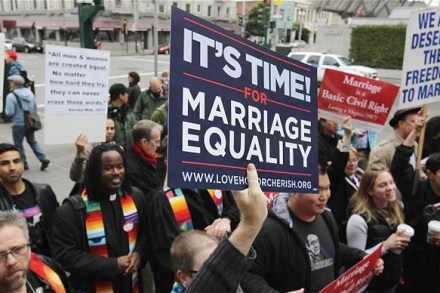
David Cameron just told the Tory conference that he supported gay marriage "because I am a Conservative". In last week's issue of the Spectator, Douglas Murray said that the best arguments in favour of gay marriage are conservative ones. For the benefit of CoffeeHousers, here is Douglas's piece. In America a new generation of Republicans is challenging the traditional consensus of their party on gay marriage. They — as well as some of the GOP old guard like Dick Cheney — are coming out in favour. In Britain the subject is also back on the agenda with the coalition government, at the insistence of the Prime Minister apparently, planning a ‘public consultation’ on the matter.

Gay rites

Gay marriage will never jeopardise straight marriage. But it can provoke political divorce. In America a new generation of Republicans is challenging the traditional consensus of their party on gay marriage. They — as well as some of the GOP old guard like Dick Cheney — are coming out in favour. In Britain the subject is also back on the agenda with the coalition government, at the insistence of the Prime Minister apparently, planning a ‘public consultation’ on the matter. Though not exactly political leadership, this nevertheless constitutes a change — not least in stealing the mantle of gay equality from the left. For decades it was presumed that conservatives could only oppose such moves.

Chance of a lifetime

 With the same coat of inevitability with which everything else gets glossed, it now seems inevitable to me that I ended up at Eton. But it was never any such thing. None of my family had been to the school or anything like it. Like most parents, mine had put their faith in state schools, not simply because they believed in them but because no other option was viable. I attended the local state primary and secondary schools and then to what had been a grammar school, but was now an inner city comprehensive. My parents had been promised that the old grammar school standards and ethos remained, but none did.

Breivik and the right

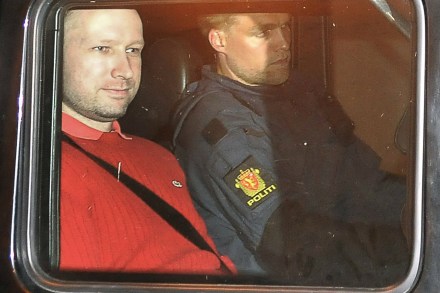
Must all conservatives answer for the actions of a psychopath? Anders Behring Breivik believed himself a Knight Templar and awarded himself various military ranks accordingly. He also believed that he and other self-described racists had common cause with jihadis and that the USA has a Jewish problem. So even before he planted a car bomb in a civilian area and gunned down scores of young people, it would have been clear to anyone who bothered to question him that Breivik was insane. But in the coverage since his atrocities first broke on to the world, two troubling tendencies have converged. The first is the search for reason in a mind that was clearly a stranger to it.

Breivik and the right | 28 July 2011

There's plenty to sate your thirst for politics in this week's issue of The Spectator (out today, you can buy it here, etc.), not least Tim Montgomerie's forceful cover article on how the Tory leadership has become detached from the wisdom of ordinary Conservatives. Here, though, is Douglas Murray's essay on the psychosis of Anders Behring Breivik, and whether the right has a case to answer for his crimes: Anders Behring Breivik believed himself a Knight Templar and awarded himself various military ranks accordingly. He also believed that he and other self-described racists had common cause with jihadis and that the USA has a Jewish problem.

Diary – 16 April 2011

‘I’m told you’re the one to watch,’ Julian Assange says when I introduce myself in the Green Room. ‘Likewise,’ I reply. We’re backstage at Kensington Town Hall on a sunny Saturday afternoon to debate the ethics of whistleblowing. The seats sold out in minutes and the audience, almost all young, female or both, are clearly here for him. One of my colleagues tries conversation. Government comes up. ‘Companies are the new government,’ Assange says. He expands on his theme. The room is becoming blurry. I’m zoning out. It’s not just the sixth-form politics but the sheer anti-charisma of the man. I start to worry about the debate. What will I do if he numbs my brain on stage? Assange’s conversation is aural Rohypnol.

Jihad against justice

For a jihadi, Britain is one of the very best places in the world. In Afghanistan, Pakistan and Yemen, overhead drones kill terrorists on a regular basis. In most democratic countries, politicians try to limit their enemies’ ability to operate — so one runs the risk of being thrown into prison, if caught mid-jihad. But not in Britain. Here, the Islamist insurgents have found that there are a hundred ways to run rings around our police and justice system. Nothing demonstrates this more spectacularly than the control orders farce.

Costs in space

‘Hello. Is that the European Union? This is Earth.’ It’s a conversation that could have happened at any time in recent years, but if the EU’s planned global satellite system ever actually takes off it might yet become reality. The plans for ‘Project Galileo’ were dreamt up in the late 1990s. They are intended as a rival to the Global Positioning System satellites, or GPS, used by almost all of today’s satnav devices. GPS worked well — but it was owned by the United States. This did not please Jacques Chirac, then French president, who thought a rival satnav project would make a fine grand projet. Lift-off for Galileo has taken a while, with hopes for a speedy launch repeatedly thwarted.

Blackballed by Cameron

David Cameron’s Conservative party has several uniquely destructive traits. But perhaps foremost is that it believes the lies of its enemies. And even when it doesn’t, it panders to them. A perfect example arose three years ago when the shadow minister of homeland security, Patrick Mercer, gave a newspaper interview in which he mentioned the fact that he had heard racist comments while he was in the army. Even a cursory glance at the interview showed that Mercer was reporting — and deploring — these comments. But Cameron didn’t bother with a glance. Here was an opportunity to show the new Conservative party.

Why can’t anyone take a joke any more?

Most people reading this will at some point have had the misfortune to meet one of those piggy-faced people who at a certain point in the conversation says, ‘Excuse me, but I find that offensive.’ Often it is someone who isn’t actually offended themselves. They have claimed offence for a group in absentia. ‘Excuse me, but I find that offensive on behalf of an absent third-party.’ Unfortunately this horrible behavioural tick is extending its reach. It is realising its power and getting organised. You often hear the phrase ‘Why does no one ever say “X” in the media?’, or ‘Why do you never hear “Y”?

We’ll never know the truth of Bloody Sunday

On 30 January 1972, a 41-year- old man named Barney McGuigan stepped out from behind a block of flats in Londonderry. Some witnesses saw a white handkerchief in his hand, others remember his hands being empty. Across the road, a soldier from the 1st Battalion of the Parachute regiment was seen by another soldier going down on one knee to a firing pos-ition. A bullet entered McGuigan’s head from the back. The head exploded, as one witness told the judge, ‘like a tomato’. Thirty years after this incident the soldier accused of firing that shot, Soldier ‘F’, testified in London. In the humming air-conditioned room, a mortuary photo of McGuigan’s head was shown to him at the request of the family’s lawyer.

‘A liberal mugged by reality’

Irving Kristol didn’t coin the term ‘neoconservative’ but he was the first person to run with it. Although it was originally intended as an insult towards those alleged to have abandoned their initial ‘liberalism’, Kristol wasn’t bothered with quibbling. ‘It usually makes no sense... to argue over nomenclature,’ he once said. ‘If you can, you take what people call you and run with it.’ Besides, ‘having been named Irving, I am relatively indifferent to baptismal caprice’. Some of the best qualities of Kristol — who died last week — can be gleaned from such casual phrases.