Douglas Murray

Douglas Murray

Douglas Murray is associate editor of The Spectator and author of The War on the West: How to Prevail in the Age of Unreason, among other books.

Britain does not need more mass immigration

Jonathan has already mentioned yesterday’s Fiscal Sustainability Report from the Office of Budgetary Responsibility. He appears to welcome mass migration both now and as an inevitable part of our future. Perhaps I could put a dissenting view? Migration itself can be a good thing. But mass migration (in the numbers it has happened in recent years in Britain and many other Western countries) is a bad thing. It strains our welfare systems, encourages people to ghetto-ise rather than assimilate and creates not so much a multi-racial society as a country made up of different mono-cultural centres. It causes a breakdown in trust both between and among communities, and erodes the possibility of any collective history or common culture.

DJ Delingpole

My Spectator comrade James Delingpole has many talents. Among them is his skill as a podcast-presenter for an American conservative website called ‘Ricochet’.  Yesterday he asked me to join him for his latest, deeply irregular, instalment of 'Radio Free Delingpole'. It was without question the most anarchic 40 minutes I have ever spent on air and  I should never have done it were it not for my love of James and the vast fee he unwisely promised. We covered a fair amount of ground, including the US elections and House of Lords reform, but mention of the Rolling Stones brought the programme to a climax with a row — instigated by James — over whether Led Zeppelin was better than Schoenberg.

The problem with UKIP’s opponents

Leafing through a pile of Economists I've just caught up on a Bagehot column from last month which inadvertently demonstrates exactly where UKIP’s opponents go wrong. The very final lines of the piece explain: ‘Mr Farage’s real dream is to reshape Britain, by pulling the Conservatives to the right and bouncing Mr Cameron into a referendum on EU membership. If he pulls that off, his insurgency will be no laughing matter.’ It is what is assumed here, rather than what is said, that is most revealing. Why should the prospect of a consultation of the British people on their membership of the EU be so fearful? Surely it could only be so if you were somebody greatly in favour of the EU who believed that the public did not share your beliefs?

4 years to bury the ghosts of Bloody Sunday?

It has just been announced that the police are going to launch an investigation into the Bloody Sunday deaths. It comes after the Police Service Northern Ireland and the Public Prosecution service reviewed the evidence of the Saville Inquiry. There will be a lot of comment about this in the coming days, but I think a couple of things are worth noting at the outset. Firstly, there can be no doubt that a number of soldiers deliberately shot and killed innocent people that day. Secondly, there can be no doubt that they then lied and misled an exceedingly long and costly public inquiry set up precisely in order to find the truth of what happened that day. As it happens, the Saville Inquiry provided ample opportunity for people to tell the truth.

At home with the Stalins

We all know what a city does when a local boy or girl has done good. But what do you do when the local boy turns out to have done very bad indeed? This is the dilemma facing the Georgian authorities in the city of Gori, not far from the boundary line of South Ossetia. For as well as being the first target of Russian forces during Vladimir Putin’s 2008 invasion, Gori is best known for giving birth to Joseph Stalin. It is now two years since the large statue of its most famous son was taken down from in front of Gori’s town hall. But there remains a dilemma over what to do with his opulently preserved birthplace and the connected museum commemorating his life. The Georgian authorities are eager to look towards Europe and away from their Soviet-occupied past.

Gitta Sereny and the truth about evil

The death of the author and journalist Gitta Sereny earlier this month drew some strangely critical notices. One piece even tried to blame her for a current cultural tendency to claim people are not responsible for their own actions. Though this was a dissenting view, there was a more general seam of criticism which ran through many obituaries. The claim was, essentially, that Sereny grew too uncomfortably close to her subjects and even ended up on occasions sympathising with them or excusing them. It is probably on the basis of her biography of Albert Speer that most of the criticism has come. It is true that Sereny got close to Speer and liked him.

A question for Martin McGuinness

‘God speed’ was apparently what Martin McGuinness said to the Queen when they met a short time ago. I wonder what she, and the Duke of Edinburgh, would have liked to say to him? Of all the things that the Queen should be asked to do in her Jubilee year, perhaps the most cruel has been to expect her to shake the hand of the former IRA commander and now deputy first minister of Northern Ireland. Many people bereaved by the Troubles have made gestures of almost super-human forgiveness, but few can have been so pushed towards doing so. And McGuinness is a particularly difficult case.

Al Qeada breathes again, but this is no time for dictators

Two sentences in the speech by the Director General of the Security Service, Jonathan Evans, yesterday evening have drawn particular notice. They are his statement that parts of the Arab world after the so-called ‘Arab Spring’ have become: ‘a more permissive environment for Al Qaeda’ and also that: ‘a small number of British would be jihadis are also making their way to Arab countries to seek training and opportunities for militant activity, as they do in Somalia and Yemen’. Without going over all of the responses to these facts, I would make just one comment.

A lesson for Cameron from Blair

A few years back the radio disc jockey John Peel died. Some public sorrow was expressed and soon Tony Blair issued a press release explaining his personal sadness. A little while later someone else who was popular died and the same thing happened. A few days later still and hundreds of thousands of people were killed and many more made homeless by a Tsunami out East. For several hours Blair was silent. Some media jumped on this and whipped up public expressions of shock. ‘Why has our Prime Minister not expressed sadness about the Tsunami deaths?’ and so on. I don’t know why Blair took a few more hours than was then normal for him to issue a personal grief-o-gram. But I doubted then, and doubt now, that it was because he was jubilant about the disaster.

Thornberry’s mock morality

I have only just discovered Emily Thornberry, Labour MP for Islington South, by catching up on last week’s Question Time. What a terrible experience. Thornberry did not only show what we must hope is her worst side, but displayed the worst of modern British politics. Answering a question about ‘problem families’, her fellow-panellist Peter Hitchens stated that ‘the reasons why we have so many problem families’ fundamentally comes down to ‘the destruction of the married family by the deliberate subsidising of fatherless families and an enormous welfare dependent class.

Rodney King and compensation

The late Auberon Waugh advised his readers to reflect on the case of David Flannigan when considering the munificent compensation often awarded to people after awful events. Mr Flannigan had been estranged from his parents for two years before the night of 21 December 1988, when Pan Am Flight 103 fell onto the family’s house in Lockerbie, killing all but one other member of his immediate family. Through a thoughtless, inhumane, process of compensation Flannigan (who had been a spray-painter) became a millionaire. Just over five years later, at the age of 24 — after fast cars, drink and drugs — he was found dead at a beach resort in Thailand.   I thought of Flannigan again this morning when reading reports of the death of Rodney King.

Martin Amis and the underclass

New Martin Amis novels haven’t always received a fine reception of late. So much so that even tepid praise now reads generously. In the current magazine Philip Hensher reviews the latest, Lionel Asbo, and closes by declaring it, ‘not as bad as I feared.’ Having just finished it I think there is much more to recommend it than that. Not least because it is such a good attempt at satirising our almost un-satirise-able modern Britain. There aren’t many novelists who can make you laugh at the strange thing this country has become. But Amis does, and often.

Another reason to part ways with Strasbourg

Even for people on the same side of an argument, opinion is often wildly divided. Among those of us who believe government should support civil marriage equality, this morning’s papers (£), and specifically Church of England fears that the religious will be ‘forced’ to carry out same-sex weddings, re-opens a fundamental division of opinion.   The coalition’s proposals rightly only relate to civil marriage equality (that the state should make civil marriage between same-sex couples equal to civil marriage between opposite-sex couples).

A final word on the BBC’s Jubilee

A very lively and enjoyable Any Questions last night from the beautiful town of Aldborough in North Yorkshire. The question which seemed to bring out perhaps the most passion from an already very passionate audience concerned the BBC’s coverage of the Jubilee celebrations. I didn’t envy Jonathan Dimbleby having to chair that one. No least because the question included a reference to his own reported criticism of the BBC’s coverage. I mentioned that I had simply turned over to Sky and others on the panel went on to attack the BBC’s management. But there are two points which I didn’t get a chance to air last night which I thought I might note here: one ‘for’ the BBC and one ‘against’.

Tune in tonight

I thought Spectator readers may like to know that I will be one of the panellists on BBC Radio 4's 'Any Questions' tonight at 20.00. The programme is coming from Aldborough, North Yorkshire and my fellow panellists are Alan Johnson (Labour), David Davis (Conservative) and Salma Yaqoob (Respect).

Syrian massacres expose Britain’s pretence

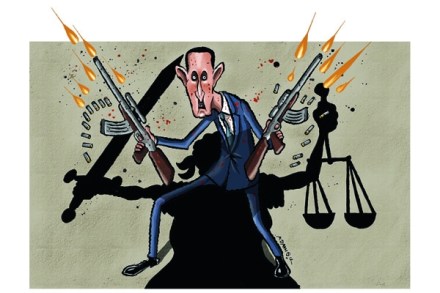
More than a week on from the massacre at Houla, another hundred or so men, women and children have been slaughtered in Hama, Syria. They were apparently stabbed to death and some of their bodies then burned. David Cameron has responded to this by describing the killings as ‘brutal and sickening’. William Hague had previously described the Houla massacre as ‘deeply disturbing.’ So what is Britain going to do about it? The Prime Minister has a suggestion: ‘I think that lots of different countries in the world — countries that sit around the UN Security Council table — have got to sit down today and discuss this issue.

The Arab Winter, continued

Back in November I wrote a cover story for The Spectator arguing that the trend in North Africa for those countries which had thrown off their dictators appeared to be more in the direction of Winter than that of Spring. Since then there have been many developments, including the first round of the Egyptian Presidential elections where the field is led by the Muslim Brotherhood candidate.  And now, in a new development reported by Raymond Ibrahim over at the Gatestone Institute, we learn about the first beheading of an ‘apostate’ convert to Christianity over in Tunisia   I recommend you don’t watch the video that he links to in his blog. His summary is enough:-   ‘A young man appears held down by masked men.

Let’s talk about this

What a strange place Britain has become. You sometimes need some time away to realise quite how strange. Take yesterday’s main story: the latest paedophile rape-gang case from the north of England. The judge in the trial told the men, during sentencing, that they had selected their victims ‘because they were not part of your community or religion’. But that is the sort of fact which causes the most terrible contortions in modern Britain. The perpetrators were all Muslim men of Pakistani origin and the victims all underage, white girls. We know exactly how we should think, how loud would be our proclamations and our desire to analyse the ‘root-causes’ were this situation reversed. But this way round? Gulp.

Sarkozy shows extremists the door

Who on earth does Nicolas Sarkozy think he is? The answer, of course, is President of the French Republic. And from that position — and propelled by the Toulouse shootings and doubtless by the imminent election — he has chosen to expel a number of people from the Republic whose views, actions and teachings are deemed inimical to the State. Sarkozy gave the order yesterday and a couple of hours later the men were on planes back to their countries of origin. As the Times reports, the Algerian Islamist Ali Belhadad was flown back to Algiers and Almany Baradji, an imam, was sent back to Mali. The French Interior Ministry explains that Baradji ‘preached anti-Semitism and the rejection of the West’. Neither man was given any time to appeal.

Behind Galloway’s grin

George Galloway has tragically demonstrated that sectarian politics are now alive and well in Britain.  The other week Ken Livingstone appeared at a London mosque and promised to make London a ‘beacon of Islam’ and last week went on to dismiss Jews as unlikely to vote Labour because they are ‘rich’. Now we see Galloway flying in to one of the country’s most divided areas to sweep the Labour party aside in what he has termed ‘a Bradford spring.’ Much can — and should — be said about this depressing, and predictable, turn of events.  But for now I’d just like to make two quick observations. The first regards the ‘Bradford spring’ phrase.  This cannot be allowed to go uncommented upon.