Charles Moore

Charles Moore

Charles Moore is The Spectator’s chairman.

He is a former editor of the magazine, as well as the Sunday Telegraph and the Daily Telegraph. He became a non-affiliated peer in July 2020.

Is there no-one in the universities sector who can do arithmetic?

This week, Universities UK and the Russell Group, seemingly speaking on behalf of the whole sector, produced an Open Letter from distinguished vice-chancellors. ‘It is no exaggeration to suggest,’ said the letter, ‘that this [leaving the EU without a deal] would be an academic, cultural and scientific setback from which it would take decades to recover.’ Actually, it would be as exaggerated as a Donald Trump tweet. The detail of this is brilliantly demonstrated by Noel Malcolm in an analysis for Briefings for Brexit. The bit that made me burst out laughing was Sir Noel’s comparison of a similar Open Letter, from 103 university vice-chancellors, just before the referendum vote in 2016, with this week’s effort.

When it comes to Brexit, UK universities’ sums don’t quite add up

This week, Universities UK and the Russell Group, seemingly speaking on behalf of the whole sector, produced an Open Letter from distinguished vice-chancellors. ‘It is no exaggeration to suggest,’ said the letter, ‘that this [leaving the EU without a deal] would be an academic, cultural and scientific setback from which it would take decades to recover.’ Actually, it would be as exaggerated as a Donald Trump tweet. The detail of this is brilliantly demonstrated by Noel Malcolm in an analysis for Briefings for Brexit. The bit that made me burst out laughing was Sir Noel’s comparison of a similar Open Letter, from 103 university vice-chancellors, just before the referendum vote in 2016, with this week’s effort.

The Spectator’s Notes | 10 January 2019

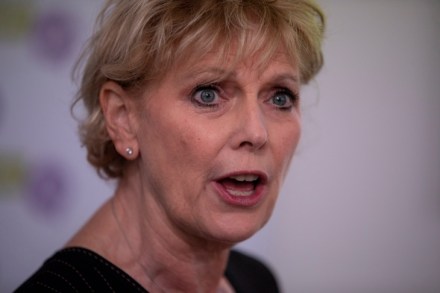
Behind the incident of Anna Soubry being called a Nazi by a small group of Leave yobs beside College Green lies a classic Brexit sequence of events. For many months now, Remain protestors have infested that area. Their numbers are small, but they are well trained to insert themselves and their banners into relevant live television interviews, and have been praised by the Guardian for doing so. Never have I seen the BBC trying to exclude them from its shots, even when the protestors’ interventions have made it quite difficult for those being interviewed. Sometimes BBC interviewers have gestured on air towards the protestors as evidence of strong pro-Remain public feeling. Often BBC cameras have used cutaways of them to punctuate news items, to make the same point.

Will the Boxing Day hunts become a one-horse race?

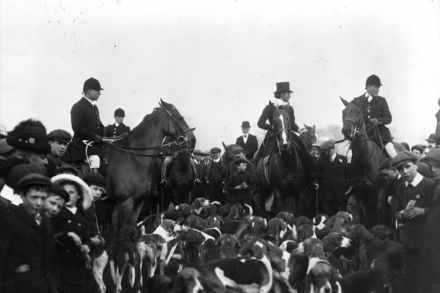
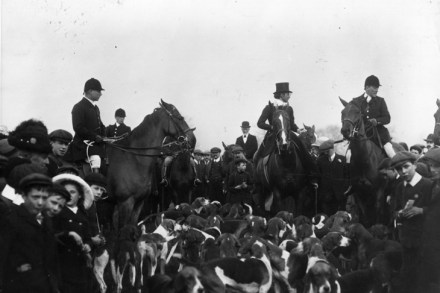
Earlier this month, the Quorn and Cottesmore hunts took separate votes on merging. The Quorn voted for, the Cottesmore against. So the merger will not take place. The fact that the Quorn wants a merger is, given its history, astonishing. For a century and a half, it was the epitome of fast, grand hunting — with too much ‘leaping’ for hunting purists, but any amount of swagger. Melton Mowbray was to hunting what St Moritz is to skiing. The place was full of louche, rich, grand persons, chancers, hucksters, poules de luxe, all so well satirised by Surtees. There the future Edward VIII met Mrs Simpson. People would take a ‘box’ nearby for the season or come up from London by train. More than 80 per cent of the subscribers were non-residential.

The Spectator’s notes | 13 December 2018

Earlier this month, the Quorn and Cottesmore hunts took separate votes on merging. The Quorn voted for, the Cottesmore against. So the merger will not take place. The fact that the Quorn wants a merger is, given its history, astonishing. For a century and a half, it was the epitome of fast, grand hunting — with too much ‘leaping’ for hunting purists, but any amount of swagger. Melton Mowbray was to hunting what St Moritz is to skiing. The place was full of louche, rich, grand persons, chancers, hucksters, poules de luxe, all so well satirised by Surtees. There the future Edward VIII met Mrs Simpson. People would take a ‘box’ nearby for the season or come up from London by train. More than 80 per cent of the subscribers were non-residential.

Four points for Tory MPs to consider before voting tonight

If I were a Tory MP, I would be worried by the timing of this vote, but, given that it is happening, I would think the following: 1. She's trying to bounce me by making me vote tonight. 2. This is the last chance for a year, because Theresa May is rule-bound and not one to take hints. 3. I do not, in fact, have confidence in her, and so, since I'm being asked, I should say so. 4. Although I do think she is sincere in wishing to deliver what people voted for, we have learnt that she doesn't know how to do this. We urgently need a Prime Minister who does. I am conscious that there is no guarantee that my vote would bring what I want, but I would reluctantly prefer the uncertainty of a contest to the certainty of Mrs May in Downing Street.

The Mail may suffer yet for its Brexit volte-face

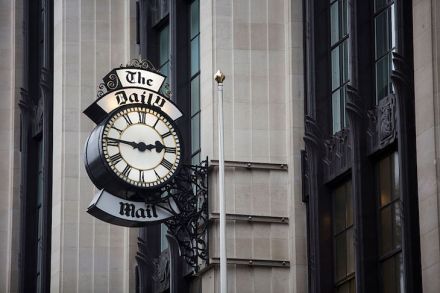
I may have spoken too soon when I predicted that the Daily Mail might not suffer from its Brexit volte-face. At the Daily Telegraph’s Christmas charity phone-in last Sunday, I was struck by how many donating readers mentioned the Mail’s desertion, and by reports of recruitment by the Telegraph of disconsolate Mail readers. There are rumours that the Mail’s new editor, Geordie Greig, has personally rung to plead with readers who are cancelling their subscriptions. Geordie is a charming man, but obviously he cannot speak to all the disgruntled tens of thousands. The Mail has chosen to switch from an insurgent to an establishment position just when that establishment is more discredited than at any time since the 1930s.

Why it was a mistake for the head of MI6 to not wear a tie

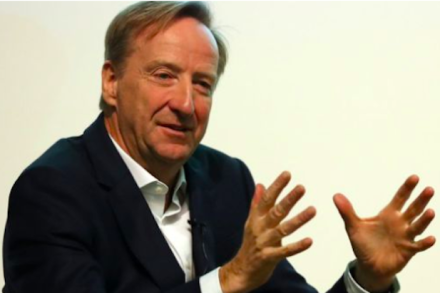
Alex Younger, the head of MI6, made his second public appearance after four years in the job, on Monday. He spoke to students at St Andrews. Presumably because of his young audience, and because he was promoting officialdom’s orthodoxy that ‘diversity’ in recruitment trumps everything else, Mr Younger did not wear a tie. This was a mistake for two reasons. The first is that able young people will wish to join MI6 not because it offers a comfy, reassuring version of their existing easy-going lives, but because it doesn’t. The idea of challenge is what attracts, and of exclusivity not inclusivity. It is, after all, called the Secret Intelligence Service. It ought to be tight-lipped, formal and (for men) tie-wearing.

Could Dominic Grieve’s Brexit amendment launch a new party?

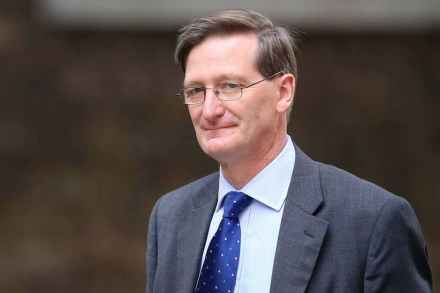
Inside the Dominic Grieve amendment carried on Tuesday is the embryo of a new political party. Any parliamentary majority for what Sir Oliver Letwin, who voted for the amendment, calls ‘something real’ (‘Norway plus’) if Mrs May’s deal falls would depend on the support of a good many Labour MPs. After three months’ work, the organisers believe they have got 75 such on board, led by Chuka Umunna. These are anti-Brexit, chiefly Blairite Labour MPs who cannot bear Jeremy Corbyn. If their number held up (a big ‘if’), the organisers calculate, the House could carry ‘Norway plus’, with the government and most Conservative backbenchers supporting, even if the ‘hard’ Brexiteers opposed. Labour would be split.

The Spectator’s notes | 6 December 2018

Inside the Dominic Grieve amendment carried on Tuesday is the embryo of a new political party. Any parliamentary majority for what Sir Oliver Letwin, who voted for the amendment, calls ‘something real’ (‘Norway plus’) if Mrs May’s deal falls would depend on the support of a good many Labour MPs. After three months’ work, the organisers believe they have got 75 such on board, led by Chuka Umunna. These are anti-Brexit, chiefly Blairite Labour MPs who cannot bear Jeremy Corbyn. If their number held up (a big ‘if’), the organisers calculate, the House could carry ‘Norway plus’, with the government and most Conservative backbenchers supporting, even if the ‘hard’ Brexiteers opposed. Labour would be split.

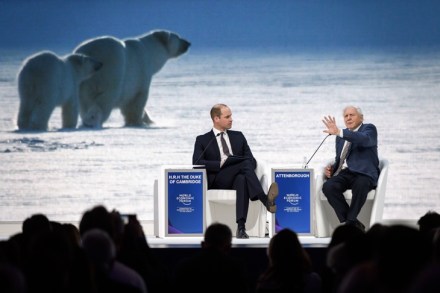
Should we listen to David Attenborough’s climate change warning?

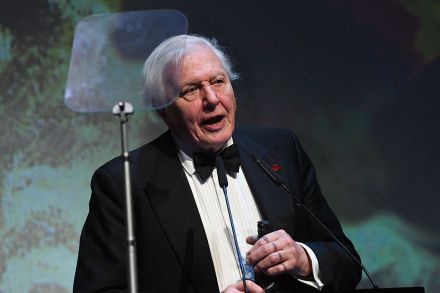
‘Civilisation faces collapse, Attenborough warns UN.’ That was the Times headline on Tuesday about the great broadcaster’s speech at the latest climate change conference in Poland. In theory, Sir David is always worth hearing. Nevertheless, his solemn warning was made less effective by the decision to print it at the bottom of page 17. I cannot help feeling that this adverse news judgment was entirely correct.

Emmanuel Macron is Donald Trump in reverse

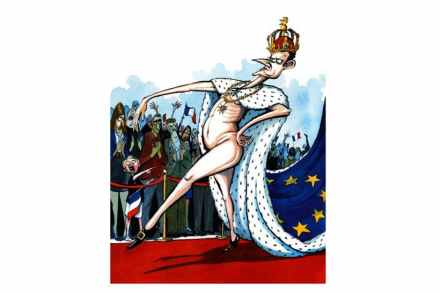
Is Emmanuel Macron the oddest leader in the EU? When he became President of France last year, he made a speech at Versailles to both houses of parliament calling for a renewal of ‘the spirit of conquest’. This year, commemorating the centenary of the Armistice, he seemed more inclined to invent a project for perpetual peace, like some 18th-century rationalist. In recent days, he has demanded our fish, decided that the gilets jaunes, who are rioting about his astonishing diesel price rises to save the planet, are really a ‘brown plague’, and welcomed a report which wishes to empty France’s museums of any treasures which originated in Africa, Oceania and anywhere else that can claim victim status, and return them thither. M.

The Spectator’s Notes | 29 November 2018

Theresa May, William Hague and others say that the EU will not want to trap Britain in the backstop because it is not in its interest. It will want to move to a free-trade agreement for its own benefit. If that is so, why is the backstop the thing above all others upon which the EU insists? Brexiteers must absolutely oppose the backstop because agreeing it would repeat Britain’s delusion in every European negotiation over nearly 50 years, which is that we should grab ‘practical’ advantages and concede ‘windy’ principles. This sounds good, but it invariably means that we are trapped later. The principles acquire legal force.

The UK must avoid the backstop trap

Theresa May, William Hague and others say that the EU will not want to trap Britain in the backstop because it is not in its interest. It will want to move to a free-trade agreement for its own benefit. If that is so, why is the backstop the thing above all others upon which the EU insists? One reason why Brexiteers have to oppose the backstop absolutely is that it is yet another manifestation of Britain’s delusion in every European negotiation over nearly 50 years, which is that we should grab ‘practical’ advantages and concede ‘windy’ principles. This sounds good, but it invariably means that we are trapped later. The principles acquire legal force.

Will May’s Brexit deal stop us making jokes about Juncker?

Article 129 (3) of the withdrawal agreement provides that ‘the United Kingdom shall refrain, during the transition period, from any action or initiative which is likely to be prejudicial to the Union’s interests, in particular in the framework of any international organisation, agency, conference or forum of which the United Kingdom is a party in its own right.’ What does that mean? That we are not free at the UN Security Council to oppose any item of EU foreign policy? That we cannot cut our rate of VAT? That we must not make jokes about Jean-Claude Juncker? Needless to say, there is no reciprocal obligation on the EU to do nothing prejudicial to the interests of the United Kingdom.

The Spectator’s Notes | 22 November 2018

It will be interesting to see whether the about-face of the Daily Mail on Brexit makes the slightest difference to anything. Paul Dacre was admirably consistent when he was editor and the paper did well. But on the whole, the history of the Mail is that it is happy dramatically changing sides on major issues. Under David English, for instance, it suddenly switched to Europe and Heseltine away from his earlier Thatcher-worship, and few seemed to notice. Thus, after attacking the High Court judges as enemies of the people in 2016, under Dacre, it can move effortlessly to attacking the Brexiteers as ‘preening peacocks’ etc, under Geordie Greig.

When the BBC’s ‘Reality Check’ reporter met his match

The BBC’s ‘Reality Check’ device is a piece of hubris, which this week met its nemesis. It effectively says: ‘We report untrustworthy politicians who disagree with one another. You, the stupid viewer/listener, obviously cannot be expected to work out where the truth lies. Our expert correspondents will tell you.’ The main man who does this on Brexit is called Chris Morris. His version of ‘reality’ is strongly pro-Remain. If you read his online summary of the withdrawal agreement, for example, he says that ‘the Brexit process has caused an enormous amount of anxiety and uncertainty’ in relation to immigration. That is a defensible proposition, but one depending on a point of view.

The Spectator’s Notes | 15 November 2018

‘It’s time for Bond — Basildon Bond,’ is the joke among pro-Leave MPs as Theresa May serves up her mess of pottage as Brexit. Market research, however, shows the joke does not work on MPs under 40 because they do not know what Basildon Bond is. So perhaps I should explain to the hip Spectator crowd that Basildon Bond remains the commonest brand of quality paper on which to write letters. There need to be 48 such letters sent to Graham Brady, the chairman of the 1922 Committee, to provoke a vote of confidence in Mrs May among Conservative MPs. There are certainly far more than 48 who do not, in fact, have confidence in her. It does not automatically follow, needless to say, that they will say so when asked.

Theresa May’s Brexit is a mess. But will Tory MPs dare move against her?

It’s time for Bond — Basildon Bond,’ is the joke among pro-Leave MPs as Theresa May serves up her mess of pottage as Brexit. Market research, however, shows the joke does not work on MPs under 40 because they do not know what Basildon Bond is. So perhaps I should explain to the hip Spectator crowd that Basildon Bond remains the commonest brand of quality paper on which to write letters. There need to be 48 such letters sent to Graham Brady, the chairman of the 1922 Committee, to provoke a vote of confidence in Mrs May among Conservative MPs. There are certainly far more than 48 who do not, in fact, have confidence in her. It does not automatically follow, needless to say, that they will say so when asked.

The Spectator’s Notes | 8 November 2018

The sixth of November 1918 was remembrance day for my great-grandfather, Norman Moore. It was the fourth anniversary of the death of his younger son, Gillachrist (known as Gilla), a second lieutenant in the Royal Sussex Regiment, who had been killed at the first battle of Ypres. Sitting quietly in his London house in Gloucester Place, Moore heard shouting in the street: rumours of peace were spreading. ‘If it be so,’ he wrote in his diary, ‘how appropriate on Gillachrist’s day for he gave his life to resist German power.’ It became so five days later. On 9 November, NM (as he was always called) attended the Lord Mayor’s Banquet in Guildhall: ‘A fanfare of trumpets announced Mr Lloyd George.