Alex Massie

Alex Massie

Nicola Sturgeon’s bandwagon rolls on: a new poll puts the SNP on 62%

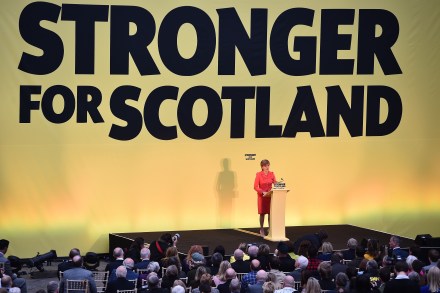
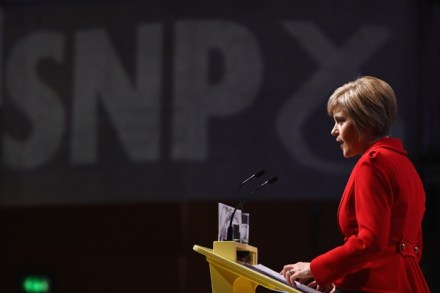
People like to support successful teams. That's why there are far more Chelsea fans now than there were 20 years ago. It's why, in Scotland, Celtic and (until recently) Rangers carved up the country between them. And it helps explain, a little, why the SNP is now polling at 62 percent. You read that correctly: 62 percent. Today's Herald/TNS poll suggests the SNP could win 78 seats at next year's Scottish parliament elections. And with the Greens projected to take nine seats, pro-independence parties would hold 87 of Holyrood's 129 seats. Labour would be reduced to 25 MSPs, the Tories 15 and the Lib Dems to only two. So if this is a bubble it's a bloody large bubble that shows no sign of bursting any time soon.
The Ashes: This Really Is As Good As It Gets

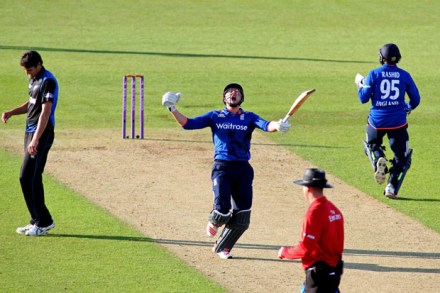
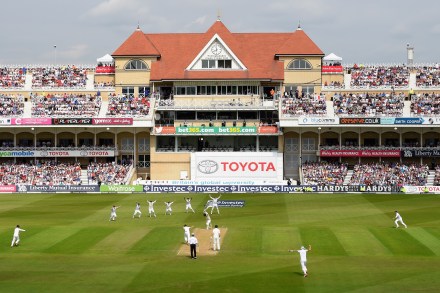
All across the country this afternoon struggling club sides could cheer themselves with the thought that once their batsmen had survived for 112 deliveries they were doing better than Australia managed in their first innings in Nottingham this week. Australia's capitulation in 18.3 overs - a Nelson of deliveries - might just be the most extraordinary thing any of us have ever seen on a cricket field. Even now, 48 hours later, it still seems shocking. And when England motored to 274/4 by the end of that first, astonishing, day it occurred to me that this might well have been the single best day of English test cricket in my lifetime. It was hard to think of many that could even rival it.

The SNP are masters at playing Heads I Win, Tails You Lose

All political parties have their cultish moments but some are more cultish than others. That doesn't mean all their supporters are kool-aid drinkers, just that, on balance, they're more likely to be so. This is not, I should have thought, a particularly novel or controversial observation. But, for some reason, suggesting that the SNP's followers are especially likely to be animated by what one might dub a quasi-religious fervour seems to annoy them. And yet, at other moments, they are keen to point out how the SNP is different from all the other parties. Which is kind of my point too. And, yes, the SNP's supporters really do behave in different ways. They are twice as likely as Labour or Conservative voters to view criticism of the party as a personal insult.

Is another referendum on Scottish independence actually inevitable?

So here we go again. Alex Salmond, popping up on the Andrew Marr show while Nicola Sturgeon is in China, makes news without saying anything new about the circumstances in which the SNP might - or might not! - press for a second referendum on Scottish independence. David Cameron, also overseas, responds saying there's no need for any such plebiscite at any point in this parliament. Calm down, Jock. This will, I am sure, be well-received. All of which should surprise precisely no-one. Seventy percent of SNP supporters want another referendum before the end of this parliament; 90 percent want one within ten years. In such circumstances, you can understand why Salmond thinks another referendum is 'inevitable'.

Who is to blame for the rise of Jeremy Corbyn? Ed Miliband

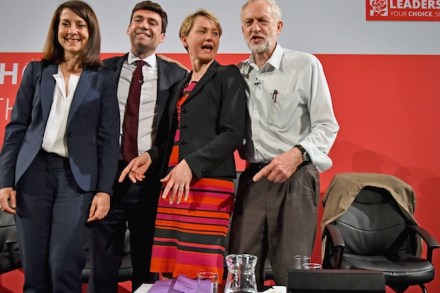
Well, look, it's Ed Miliband's fault isn't it? Thrice over in fact. First for winning the Labour leadership, then for leading the party in the way he did and, finally, for leaving the leadership so abruptly. There are many ways of measuring the funk into which Labour has plummeted but one of the best is to consider that it is now seriously believed, in some quarters anyway, that Jeremy Corbyn might not be the worst choice as leader. Believed, I mean, by sensible people of reasonably sound mind who recognise that Corbyn would be a disaster for Labour and, quite possibly, for Britain. (If you doubt that, consider whether the country benefited from Iain Duncan Smith's tenure as leader of the Conservative party. Hint: it did not.) The alternative, after all, appears to be Andy Burnham.

Tally No: the SNP abandons its principles to tweak the Tories

In 2008 Alex Salmond told Total Politics that: 'As you know, by choice, SNP MPs have abstained from every vote on English legislation that does not have an immediate Scottish consequence. If you're asking me should people in England be able to run their own health service or education system, my answer is yes. They should be able to do it without the bossy interference of Scots Labour MPs. We had this in reverse through the 1980s.' A year earlier, Angus Robertson, MP for Moray, had asked the Prime Minister if he agreed it was 'completely iniquitous' that English MPs 'are not able to decide on matters in Scotland but Scottish MPs from the UK parties can vote on matters which only impact on England. Why does he not join the SNP in abstaining on these issues?

Calm down: English Votes for English Laws is a very minor modest proposal

Ed Miliband - remember him? - has just told the House of Commons that the government's proposals for so-called English votes for English laws (EVEL) are a betrayal of everything for which the Conservative party is supposed to stand. Well, that's certainly one way of putting it. According to Miliband, EVEL is "not true to the great traditions of the Conservative and Unionist party" but since the foremost of those traditions is a keen and ruthless appreciation of the best interests of the Conservative party I suspect Miliband, not for the first time, misunderstands the Tory party. “You’re the Conservative and Unionist party", Miliband said. "This is neither for Conservatism nor Unionism.

Cheer up! The Greek crisis shows you were right all along

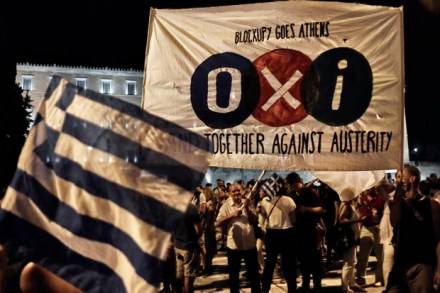
I don't know whether the joy on the right was worse than the preening on the left last night but as the result of the Greek referendum swept across social media I found myself thinking that any result so cheerfully welcomed by Marine Le Pen, Nigel Farage, Jeremy Corbyn and Sinn Fein can't be thought altogether cheerful. Of course you needn't judge a cause by its followers but when a cause is followed and endorsed by such a collection of rogues, crooks and cranks it's wise to begin to wonder about it. All this glee seemed especially shabby since, really, it didn't really seem to be about Greece at all.

Fun runs

Something wonderful is happening in English cricket. The Ashes are upon us and, at last, the England team seem determined to play the right way. The recent series against New Zealand was a revelation. The Kiwis’ have-a-go approach rubbed off and, for the first time in too long, England played as if cricket was more than a job. It could be fun too. Remember fun? We have seen it before. In 1981, at Headingley, England were revived by the rustic virtues of what their captain Mike Brearley called ‘blacksmith cricket’. See ball, hit ball. Bowl as fast as you can. Keep it simple. Trust yourself. For a long time England have approached cricket as though it was not a game but a military campaign.

The oldest sport in the world

This is the best book you’ll ever read about mixed martial arts fighting; and this will still be the case even if it’s not the first book you’ve ever read about mixed martial arts fighting. Kerry Howley’s debut is a riotously entertaining and piercingly perceptive account of the contrasting lives and dreams of a pair of Iowa-based fighters whose battles in the ‘Octagon’ become the vehicle for a philosophical treatise on the nature of glory. One of these fighters, Sean Huffman, is a journeyman; the other, Erik Koch, has dreams of the big time which, in this instance, means Las Vegas. Huffman, by contrast, makes do with dingy fights in hotel function rooms in a succession of no-name Iowa towns.

Is Home Rule the only realistic alternative to independence for Scotland?

'Is Home Rule the only realistic alternative to independence?' was the question posed at a Spectator debate, sponsored by Brewin Dolphin, in Edinburgh last week. In one sense the question is redundant since, no matter how much some nationalists claim otherwise, there is no reasonable or realistic scenario in which it is possible to envisage the United Kingdom government scrapping the Scottish parliament. Some measure of Home Rule, therefore, is indeed the only realistic alternative to independence? But what is Home Rule? As the panel agreed (not least since this has long been obvious) there is no agreed or even satisfactory definition of Home Rule. Is it, as the journalist Iain Macwhirter suggested, something similar to the parliament Ireland was promised in 1914?

Is the SNP an Anglophobic party or just a party for Anglophobes?

Writing in the Herald this week Iain Macwhirter noted that “Any trace of ethnic nationalism, and anti-English sentiment, was expunged from the [Scottish National] party in the 1970s”.  Responding to this JK Rowling - of whom you may have heard - suggested this was "Quite a claim", suspecting that plenty of English-born Scottish residents might take a slightly different view. This, obviously, made for great Twittering and, equally predictably, gave plenty of people enough characters with which to hang themselves. Tiresomely, they are both correct. As nationalist parties go, the SNP really is a remarkably broad church. It imposes no kind of genetic test upon its members.

Adventures in Truthiness: The SNP and Full Fiscal Autonomy

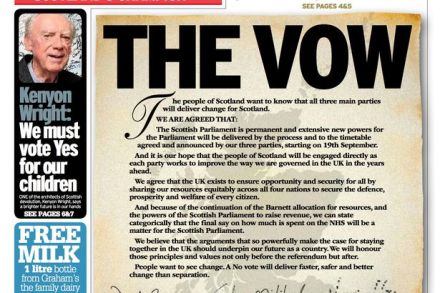
As a general rule I prefer the stupidity theory to the mendacity concept of politics. That is, if a politician says something obviously wrong it is more probably because they are thicker than mince than because they wish to deceive the public. There are some exceptions to this usual rule but, most of the time, dumb beats cunning. Occasionally, however, dumb can also be cunning. Consider this statement from Angus Brendan MacNeil, MP for the Western Isles, as recorded by Hansard: Now Mr MacNeil, bless him, often fumbles his way towards wishful thinking but this will not quite do. The Vow, no matter how ballyhooed it may be these days, said precisely nothing about Full Fiscal Autonomy. We know this because, helpfully, it was splashed on the front page of the Daily Record.

The SNP, which would impose eye-watering austerity on Scotland, remains immune to the laws of politics

David Mundell, the somewhat improbable Secretary of State for Scotland, had at least one good line yesterday: "The SNP are asking for something they don't really want, but of course they will complain if they don't get it." It being our old chum Full Fiscal Autonomy (or Responsibility) for Scotland. Now if the ordinary rules of politics still applied you might think a party might pay some price for bitterly complaining about a £100m cut to the Scottish block grant while also advocating measures that would require some £7 billion in additional tax increases or spending cuts would be laughed at. But the ordinary rules of politics no longer apply and no-one finds anything very funny in Scotland any more. Nevertheless, that is the SNP's actual policy at present.

Even if he wins his EU referendum campaign, David Cameron will be the loser

I suppose David Cameron had little choice but to offer a referendum on Britain's membership of the European Union. How else could he have held his party together? Indeed, it is possible that he owes some part of his small majority to that promise. Nevertheless, it will all end badly. I think there is no plausible scenario in which it can end well for Cameron. Indeed, it is entirely possible that having begun this parliament with a majority he - or, rather, his successor - will end it leading a minority administration. The most important thing to remember is that perhaps a quarter of his backbenchers actually want the Prime Minister to fail. They have no interest in his cockamamie renegotation strategy.

Alex Salmond’s reaction to the death of Charles Kennedy was as revealing as it was contemptible

Neither man will much care for the comparison but, more than ever, Alex Salmond is rather like Gordon Brown. Each struggles to admit their opponents might ever have a point and that said point might be held in good faith. More importantly, each has the habit of thinking their opponents lesser mortals simply because they dare to take a different view on the great issues of the day. I thought of this today when I saw Salmond's remarks responding to the sad news about Charlie Kennedy's death. They were revealing remarks, just not in any way that flatters the former First Minister. Salmond, like everyone else, acknowledged Kennedy's essential decency but then, as has often proved the case, found himself unable to resist the lure of some wishful thinking.

Charles Kennedy, 1959-2015

Charles Kennedy had many favourite jokes but when, as he often did, he returned to the Glasgow University Union, he was particularly fond of regaling his audience with the story of how his career had developed. As more than one old GUU hand has remembered this morning, it went something like this: 'I received a letter from my careers adviser about halfway through my final year telling me that I needed to come in for a chat, so off I trooped to University Gardens.

The SNP is a party happy to pursue the wrong policies ‘for the right reasons’

Of course, as the SNP keep reminding us, this year's general election had nothing to do with advancing the case for independence. Besides, please, you must remember there's much more to the party than its thirst for national liberation. Any suggestion to the contrary is quite deplorable. Which is fine, I suppose, as far as these things go. Unfortunately these things do not go very far. If you doubt this, ask yourself this question: would the SNP advocate, far less pursue, any policy it thought likely to hinder the drive towards independence? Helpfully - for us, if not for the party leadership - this question was answered by Kenny MacAskill earlier this week.

Today Britain has changed, changed utterly. A terrible beauty is born.

So this is what history feels like. Painful, frankly.  None of the usual meteorological metaphors - earthquake, hurricane, avalanche, landslide, tsunami - seem strong enough. Make no mistake, Theresa May was right. This is the biggest constitutional drama - even crisis - since the abdication. Actually, it's bigger than that. It's the greatest (internal) shock to the British state since the 1918 election. Sinn Fein won 47 percent of the vote in Ireland that year as it all but swept southern Ireland. The Irish Parliamentary Party lost 61 of its 67 seats, every one of them to Eamonn de Valera's party who increased their representation from 6 to 67. As then, so now. Even nationalists can't quite believe this has happened. Motherwell! Rutherglen! Paisley! Coatbridge! Kirkcaldy!

The disunited kingdom

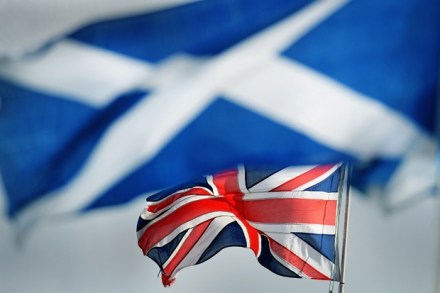
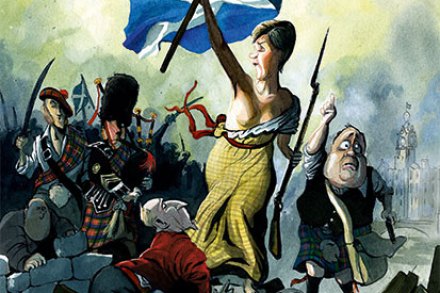
Never before — at least, not in living memory — has there been such a disconnect between north and south Britain. We vote together, but cast our ballots in very different contests. Scotland and England, semi-detached in the past, are more estranged than ever. The mildewed contest between David Cameron and Ed Miliband touches few hearts north of the Tweed; the battle between Labour and the SNP still mystifies many of those sent north to observe the strange happenings in Scotland. Edmund Burke wrote of another revolution: ‘Everything seems out of nature in this strange chaos of levity and ferocity, and of all sorts of crimes jumbled together with all sorts of follies.’ Something similar might be said of this Scottish insurrection.