Alex Massie

Alex Massie

The Tory party’s attitude towards Scotland is as stupid as it is cynical

I preferred Grant Shapps when, as Michael Green, he was just another loathsome internet huckster peddling obviously quackish get-rich-quick schemes. He did less damage then. That is, he played a smaller number of people for fools back then. This morning Shapps, the Conservative party chairman, made the remarkable claim that "Alex Salmond is threatening to undermine a government chosen by the British people". (Note to Mr Shapps: the Scottish people are British too. We had, as you may recall, a vote on this. Quite recently.) I assume Shapps is the member for Codswallop-on-Stilts because this is nonsense. Worse than that, it is dangerous nonsense. Which in turn means it is hard to decide if it is worse that Shapps does not know this or that he does know it and does not care.
Scottish nationalism is a faith-based initiative, creating its own reality

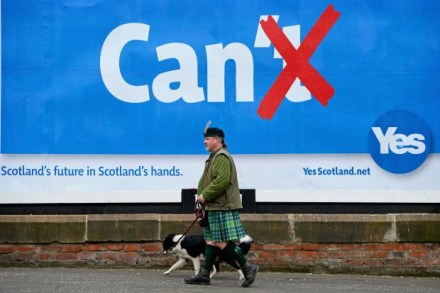
One of the most notable features of Alex Salmond's account of the closing stages of last year's referendum campaign is his hatred of the press and, indeed, the media more generally. Newspapers which run inconvenient stories are 'anti-Scottish' and journalists who ask awkward questions are accused of 'impersonating Alistair Darling'. Salmond cannot quite decide whether the press are an obsolete irrelevance or the primary reason the Yes campaign fell short. His greatest vitriol is reserved for the BBC which is accused of being a fully-owned part of the No campaign. Of course Salmond was so convinced Yes were going to win that it comes as some surprise to discover that Scotland actually voted No. It certainly seems to shock him.

In a brave move, David Cameron sets fire to his authority

It is always useful to remember Robert Conquest's suggestion that The simplest way to explain the behaviour of any bureaucratic organisation is to assume it is controlled by a cabal of its enemies.  No, I don't know why David Cameron would amputate his authority before he runs for re-election either. But that's what he has done today by ruling out running for a third term in office.  I dare say it was an honest - and spontaneous - answer to a simple question. But still: what a bizarre thing to do, not least because no-one expected him to run again in 2020 even if, by some good fortune, he returns to Downing Street on May 8th. But there is every difference between common knowledge inside the village and broadcasting that knowledge to the wider world.

Could the Tories do a deal with the SNP? (Yes they could)

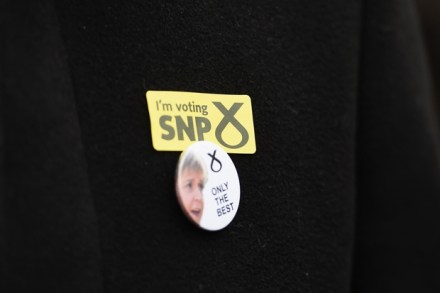
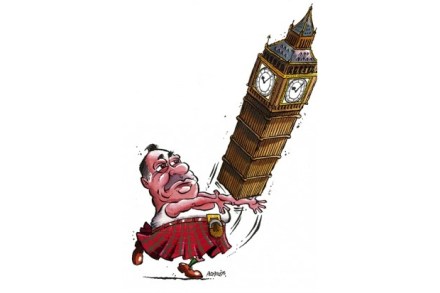
We have been here before, you know. Seven years ago Alex Salmond looked forward to the prospect of a hung parliament and spied an opportunity to 'make Westminster dance to a Scottish jig'. If Scotland returned at least 20 SNP MPs - members, as the then First Minister indelicately put it, 'ready, willing, and able to defend our parliament and our people' - then Scotland's interests might yet hold the balance of power in London. Not, he stressed, as part of any formal coalition but on a case-by-case and vote-by-vote basis. That didn't happen, of course. The SNP won only six seats in 2010. Still, a victory delayed is not the same as a victory denied and Salmond's party stands on the brink of a historic victory.

The children of migrants are just as British as anyone else

I long ago accepted that the Conservative party has lost its mind on immigration but until recently I still hoped it retained its decency. Alas, such charity seems ever more sorely misplaced. Responding to a question from Andrew Green, the MigrationWatch campaigner inexplicably elevated to the peerage by David Cameron, in the upper house yesterday, Lord Bates, a Home Office Minister, suggested immigration needs to be further restricted because too many foreign-born women residing in Britain are having babies. Damn their ovaries, damn it. This is a remarkable thing to say.

Ed Miliband’s question for the SNP: ‘Do you feel lucky, punks?’

I've written for the Scottish Daily Mail about Ed Miliband's decision to rule out a coalition with the SNP no-one was seeking. It makes, I am almost embarrassed to say, the conventional argument. Ed epitomises the banality of mediocrity, his campaign is candy-floss disguised as cast-iron etc etc. The SNP have Labour on the run and all the rest of it. They know what they are doing; Labour does not. All this may be true. But it's always useful to step back and wonder if there might be a different view. Suppose, just for the sake of argument, Labour are actually in a better position than many people assume? Suppose, just for the sake of argument (if also, admittedly, in contravention of one of the iron laws of punditry) what's happening now doesn't continue to happen forever.

Nicola Sturgeon’s baffling electoral logic: vote Green to get Labour (and the SNP)

This election is going to be fun. Not because of the talent on display  - this is not the Champion's League - but because most of the players are so hopeless their flounderings almost become endearing. There's something wrong with each of them. Pick your favourite cripple. Nicola Sturgeon is one of the more impressive performers which is why her lecture speech in London is, as always, worth paying attention to. Despite this, it was her remarks about her preferred outcomes that will draw more comment. Because, however unwittingly, the First Minister revealed how this election may yet chump us all. All across the country, you see, voters are confronted with imperfect choices. More noses may be held than ever before.

Why Scottish public schools are in a field of their own

In 1919 the literary critic G. Gregory Smith coined the term ‘Caledonian antisyzygy’, by which he meant the ‘zigzag of contradictions’ that so dominated the national literature that it might be reckoned a useful summation of the Scottish character itself. ‘Oxymoron,’ Smith observed, ‘was ever the bravest figure, and we must not forget that disorderly order is order after all.’ Perhaps so. Certainly, the Scottish public schools endure an often ambivalent, even awkward, relationship with their native land. The most prestigious are outposts of England in Scotland, custodians of an idea of Britishness that’s increasingly out of favour north of the border.

Yes, Scotland does receive an unfair share of public spending. Probably

Gulp. But what about England? That's one of the questions to be asked in the aftermath of the latest Scottish spending and revenue figures, published today. The figures do not lie. Even when North Sea oil figures are taken into account - a geographic accident that, while welcome, remains an unearned accident - England (as a whole) subsidises other parts of the United Kingdom. This is a good thing. This is the way it is supposed to be. But - double gulp - shouldn't Scotland be subsidising other parts of the UK too? Identifiable spending per capita in Scotland is a bit higher than in Wales, London and north-eastern England, quite a bit lower than in Northern Ireland, and much higher than in southern and eastern England.

The latest economic statistics are a disaster for the SNP (not that it matters)

That, pictured above, is what the Scottish government wants you to remember about the latest GERS (Government Expenditure and Revenue Scotland) figures released today. It's not, at least according to these calculations, an untruth. Per capita revenues from Scotland are indeed higher than per capita revenues for the UK as a whole once - importantly - a geographical share of North Sea revenues are assigned to Scotland. Hurrah! Winning! Except, of course, these are Revenue and Expenditure figures. And the latter confirm that, once again, per capita spending in Scotland is significantly higher than in the UK as a whole. Some £1,200 per head higher. 1200 is a larger number than 400.

‘We’ve got to look at the data’ – English cricket kills itself

"We've got to look at the data". And so ended the Peter Moores era. Sure, Moores may yet remain the England cricket coach but he can never move on from the ignominy of this morning's disaster in Australia. He could, at a pinch, remain in office but he'll never again be respected. "We've got to look at the data." If ever there was an appropriate epitaph or this era of English cricket this is it. England have, under Moores, known the price of everything but the value of nothing. The data has given them heaps of information; they've had no idea what to do with it. But why would they? Cricket is a complex game but not a mysterious one. It has changed much less than most people think.

Night of the long claymores: the SNP are poised for a historic, momentous, victory.

The latest Scottish polling conducted by Lord Ashcroft is another reminder, should you still need it, that this year's election looks like being an unmitigated disaster for Unionism. The noble, if mischievous, Lord's research reveals that, as matters stand, the SNP are still on course to all but wipe Labour - and everyone else - off the political map. It will be a bloodbath; a night of the long claymores. Gordon Brown's Kirkcaldy seat? Gone. Alistair Darling's Edinburgh constituency? Taken. Charlie Kennedy's Highland fortress? Sacked. Even Jim Murphy's East Renfrewshire seat is threatened by the Nationalist insurgency. So too is the last remaining Tory MP in Scotland, David Mundell.

Vladimir Putin’s Russia is no longer just an authoritarian state; it is a dictatorship

The murder of Boris Nemtsov, even more than previous assassinations of journalists and other figures deemed unhelpful to Vladimir Putin's regime, feels like a moment of grim significance. It represents a watershed, dividing Putin's past from his future. It is true, for sure, that Putin has rarely bothered to conceal his darker side. True, too, that too many people are prone to forgetting his actions - or rather the actions of people close to and supportive of Putin - in the Moscow apartment bombings which eased his path to power. Nevertheless, for a long time now, many people have preferred to turn away from the reality of Putin's Russia. Reality is a heavy puncher, however, and after the Crimea and the Ukraine comes this.

Why an SNP surge at Westminster could mean the end of Britain

[audioplayer src="http://rss.acast.com/viewfrom22/the-snp-threat-to-westminster/media.mp3" title="Alex Massie and Sebastian Payne discuss what an SNP victory will mean for the union" startat=42] Listen [/audioplayer]Anyone seeking to understand the strength of the SNP should look to those parts of Scotland where the party is supposed to be weakest. At the last election, the nationalists took just under 10 per cent of the vote in the Scottish Borders. This year, Tory canvass returns suggest the SNP may treble its share of the vote in one of the most staunchly unionist seats in Scotland. For months, opinion polls have made unremittingly gloomy reading for unionists. The nationalists are heading for a victory on a scale still not fully comprehended in England.

When did it become OK for the police to electrocute children?

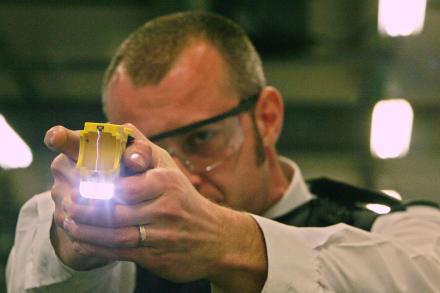
Hard as it may be to imagine, dear reader, once upon a time the police managed to fulfil their obligations to society without resorting to electrocuting children. The sky did not fall. Teenage ruffians did not run amok. Life went on, much as it had before. Changed times, of course. These days, the carrying of Tasers has become increasingly normal. And when the police are armed as a matter of course, it's no surprise that they are increasingly likely to deploy force. Even on children. And pensioners. The youngest person Tasered by the police in England and Wales in 2013 was 14 years old; the oldest a menacing 82 years old. According to police statistics obtained by the BBC, officers Tasered 37 children in 2013.

Ruth Davidson’s Blue-collar Conservatism subtly rebukes David Cameron

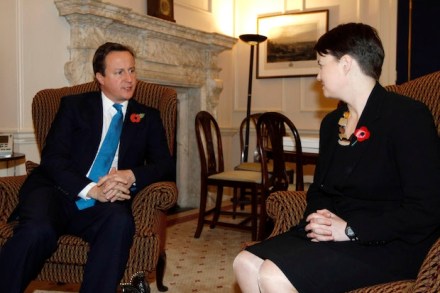
Today's Scottish Conservative conference in Edinburgh proved unexpectedly interesting. No, really. Or, rather, yes, really. Or whatever. David Cameron spoke, you see, and so did Ruth Davidson and they said very different things. For important Prime Ministerial timetabling reasons (ie, he needed to get back to London) Cameron spoke first and thus, unusually, served as the warm-up guy. Which merely helped emphasise the difference between what the Prime Minister said and what the Scottish Tory leader had to say. Some of this was a question of substance.Cameron declared that the national question is "settled" whereas Davidson warned that "This isn't over and it hasn't gone away". Only one of them can be right and it's not the Prime Minister.

Peter Oborne has performed a great public service today

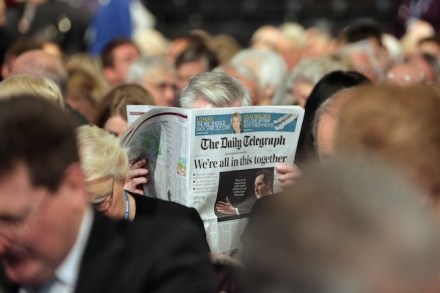
Well, this is awkward. Peter Oborne is a friend and The Spectator shares a proprietor with The Daily Telegraph. So there is a danger that anything written in this space will seem craven or kowtowing. Nevertheless, Peter, late of this parish and now late of the Telegraph too, has performed a public service today by resigning his post as the Telegraph’s Chief Political Commentator. He is a man of great conviction and deep principle. Often mistaken, perhaps, but always magnificently worthwhile. His suggestion that the Telegraph has, shall we say, a rather too cosy relationship with some of its advertisers - and especially with HSBC - is not the kind of allegation made without good cause or serious consideration.

Bold new Tory election strategy: Tax cuts for our chums; welfare cuts for you

"There's a lot we need to do in this party of ours. Our base is too narrow and so, occasionally, are our sympathies. You know what some people call us - the nasty party." Theresa May, October 8th 2002. February 17th 2015, David Cameron announces plans to make 50,000 youths spend 30 hours a week on community service schemes to keep their "Youth Allowance" benefits. The Youth Allowance, by the way, is £57 a week. And today's announcement follows suggestions that fat people should lose access to benefits unless they lose weight. Look, it's not the goal that's the problem here. When Cameron says there is a moral quality to reducing the benefits bill he is not wrong. When he says there are people who could work  - and with the right assistance can work - he is not wrong.

David Cameron is lucky he faces Ed Miliband, not Nicola Sturgeon

In some respects David Cameron has been a lucky politician. Lucky that his predecessors had failed so completely that his initial brand of so-called modernisation seemed a punt worth taking. Lucky that he faced Gordon Brown, not Tony Blair. Lucky that he could pivot from 'sharing the proceeds of growth' to 'we're all in it together' without too many people noticing (or caring too much). Lucky, above all, that he now faces Ed Miliband. Because however you dress it up, this has not been a happy government. In economic terms - the defining issue of the age - his party has missed many of its most important targets. Functionally-speaking, George Osborne's record in office has followed Alistair Darling's 2010 plans more than it resembles Osborne's own projections from five years ago.

Another day, another UKIP dog whistle. Fancy that!

You will recall that when Talleyrand died, Metternich is supposed to have asked 'What did he mean by that?' Say this for Nigel Farage: he's no Talleyrand. Subtlety is not part of the UKIP genome. Take, for instance, a Kipper press release issued this afternoon. I confess I had not hitherto been aware of UKIP's alliance with the RSPCA and the British Veterinary Association. So it was good to discover that Mr Farage's party is calling for a 'ban on the non-stun slaughter' of animals. I wonder what they mean by that? Oh. You see: "We find the government response to this issue is [sic] weak, lazy and bordering on spineless.