Alex Massie

Alex Massie

Why I am voting Labour

This is a bastard election full of bastard choices. In such circumstances some triage is required. Once everything that is impossible has been eliminated what remains must, for tomorrow at least, be the truth. Which is why, as I wrote in today's Times, I shall be voting Labour. For the first time. Ever. It is not a vote cast lightly or with much confidence. But though my constituency, Edinburgh North and Leith, has an admirable Tory candidate the sorry truth is that he cannot win tomorrow. This being the case, it is not illogical to vote for the least bad candidate who might have a chance of prevailing. In this instance, that is the Labour candidate. It will probably not be enough.
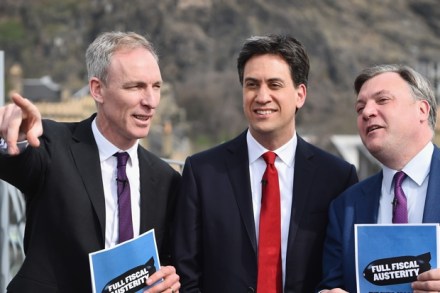
Labour’s demise in Scotland is a problem for the Tories too. They just don’t know it yet

Heaven preserve us from our friends for, though they mean well, they know not the damage they do. I have great respect for Danny Finkelstein. The Pride of Pinner is one of the best and sharpest columnists in the land. There is gold in every column he writes. So having said that, I am not - this should be obvious - altogether persuaded by his latest epistle. Let's concede there's plenty the noble lord gets right. He is correct to observe that the SNP is now doing to Labour what Labour once did to the Conservatives: denying their legitimacy. He is right, too, that the logic of devolution only leads in one direction. (The Unionist Ultras who opposed the establishment of the Scottish parliament had a point - and, in their terms, some logic - on their side.

Francine Prose reminds us why so many novelists are so very, very stupid

I asked yesterday why so many novelists are so often so stupid. The answer, I suppose, is that we should expect no more from novelists than we do from plumbers. (Though I apologise to plumbers for comparing them with novelists). Helpfully, however, Francine Prose pops-up in the Guardian (where else?) to validate most of what I wrote about the protest, of which Ms Prose is part, against awarding the staff of Charlie Hebdo an award for their courage in defending free speech under, literally, fire. You can tell that Ms Prose is a simpering ninny straightaway because she frets that Charlie Hebdo is an 'inappropriate' recipient of such an award. Inappropriate! Nevermind the facts, madam, judge the appropriateness.

This is a narrow-cast election, not a national contest

This continues to be a most remarkable election. I can't recall any other contest in which so many parties were speaking to so many different audiences, many of them niche. This, to use a ghastly piece of jargon, has been a narrow-cast election. There is no UK-wide conversation; everything is local and particular. It's spawned some notable election literature. I've been forwarded one such piece of mail, delivered to lord knows how many voters in Berwickshire, Roxburgh and Selkirk (the finest constituency in the land, by the way). This is what it looks like: It reads: Dear Resident, I'm writing to thank you for the tremendous support that I have received from across the Borders during the last few weeks and months of this election campaign.

Why are so many novelists so stupid?

If you feel a need to search for moral cowardice then, in my experience, literary festivals are likely to be as happy a hunting ground as any. Should you be lucky enough to find Peter Carey, Michael Ondaatje, Francine Prose, Teju Cole, Rachel Kushner or Taiye Selasi listed in the programme then, by jove, your ship will have come in. Moral dwarves, each of them. You see they are, all of them, unhappy that PEN America decided that, this year of all years, it would honour the editors and staff of Charlie Hebdo with PEN's annual Freedom of Expression Courage award at the organisation's annual gala. So unhappy, in fact, that they have decided to 'boycott' the evening.

Scotland’s two tribes are more divided than ever – they see reality differently

Expectations just keep increasing for the SNP. Today's Panelbase poll for the Sunday Times puts the nationalists on an eye-popping 48 percent of the vote in Scotland. Labour activists and candidates report better that on the fabled doorsteps the response they're getting is much better than that recorded by the opinion pollsters. Doubtless, in some constituencies, this is true. But it seems unlikely to be enough. The ship will not go down with all hands but there will still, it seems, be few survivors. This remains a strange election. Ordinarily I'd say the straw-clutchers are hopelessly mistaken. The numbers do not lie. They are worth more than anecdotal evidence and gut-checking hunches. And yet, can it really be the case that the SNP will win as many as 50 seats in Scotland?

Yes, of course an SNP-backed Labour government is perfectly legitimate

I am sure, as Isabel says, that Tory warnings about the horrors - the horrors, Mabel - of a Labour-SNP arrangement at the Palace of Westminster are, as they say, cutting through with voters south of the border.  It's not as though the Tories have been pushing their own uplifting, positive, cheery, message for the country. Instead they have doubled-down on nationalist-inspired risk and chaos.  Why, Sir John Major (and others) chunter on about the appalling lack of democratic legitimacy any SNP-backed Labour government would have. Fiddlesticks and codswallop and a hundred other brands of prattling nonsense. Such a government might be less palatable than some; it would be every bit as legitimate.

The SNP create their own reality – and voters lap it up

First let's look at this chart. That's Scotland's fiscal position relative to that of the UK according to the latest IFS projections. It's not a particularly bonny position though, of course, it is only a projection. Nevertheless, the picture is quite clear: fiscally-speaking Scotland gets a pretty good deal from the UK. An above-average contributor? Sure. But also, importantly, an above-average recipient. Scotland contributes (thanks to oil) like a tiny-London but receives like a mini-Northern Ireland. Nowhere else is like this. Now have a keek at this: Stephen Noon, you will recall, was one of the architects of the Yes Scotland campaign and someone, I hope he will not mind me saying, generally considered one of the sharper SNP blades.

A vote for the SNP is a vote for a Labour government

For decades now the SNP have thirsted for the moment when they can be 'relevant' to the outcome of a Westminster general election. Well, they have that relevance now. Never before has the launch of their manifesto attracted this kind of attention. Then again, never before has the SNP had realistic hopes of becoming the third largest party in the House of Commons. But strength is often just weakness disguised and, once again, more than one thing can be true at the same time. And the truth is that the SNP's position is both remarkably strong and much weaker than many people assume. I still don't believe that the nationalists will win 50 of the 59 seats they are contesting but I concede that my faith in this belief is a little weaker than it was a fortnight ago.

Yes, the SNP really is a faith-based party peddling miracles

The thing about faith is that, in the end, it's unfalsifiable. You either have it or you don't. But even within the community of the faithful there must be room for doubt. Indeed it's the doubt that often proves the faith. The late Neil MacCormick (praise be upon him, etc), once suggested there were two kinds of Scottish nationalist. The existential, come-what-may, nationalist and the utilitarian, evidence-weighing, nationalist. It was, and remains, a cute distinction. Unfortunately, for the most part, it is also bogus. A man - or, indeed, a woman - may start as a utilitarian nationalist but by the end of his cost-benefit analysis he is likely to have become an existential nationalist. If the facts change, his mind would not.

Scotland’s new national faith

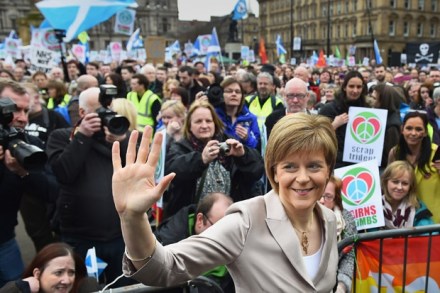
The Church of England’s catechism begins ‘What is your name?’ The old Presbyterian catechism favoured in Scotland asked a better, sterner question: ‘What is the chief end of man?’ The difference is telling and, in this general election, illuminates something useful about the differences between politics north and south of the Tweed. Nicola Sturgeon is a populist, certainly, but she is offering something stronger on the side. If England’s election offers a meek choice between Cameron and Miliband, Scotland’s is a faith-based affair. The answer to the catechism’s question, in these irreligious days, appears to be that man’s chief end is to glorify Scotland and enjoy her for ever.

Sturgeon vs Murphy vs Davidson is the best show in British politics

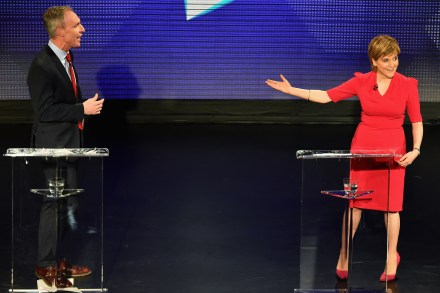
Right now, you know, Nicola Sturgeon vs Jim Murphy vs Ruth Davidson is the best show in British politics. It really is. Better, for sure, than David Cameron vs Ed Miliband vs Nick Clegg. The three Scottish leaders are each substantial - and likeable - figures in their own right but it also helps that the question of Scotland is a large and important issue upon which there is mighty disagreement. That makes for a heftier, more passionate, kind of politics. The future matters and is, depending upon our choices, very different. It is more than just a managerial process. This week's two Scottish debates confirmed all this. They were, as Fraser says, proper politics. There is a thirst for argument up here and a welcome for the rough-and-tumble too.

Nicola Sturgeon and the SNP continue to defy the usual laws of politics

It's nice to be noticed. I cannot recall the Scottish portion of a UK general election ever exciting this much interest from folk unfortunate enough to live south of the Tweed. I don't blame southrons for wondering just what in god's name is happening up here, however. These are uncharted waters for all of us. And yet, despite that, it is a little less revolutionary than it seems at first. Consider these numbers: 39, 33, 29, 32. That's the share of the constituency vote won by Labour in the four elections to the Scottish parliament. And then there are these numbers: 29, 27, 33 and 45. That's the share won by the SNP.

Who won the leaders’ debate? All of them.

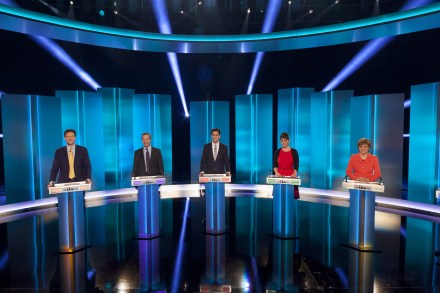
So who won? That's the question, isn't it? Well, not really. This debate, like most such affairs, is not a horserace in which the winner is easily determined. Because not everyone was racing to be across the line "first". That's not actually the nature of the game. The question is not who was crowned the "winner" by the post-debate polls (which are, in any case, largely meaningless and utterly useless in terms of measuring any impact on the wider campaign). No, the only question that really matters is this: who achieved what they wanted to achieve last night? And the tiresome, boring, correct answer to that is all of them. Let's run through the list: David Cameron: A good night for the Prime Minister.

No, Jim Webb will not beat Hillary Clinton

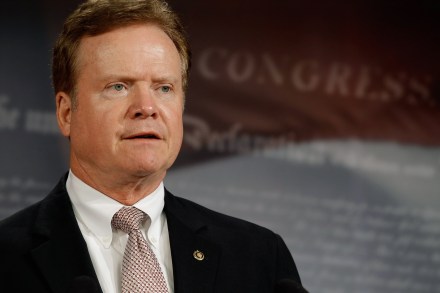
Look, I'm sorry about this, but Jim Webb is no more going to be the Democratic nominee next year than Rick Santorum is going to be the Republican candidate for the Presidency of the United States. Indeed Santorum, who has no chance, has a better chance than Webb of succeeding Barack Obama. Which is annoying, I know, because it means the search for a pundit-worthy alternative to Hillary Clinton goes on. Webb, the Marine Corps veteran, novelist, historian and one-term Virginia Senator, is neither the first nor the last candidate to inspire could-he-really journalistic prayers for a competitive contest for the Democratic nomination.

Why aren’t the Tories winning? Because they are seen as the party of the rich.

The leader column in this week's edition of the magazine (please subscribe, by the way) asks an excellent question: Why aren't the Tories winning? After all, and despite everything, David Cameron has presided over a period of, first, economic stabilisation and, now, some useful quantity of economic growth. His party is better trusted on economic issues than the opposition and, well, Mr Ed Miliband has not yet convinced voters he has the chops to be Prime Minister. As Danny Finklestein observed in The Times yesterday, it is possible to lose despite enjoying one of those advantages but most unusual to lose while being ahead on both these metrics. And yet the Tories may still lose. What gives?

A shocking Scottish opinion poll reveals that Labour aren’t dead yet

When is a disaster also a miracle? When it allows Scottish Labour to simultaneously endure its worst result since 1931 and live to fight another day, that's when. Yesterday's ComRes/ITV poll is the best news Labour has enjoyed in months. That's how grim it has been for Labour lately. A poll of voters in 40 Labour constituencies which puts them six points behind the SNP may not be much of a lifeline but it's the only lifeline available to the erstwhile people's party. It will have to do. Sure, this poll suggests the SNP could take as many as 28 Labour seats meaning that the nationalists would, probably, win something like 44 of the 59 Scottish constituencies. This is not exactly a good result for Labour; it's still a better result than those indicated by previous polls.

Boffo Tory election strategy launched

You will remember how the Tories planned to deal with Ukip. Well, that was just the start. David Cameron's interview with the Daily Mail today is all very well and good but it remains the case that the party's approach to Scotland is very simple: THE SNP ARE DREADFUL. PLEASE VOTE FOR THEM. (Works best if delivered in the style of Kenneth Williams.

Everything Yes voters believe about the Scottish independence referendum is wrong (but that doesn’t matter)

Say this for Alex Salmond: he is entirely typical of the movement he once led. The former First Minister's new book makes much of what you might deem the referendum's dirk-in-the-back theory. It was The Vow what won it; the last-minute, hastily-prepared, promise of more powers for the Scottish parliament. Without that, Yes would have carried the day. And it if wasn't the bleedin' Vow it was the revolting, Unionist, press. If they had not hoodwinked the Scottish people everything would have been different. Conveniently, this allows Yes voters to avoid asking why they lost a referendum they might have won. A referendum, in fact, that until the votes were counted they were convinced they had won.

The BBC was right to sack Jeremy Clarkson

There's no cause so disreputable it cannot find adherents. And, failing that, apologists. Take, for instance, the apparently simple case of a powerful man - powerful in status more than physique - who assaults one of his junior helpers. In ordinary circumstances -  that is, if this assault took place in a cheese factory or on a farm or in an insurance brokerage - everything would be pretty bloody simple. It's not really OK for senior folk - even if they are the talent - to start lamping their subordinates. Said lamper would ordinarily - and quite properly - risk their job by hitting their junior colleagues. I guess my view is weirdly stupid, however. I mean, it had never occurred to me that Jeremy Clarkson was sacked for being too right-wing.