Alex Massie

Alex Massie

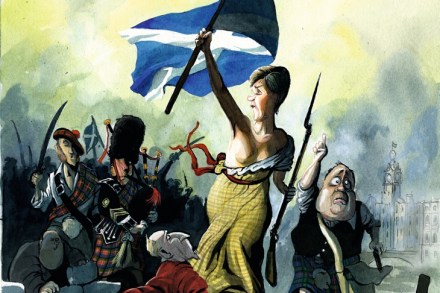
Ruth, Queen of Scots

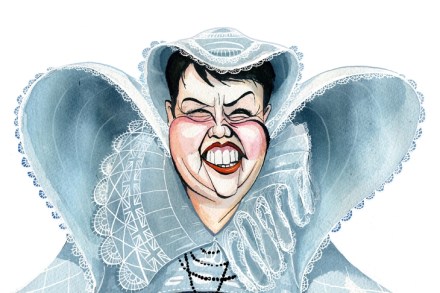
Twenty years ago, Conservatism all but died in Scotland. Tony Blair’s landslide victory made Scotland, at least in terms of its Westminster representation, a Tory-free zone. At no point since has the party won more than a single Scottish seat, and the last time the party won more than a quarter of the Scottish vote, in 1983, its current leader, Ruth Davidson, was four years old. Two years ago, the Tories won just 14 per cent of the vote, an even worse result than 1997. This seemed to fit a broader narrative: Toryism had been beaten back into England, a sign of the union’s exhaustion and a Scotland moving inexorably towards independence. How different it all looks now.
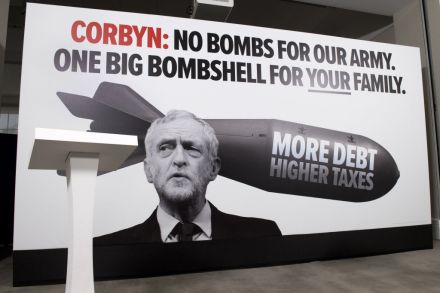
The Conservative party is treating the electorate like mugs

What a curious election this is proving to be. It is hard to think of another general election in which the two largest political parties indulged in so much nonsense, nor did their best to persuade you that what is evidently true cannot possibly be true.  In the first place, the Conservative party asks you to believe the Labour party could yet finagle its way into Downing Street. You can’t afford to take a risk on Jeremy Corbyn, the Tories tell a public that has not the slightest intention of taking a risk, or anything else, on Jeremy Corbyn.

What’s the point of the SNP?

Well, golly, Nicola Sturgeon, leader of the SNP and First Minister of Scotland, says this general election has nothing to do with the arguments for or against Scottish independence.  In one sense, this is correct in as much as independence is not the question on the ballot. But in another, deeper, more genuine sense, everyone knows Sturgeon is pulling your leg here. The election is a proxy referendum on the question of whether there should, at some point in the next couple of years, be another independence referendum. Everyone in Scotland, including SNP supporters, knows this. Even so, as the Tories have noted, this is a familiar SNP argument.

There is something grubby about Theresa May’s snap election

Since I suggested last July that Theresa May, newly anointed as leader of the Conservative and Unionist party and Prime Minister of the United Kingdom of Great Britain and Northern Ireland, should call an election to both establish her own legitimacy and allow the country an argument over the kind of Brexit it preferred, it would be unseemly to now deplore her belated decision to go to the country.  Happily, there remain many other things that may be deplored. Far from the least of these is the manner in which the Prime Minister has made her case for an election. It’s not her fault, you see, that she has (correctly, in my view) gone back on her word. She remains a pretty straight kinda gal, you know.

The general election will be a vote on Scottish independence

'Now is not the time' except, apparently, when now is the time. The reasons for engineering a general election are many and obvious. The current government is tolerated, not welcomed. Theresa May needs a mandate of her own. A thumping Tory majority - the only conceivable outcome of any dash to the country - will not hugely strengthen her position with Britain’s erstwhile european friends and partners, but it will secure her position on the domestic front. For Labour, too, this is an opportunity to lance a boil: it will, or should at any rate, end the Jeremy Corbyn era. For their part, the Liberal Democrats should welcome the opportunity to make their pro-EU - or, rather, anti-Brexit - pitch to the electorate.

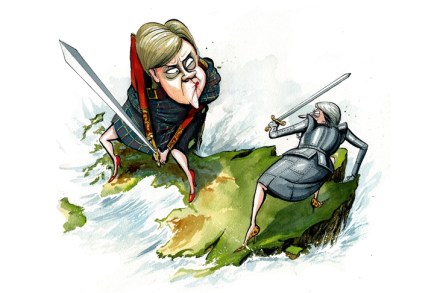
Who has the better mandate: Theresa May or Nicola Sturgeon?

For the last week, the Unionist opposition at the Scottish parliament has enjoyed observing that the Scottish government is happy to ignore non-binding votes at Holyrood when it suits them to do so but now expects the UK government to be bound by today's vote authorising the Scottish government to seek a Section 30 order that would begin the process by which a lawful second referendum on independence can be held. It is a neat line but an insufficient one, not least since this vote - unlike some of those on which the SNP government has been defeated - actually recommends a particular course of action that the government should follow.

Why do so many right-wingers hate Britain so much?

One of the curiosities of the past 72 hours has been the manner in which it has become possible to make a clear distinction between those people who like and admire this country and those who only say they love it. There are certain ways in which the latter may be identified. The presence of a Spitfire or a noble lion on their social media profiles is one all but unerring indicator that you're dealing with someone who deplores the realities of modern Britain. These stout-hearted, willy-waving yeomen cannot help wetting themselves. The Mooslims are coming! (From Kent, it seems.) They are the panicky ones, not the ordinary British people who, while horrified by this week's events, have quietly continued to go about their business. London is not under siege; it has not fallen.

Nicola Sturgeon’s speech to SNP conference suggests she’s playing a long game

If Nicola Sturgeon is not the only star in the nationalist firmament, she remains the only one that can be relied upon to shine brightly. The SNP's conference in Aberdeen this weekend reminded us of that fact. Angus Robertson commands a measure of respect but not even he would claim to be loved by the party. Nicola Sturgeon hasn't always been either; she is now. And there was a reason—or, rather, many reasons—why Alex Salmond as denied the chance to address delegates from the conference stage. Yesterday's man is considered an unfortunate embarrassment these days. And Sturgeon's speech began well. ‘Our job is not to talk to each other’ she said.

Why is the UK government so happy to give the SNP what they want?

'Now is not the time' is not an answer to anything, not least since no one has actually suggested a second referendum on Scottish independence take place 'now'. In that respect, the Prime Minister's line today answers precisely nothing and cannot be sustained inevitably. I should have thought this sufficiently obvious enough that even people in Downing Street could have discerned this. But evidently not. The SNP are past-masters when it comes to mining grievance. That being so, however, you wonder at a strategy that hands them a gold-plated grievance and does not even seek to charge them a fair price for it. Theresa May might as well have said: 'Here, have this one for free'.

Scottish nationalists will now use a simple slogan: ‘Take back control’

Fraser Nelson is joined by Alex Massie and James Forsyth to discuss IndyRef2: You were warned, you know. You were told this would happen. And you voted for Brexit anyway. Because you privileged leaving the European Union over not giving the Scottish government an excuse to put the future integrity of the United Kingdom back at the heart of our politics. And then you did it anyway. That was your right. Of course it was. But you were told what would happen next and, lo, it has. So do not feign surprise today. Choices have consequences and some of them were not hard to foresee. This morning, Nicola Sturgeon made the biggest gamble of her political life. Brexit, she confirmed, has changed everything.

The SNP’s rosy-tartaned independence vision comes unstuck

In 2013, the Scottish National Party claimed an independent Scotland would be the sixth richest country on earth. Like many extravagant suggestions, this contained the essence of its own downfall. It would be lovely if it were true but didn't it seem just a tiny bit too good to be true? At the same time, and for the next 18 months or so, SNP politicians assured the Scottish people that there was no need to worry about the economic case for independence. They had the numbers to prove it. Granted, no one was ever encouraged to ask awkward questions about the assumptions made to generate this rosy-tartaned vision. For instance, what level of immigration would be needed to compensate for a population ageing more rapidly than the UK as a whole?

Back into battle

On 24 June last year, in the Georgian splendour of her official residence in Edinburgh’s Charlotte Square, Scotland’s First Minister offered her reaction to Britain’s decision to leave the European Union. Since Scottish voters endorsed Remain, it was now, Nicola Sturgeon said, ‘highly likely’ there would be another referendum on Scottish independence. Since then that promise — one viewed with dread by the two million Scots who voted to preserve the Union in 2014 — has been variously ‘on the table’, ‘more likely’ than ever and even ‘all but inevitable’. The clock is ticking. Later this month, Sturgeon will address her party’s annual conference.

Tony Blair is right about Brexit

I don't know about you but if I were to make a speech arguing that democracy should be abandoned, I probably wouldn't begin by saying 'I want to be explicit. Yes, the British people voted to leave Europe. And I agree the will of the people should prevail.' That's just me, however. When Tony Blair says this, he apparently means to encourage an anti-democratic insurrection. Which, I suppose, makes sense if you still suffer from an acute case of Blair Derangement Syndrome. Plenty of people evidently do. If Blair is really as toxic and irrelevant as his critics aver, there'd be no need for all this fury. Blood vessels could remain unburst and eyes unpopped. The reaction to Blair's speech suggests something else. It suggests that he must have a point.

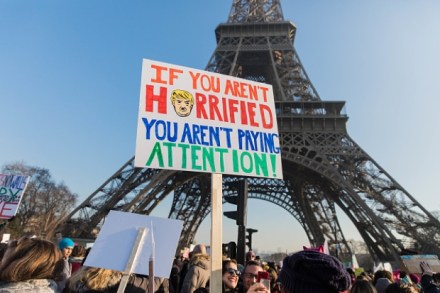
People who protest against Donald Trump are not the problem. They are right

You know what the world needs right now? More seriousness, that's what. Within that, we desperately need more serious commentary. These are serious times and they demand stout-hearted, truth-telling, serious people. The kinds of people who will speak truth unto power while assaulting a series of diminutive straw men. Serious types who stroke their serious chins with their seriously perfectly-formed serious fingers. There are rituals that must of course be observed. You must, if you wish to be serious about these matters, admit that Donald J Trump is a sub-optimal, even deplorable, president. You certainly do not hold a candle for him. Nor do you hold anything else. No fawning admirer you. No sirree. But, being gimlet-eyed, you can identify the real issue here. Trump might be vulgar.

Theresa May’s embrace of Donald Trump humiliates Britain

So now Theresa May knows what it's like to be Tangoed. Her visit to Washington, hailed a 'triumph' by friendly newspapers, has become a liability. Life comes at you fast, especially when you launch a diplomatic initiative on a wing and a prayer, not in response to a clinical evaluation of its likely outcome. Because who can really be surprised that hugging Donald Trump close would so swiftly induce a form of diplomatic blowback? Who is surprised that tying yourself to an administration as vicious as it is incompetent might prove a high-risk enterprise? The Prime Minister played two roles on her trip to the United States. She was both supplicant and counsellor.

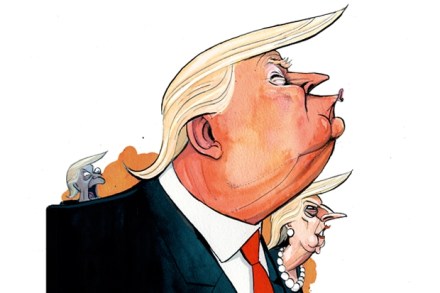
No, Donald Trump isn’t a ‘massive, magnificent gift’ for Britain

There are certain traditional ceremonies without which the inauguration of a new American president cannot take place. Chief among them, at least on this side of the atlantic, is the opportunity such a moment provides for pondering anew the health and well-being of the 'special relationship'. A remarkable amount of tripe must be talked on these occasions. You will recall how Bill Clinton's supposedly-unhappy time at Oxford prejudiced him against this country and you will recall, of course, that Barack Obama's Kenyan heritage left him temperamentally ill-disposed towards this sceptr'd isle. Obama, of course, confirmed this by removing the now famous Churchill bust from the Oval Office, an act of unpardonable impertinence.

A full English Brexit is on the menu

Kipling wrote about Brexit first, you know: "It is always a temptation for a rich and lazy nation, To puff and look important and to say: Though we know we should defeat you, We have not the time to meet you. We will therefore pay you cash to go away." That, in essence, was David Cameron's approach to the eurosceptics within his own party. Promise to pay just enough to keep them satisfied in the hope they would not then be emboldened to come back for more. But, as Kipling knew: "And that is called paying the Dane-geld; But we've proved it again and again, That if once you have paid him the Dane-geld You never get rid of the Dane." Theresa May, to give her credit, has solved this problem. She has decided that if you can't beat them you might as well join them.

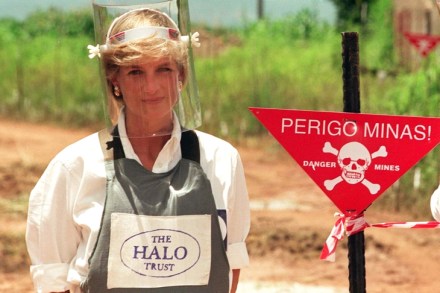
Princess Diana understood what ‘global Britain’ meant. Does Theresa May?

So, 'global Britain' eh? This, we are told, will be the leitmotif for Theresa May's Brexit speech tomorrow and, indeed, for her approach to international affairs more generally. And who could disagree with any of that? The argument will, of course, be couched in economic terms. The spirit of Britannia will be unleashed to sail the world's oceans. Britain is back, you know. We shall show the doubters what we're made of and by jove we'll make a success of Brexit. Well, let us hope so. There are many kinds of internationalism, however, and I'm not sure - at least not sure yet - the buccaneers really appreciate, far less admire, all of them. I always thought David Cameron's aspiration to spend 0.7 per cent of GDP on foreign aid a noble ambition.

The SNP’s dominance in Scotland is complete

Like the past, Scotland is a different country. Things are done differently here. What might be thought eyebrow-raisingly inappropriate in a larger polity is considered normal here. Consider these three examples: In 2015, Scottish Television decided it was a good idea to make Nicola Sturgeon, together with her sister and her mother, the star of its Hogmanay broadcast. New Year with the Sturgeon's was in turn hosted by Elaine C Smith, the comedienne who was, conveniently, also a member of Yes Scotland's advisory board during the 2014 independence referendum. Earlier this month, the SNP rolled-out the first 'baby boxes' that will be delivered to every new-born infant in Scotland. The idea, borrowed from Finland, is to support mothers by providing a kind of starter-pack for infancy.

Nicola Sturgeon is making it up as she goes along

Because the SNP have won so often and so conclusively in recent years there is an understandable temptation to suppose they must always know what they are doing. Accordingly, Nicola Sturgeon sits in Bute House like some political Moriarty: motionless, perhaps, but like a spider at the centre of its web. And 'that web has a thousand radiations, and [s]he knows well every quiver of each of them'. Other political parties may plan, but the SNP plots. Everything is done for a reason and nothing is left to chance. The nationalists are relentless and implacable. No wonder they put the fear of God into their foes (especially a Labour party they long since supplanted as the natural party of government in Scotland).