Culture

Culture

The good, the bad and the ugly in books, exhibitions, cinema, TV, dance, music, podcasts and theatre.

One beauty – one turkey: Wexford Festival Opera reviewed

Opera

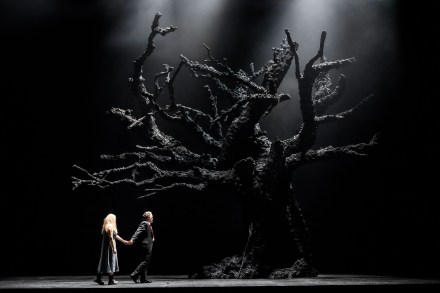
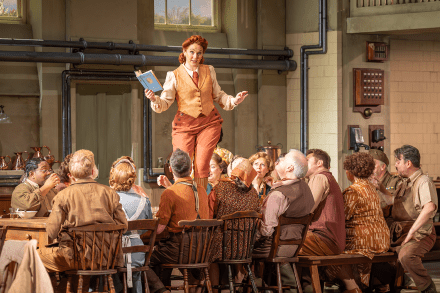
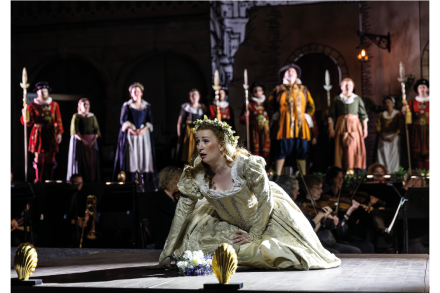
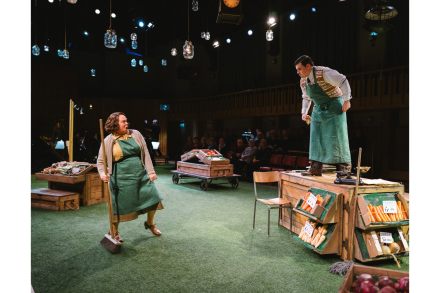
‘Theatre within Theatre’ was the theme of the 2024 Wexford Festival and with Sir Charles Villiers Stanford’s The Critic, that’s exactly what you get. Conor Hanratty’s production showed the interior of an 18th-century theatre, viewed from the stage. In the second act it flipped around to reveal the audience’s perspective. Were we now the audience? Clearly we were; which was awkward because where does that leave a critic? Obviously, one can’t be the critic because there’s already one on stage (the clue’s in the title), and as it turns out, The Critic isn’t really about critics, at all. Whatever – you get the picture. It’s all very meta; and more than a bit silly.

You’re unlikely to see a better case made for this Bernstein double bill 

Opera

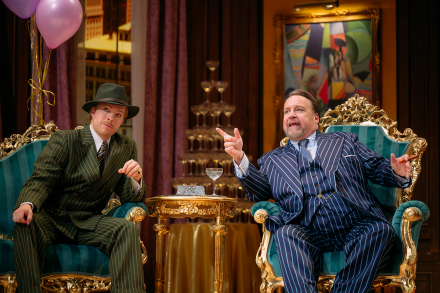
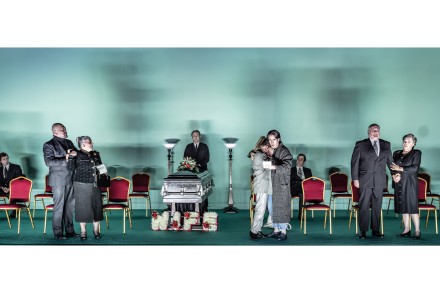
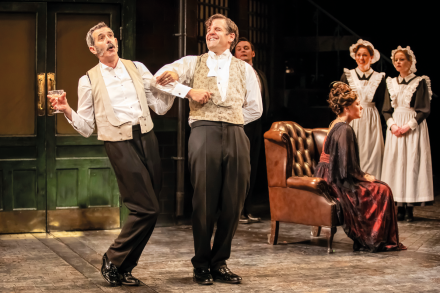
It’s rare nowadays to see a new opera production that’s set in the period that the composer and librettist intended, but they do occasionally come along. In the case of Leonard Bernstein’s operas Trouble in Tahiti and A Quiet Place, the time and place are basically the whole plot. Trouble in Tahiti dates from 1951; a sassy little one-act satire on America’s postwar consumer idyll. It’s practically perfect. A Quiet Place is from 1983 and it’s a sequel, set 40 years later – post-Vietnam and post-Woodstock, with the nuclear family in full meltdown. These performances, and this production, provoke thoughts that might rob you of sleep It’s a bit of a mess, in other words, and Bernstein never really made the pairing work.

Committed performances – but who was the granny? Northern Ireland Opera’s Eugene Onegin reviewed

Opera

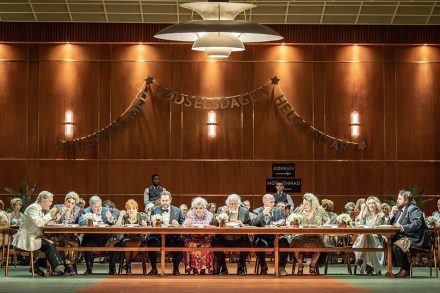
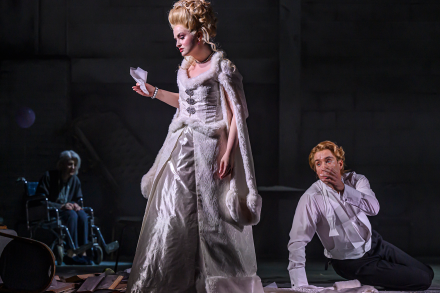
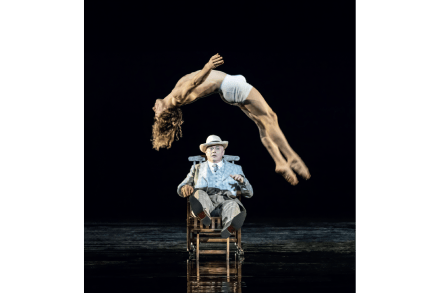
It’s a critic’s job to pick holes in the dafter aspects of opera productions, but in truth audiences are usually capable of detecting nonsense when they see it. ‘She must be at least 150,’ commented the gentleman sitting behind me, referring to the wheelchair-bound old lady who was trundled on stage at the start of Northern Ireland Opera’s new production of Eugene Onegin, and then parked there, pretty much for the duration. It really buzzed along, even if the set resembled a public lavatory (urinal chic seems to be an emerging trend) He had a point. Was she meant to be an elderly Tatyana? Then why was she dressed in modern clothes when the rest of the action played out in the era of Pushkin?

Aggressively jaded: Edinburgh’s Marriage of Figaro reviewed 

Opera

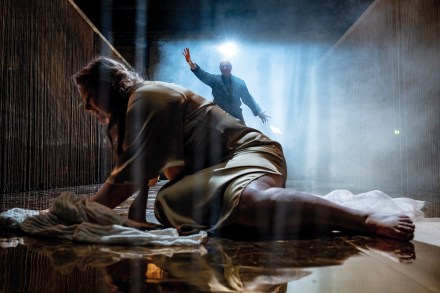
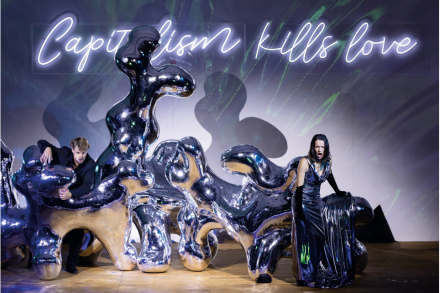
‘Boo!’ came a voice from the stalls. ‘Boo. Outrage!’ It was hard not to feel a pang of admiration. British opera audiences don’t tend to boo; we’re either too polite or too unengaged. But there we were in Act Three of Kirill Serebrennikov’s production of The Marriage of Figaro – just after the scene where Susanna, the Count and the Countess enjoy a three-in-a-bed romp while singing the trio ‘Soave sia il vento’ – and at least one person felt passionate enough to raise his voice. It was hard not to feel a pang of admiration. British opera audiences don’t tend to boo Obviously, there’s no such trio in The Marriage of Figaro.

Britain’s youngest summer opera festival is seriously impressive

Opera

Waterperry is one of the UK’s youngest summer opera festivals: it started up in 2018, at the northern limit of the species’ natural habitat. You leave the motorway at Oxford services and double back through the fields to the hamlet of Waterperry. Drive past the ‘Cats Crossing’ sign and the life-sized effigy of Rowan Atkinson (honestly) and you’re there. There’s a big house (slightly run to seed), a farm shop, a garden centre and a nursery containing the national saxifrage collection, which is not something you see every day. The opera festival squeezes in between them. Let’s do the show right here! Well, why not? The Barber was literally staged on the lawn. And if it rains? ‘We hope it won’t. Would you like a poncho?

In defence of Gilbert & Sullivan’s The Grand Duke

Opera

Artistic partnerships are elusive things. The best – where two creative personalities somehow inspire or goad each other to do better than their individual best – can seem so natural that they’re almost easier to identify by their absence. No one’s queuing up to revive Richard Rodgers’s Rex (lyrics by Sheldon Harnick). Pretending to rate Band on the Run above Revolver is a fun way to wind up boomers, but c’mon – honestly? With Gilbert and Sullivan, meanwhile, recordings have given us the chance to rediscover Grundy and Sullivan’s Haddon Hall and Gilbert and Cellier’s The Mountebanks: turkeys both.

A major operatic rediscovery: Birmingham Opera Company’s New Year reviewed

Opera

This prophecy Merlin shall make, for I live before his time. One of the most thrilling aspects of the Tippett revival has been the discovery that his late masterpieces seem to have been fitted with a four-decade time-fuse. Works that prompted bafflement in the 1970s and 1980s, and then sat there for years looking like duds, are suddenly acquiring their targets. A quarter of a century after Tippett’s death, they’re blinking into life, locking on, and detonating in huge, psychedelic sunbursts of precision-targeted beauty and truth.

Sparky and often hilarious: Garsington’s Un giorno di regno reviewed

Opera

Hang out with both trainspotters and opera buffs and you’ll soon notice that opera buffs are by far the more trainspotterish. It’s the pedantry, the one-upmanship (‘Really? You should have heard it with Goodall in 1976’). Above all, it’s the impulse to collect. You can’t actually buy little pocket books with lists of obscure operas to be underlined in biro once you’ve seen them (blue for a full staging, red for a concert performance) but there are certainly opera-goers who compile their own lists of personal stats – and they let you know it. The completist urge is powerful. Hardcore opera-spotters will cheerfully cross continents to cop a rare performance of Schreker’s Der Schatzgräber or César Franck’s Hulda.

An ensemble achievement that dances and sparkles: Glyndebourne’s Giulio Cesare reviewed

Opera

A classic opera production ages like wine. When David McVicar’s staging of Handel’s Giulio Cesare first opened at Glyndebourne in 2005, Michael Tanner – writing in these pages – loathed it. ‘A quite hateful betrayal’ was how he described a production that is now widely regarded as a classic. It would be easy to brandish those words now he’s gone – ha ha, no one ever erected a statue to a critic – ignoring the truth that any first night review can only ever be a snapshot, and that the big story back then was the hyperactive, neon-lit debut of Danielle de Niese as Cleopatra. Tanner did predict that de Niese would do well out of it, though no one guessed that she’d end up marrying the owner of the theatre.

‘Zings off the stage’: My Fair Lady, at Leeds Playhouse, reviewed

Opera

If you want to kill a musical, make it into a movie. Cats, Phantom of the Opera, South Pacific… cinema history is littered with dud remakes of world-conquering theatrical sensations. But it’s almost worse when a film musical succeeds on its own terms, and – like a mask eating into the face – proceeds to write over the original show in the collective memory. I once saw a newspaper describe a West End revival of The Sound of Music as a ‘stage version of the classic movie’, which is a bit like describing Pride and Prejudice as a novelisation of the hit BBC drama. Her coloratura is like sunlight on water.

A sugar rush for the eyes: Glyndebourne’s The Merry Widow reviewed

Opera

In 1905, shortly before the world première of The Merry Widow, the Viennese theatre manager Wilhelm Karczag got cold feet and tried to pull it. He offered Franz Lehar hard cash to withdraw the score, and when that failed, he rushed it on under-rehearsed, using second-hand sets from an older show. Or so the story goes anyway. Karczag couldn’t know that within a decade The Merry Widow would become the most successful piece of musical theatre in human history up to that point: an all-conquering global brand that gave its name to hats, corsets, cigarettes and a rather nice cocktail (equal measures gin and vermouth, splashed with absinthe, Bénédictine and bitters, in case you’re curious). In the 1920s an American firm even marketed Merry Widow condoms.

Shiny, raunchy, heartless spectacular: Platée, at Garsington, reviewed

Opera

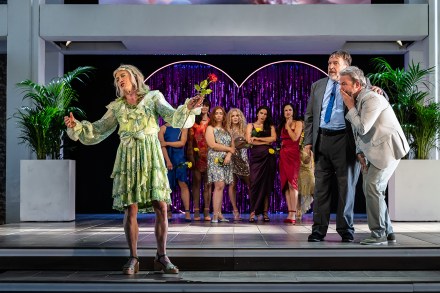
Fast times on Mount Olympus. Jupiter has been shagging around again and now his wife Juno has bailed on their hit reality show Jupiter & Juno, storming off set in a thundercloud of gold lamé and wheeled luggage. The producers are freaking out. Production runners scamper in all directions until Bacchus sends out to Starbucks and they all sit down to brainstorm a route out of ratings Hades. Meanwhile the luxury villa lies silent, its jacuzzi empty and the fake grass scattered with cardboard coffee trays. Cupid, it turns out, might have a plan – she knows a wannabe called Platée and, hilariously, she’s a total minger. Garsington’s new Platée is Greco-Roman mythology restaged as Celebrity Love Island And that’s just the prologue.

You could have built a tent city from all the red chinos: Aci by the River reviewed

Opera

The Thames cruise for which Handel composed his Water Music in 1717 famously went on until around 4 a.m. The boat trip downstream that formed part of the London Handel Festival’s Aci by the River was a bit zippier. We piled onto a chartered Thames Clipper at Westminster Pier, and a quartet of wind players were already huddled in the gangway, playing suitably aquatic Handel favourites. A bassoonist gave an anxious grimace as the captain floored the throttle and the boat lurched forward. If our craft had been wrecked on some enchanted isle, we could have built a tent city from the red chinos You do get to see an older, more Hogarthian city from the river, even if the skies were London-drab rather than the hoped-for Canaletto blue.

Think flute-playing Sir Keir will rescue opera? Look at Labour-run Wales

Opera

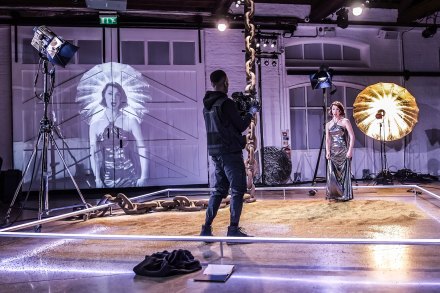
A tale of two opera companies from the Land of Song. After its distinctly gamey new Cosi fan tutte, Welsh National Opera has sprung dazzlingly back to form with a new production of Benajmin Britten’s final opera, Death in Venice. It’s directed by Olivia Fuchs, in collaboration with the circus artists of NoFit State, and in a word, it’s masterful. Fuchs’s Serenissima is a city of shadow, its landmarks glimpsed distantly in smudged, restless scraps of black and white film. The tourists and locals wear monochrome period dress; only Aschenbach (Mark Le Brocq) is in a noncommittal grey. The colour has drained from his world and from the peripheries of the stage he gazes, impotent, at the figures who dance and sport in the light, played by the acrobats and aerialists of NoFit State.

Homework, not theatre: WNO’s Cosi fan tutte reviewed

Opera

Mozart’s Cosi fan tutte hasn’t always been taken seriously. In fact for much of the 19th century it wasn’t even reckoned to be very good (Donald Tovey described its characters as ‘humanly speaking, rubbish’). For the modern director, there are several potential approaches. One – the hardest – is to try and evoke in the audience an approximation of a late-18th-century mindset. Another, scarcely easier, is to go all-in on psychological subtlety – the path taken by Tim Albery in the current Opera North production. A third is simply to play the whole thing as a saucy romp with a beautiful score, and that’s the choice that Max Hoehn has taken in his new staging for the Welsh National Opera.

Gleefully silly: Scottish Opera’s Marx in London! reviewed

Opera

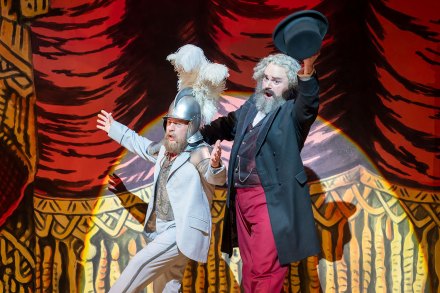
A bloke was working the queue outside the Theatre Royal, selling a newspaper called the Communist. ‘Marxist ideas, alive today!’ he shouted into the Glasgow drizzle. Was he part of the show; a Graham Vick-style touch of Total Theatre? In any case, he didn’t seem to be shifting many units. He might have been even more disappointed by the opera itself: Jonathan Dove’s Marx in London!, here receiving its first UK production, is a new opera buffa with Karl Marx as the protagonist of a gleefully silly period comedy.

On the evidence of their Siegfried, Regents Opera’s Ring will be well worth catching

Opera

It’s sometimes said that if Wagner were alive today he’d be making movies, but come on – really? A generation of Wagnerites has grown up for whom the first and definitive encounter with Der Ring des Nibelungen was on the small screen – in my case, the BBC’s early-eighties serialisation of the Bayreuth centenary production. What lingered was not the spectacle, but the intimacy: Donald McIntyre and Gwyneth Jones enveloped in darkness, reaching into each other’s souls. If you grew up with Wagner on TV and came of age, culturally speaking, around the time The Sopranos first aired, it seems obvious that the Ring isn’t some effects-laden Marvel blockbuster before its time, but the world’s first long-form TV drama.

Fresh as an April shower: Opera North’s Albert Herring reviewed

Opera

Opera North has launched its spring season with Giles Havergal’s 2013 production of Benjamin Britten’s Albert Herring, performed (as conceived) in the Howard Assembly Room – the company’s studio space next door to the Grand Theatre. The economics of opera are a dark and dismal science, but one of the few constants is that ticket sales are never the whole story. So if ON has revived a show that can only accommodate an audience of around 300, and which can’t tour, we should assume that’s all priced in. The problem here is that Havergal presents the opera in the round, a practice rarely seen on the unsubsidised stage but beloved by directors who don’t have to worry too much about the paying public.

Everything hits the spot: Royal Opera’s Elektra reviewed

Opera

Aristotle wrote that classical tragedy should evoke pity and awe. With Richard Strauss’s Elektra, the awe can be taken as read: a certain irreducible level of epicness is written into the score, even if – like Sir Antonio Pappano on the first night of this new production at the Royal Opera – a conductor takes the composer’s advice and treats it like Mendelssohn’s ‘fairy music’. But I genuinely hadn’t expected quite so much of the other emotion – pity, or if you prefer, compassion.

Irresistible: Hansel and Gretel, at the Royal Opera House, reviewed

Opera

Fun fact: Engelbert Humperdinck composed part of Wagner’s Parsifal. Shortly before the première, it was discovered that Wagner’s score didn’t allow time for a crucial scene change. The 27-year-old Humperdinck, then working as Wagner’s assistant, composed a few temporary bars to cover the gap and, rather to his own surprise, found that they met with the Master’s full approval: ‘Why not? It should work!’ It’s worth knowing partly because of the light it throws on the practical, collegial working methods of music’s favourite cartoon supervillain, and partly because it reaffirms the originality of Humperdinck’s own best-known opera, Hansel and Gretel. How many artists could have flown that close to Wagner’s magic fire, and still emerged with their individuality unsinged?

Cliché, cynicism and a car-crash finale: Royal Opera’s Jephtha reviewed

Opera

London’s two opera houses have been busy staging non-operas. Handel’s English oratorio, Jephtha, is his final exercise in a form that only existed because it was, explicitly, not opera (Georgian theatres needed something to play during Lent). We know better today, and dramatised reboots of Handel oratorios are proliferating, possibly because – unlike his actual operas – they give the chorus something to do. Katie Mitchell directed Theodora at Covent Garden last year. Now Oliver Mears has had a bash at Jephtha and has encountered the same basic problem. Operas seduce; oratorios preach. These are explicitly Christian, implicitly patriotic works, and what self-respecting contemporary director could allow that?

Juicy solution to the Purcell problem: Opera North’s Masque of Might reviewed

Opera

Another week, another attempt to solve the Purcell problem. There’s a problem? Well, yes, if you consider that a composer universally agreed (on the strength of Dido and Aeneas) to be a great musical dramatist left only one stageable opera (that’d be Dido and Aeneas), but hour upon hour of theatre music that’s effectively unperformable in anything like its original context: i.e., yoked to text-heavy Restoration dramas. How to get this stuff back on stage?  The story is rudimentary – just enough to support song, dance and a thumping great moral Masque of Might, David Pountney’s new extravaganza for Opera North, is one solution, and it’s rather a fun one.

Ebullience and majesty: Opera North’s Falstaff reviewed

Opera

Opera North has launched a ‘Green Season’, which means (among other things) that the sets and costumes for its new Falstaff are recycled. On one level, that’s nothing new: this eternally underfunded company has been performing miracles of sustainability for years now, and there’s usually at least one production each season that looks like it’s been cobbled together from the lumber room. A few seasons back, when ON rebooted their ‘little greats’ season of one-act operas, they mixed ’n’ matched sets between wildly different operas, with cheerful abandon.

ENO’s Peter Grimes shows a major international company operating at full artistic power 

Opera

In David Alden’s production of Peter Grimes, the mob assembles before the music has even started – silhouetted at the back, muttering and menacing. Ah, Britten’s mob: simultaneously the source of some of the most electrifying, elemental choral writing since Mussorgsky and a licence for British directors to indulge in premium-strength snobbery. Fully endorsed by the composer, of course: it’s essential to Britten’s artistic schema that we believe the inhabitants of small-town England are only ever one beer away from forming a lynch mob. As their hatred boils over, Alden has them pull out little Union Flags, completely without pretext. There’s no trace of political nationalism anywhere in the libretto or score.

Wagner rewilded: Das Rheingold, at the Royal Opera House, reviewed

Opera

In Northern Ireland Opera’s new Tosca, the curtain rises on a big concrete dish from which a pair of eyes gaze down, impassive. Walls of scaffolding tower on three sides of the stage, creaking as they expand under the heat of the stage lights. Point taken: Cameron Menzies’s production (the sets are by Niall McKeever) is a semi-abstract updating. It’s a fairly standard contemporary approach to Puccini’s Napoleonic thriller, though whether you get the full impact that comes with a more period-specific setting – that sense of individuals being crushed beneath the wheels of history – is another question.

An absolute romp framed by dutiful tut-tutting: Semele at Glyndebourne reviewed

Opera

If directors will insist on staging Handel oratorios as if they’re operas, it makes sense to pick Semele, which is practically an opera already. Under George II, opera was banned in London theatres during Lent (too exotick, too irrational), so Handel slipped his best material past the authorities by presenting it in concert format, set to biblical stories. Possibly by 1744 he was getting a bit careless, because there’s nothing remotely biblical about lovely, pouting Semele’s 24/7 shagathons (‘endless pleasure’, apparently) with King of the Gods and all-round studmuffin Jove. Handel’s sometime collaborator Charles Jennens denounced Semele as ‘no oratorio but a bawdy opera’: all the tunes, double the outrage.

The future of opera – I hope: WNO’s Candide reviewed

Opera

Bernstein’s Candide is the operetta that ought to work, but never quite does. Voltaire’s featherlight cakewalk through human misery, set to tunes from the West Side Story guy: what’s not to like? And what can be so wrong with its twinkle-toed score that the combined rewriting efforts (and this is not remotely the full list) of Lillian Hellman, Dorothy Parker and Stephen Sondheim have all failed to make it work as theatre? For my money it’s the ending. Voltaire coolly pricks his own bubble and tells us to get on with tending our gardens. Bernstein, the all-American idealist, just can’t, and he kills the whole thing dead with ‘Make Our Garden Grow’, a Hallmark moral drenched in gooey musical uplift. Unless you can solve that, Candide simply can’t be fixed.

Was Vera Brittain really this insufferable? Buxton Festival’s The Land of Might-Have-Been reviewed

Opera

‘Ring out your bells for me, ivory keys! Weave out your spell for me, orchestra please!’ It’s lush stuff, the music of Ivor Novello, and when the Buxton International Festival announced a new musical ‘built around’ his songs, the heart took flight. Novello is one of those fringe passions that are, one suspects, a lot less marginal than fashion might suggest. If his great hit operettas of the 1930s and 1940s – The Dancing Years, King’s Rhapsody and the rest – really are unrevivable (and the jury is still out on that), a sympathetic, newly constructed showcase for his finest material in the manner of the Gershwin reboot Crazy For You might be the next best thing.

Featherweight fun: La Cenerentola, at Nevill Holt Opera, reviewed

Opera

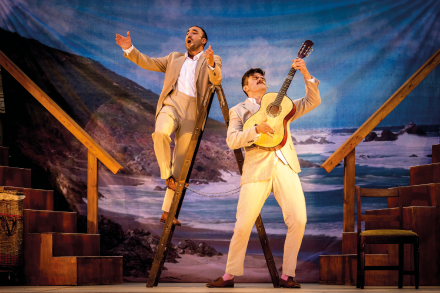
‘Goodness Triumphant’ is the subtitle of Rossini’s La Cenerentola, and you’d better believe he delivers. It’s the sweetest thing imaginable; true, the stepsisters are awful, but their spite bubbles over in streams of such sunny major-key effervescence that it’s hard to hold it against them. As for their father Don Magnifico, you can’t seriously hiss a villain whose principal ambition is unhindered access to the palace wine cellar. It’s testimony to just how deftly Rossini handles his material that the final scene – in which the now-royal Cinderella asks only that her stepfather address her, for the first time, as ‘daughter’ – can still make you go as gooey as a chocolate fondant.