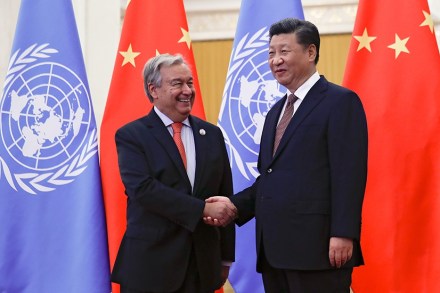
Xi jinping

The China reckoning

Fifteen years ago, I remarked to an acquaintance over lunch that it looked like China might eat America’s lunch in naval power. My interlocutor, a person well-known in leadership positions in the China studies community, scoffed at my comment. Over the next few years, he never missed an opportunity to ridicule my wild-eyed prediction. I often wonder what he thought in February 2021 when, less than a month after becoming president, Joe Biden warned US senators that if America didn’t “get moving, [China is] going to eat our lunch.” I claim no credit for prescience, just a historian’s sensitivity to trends over time. The fiftieth anniversary of President Richard Nixon’s visit to China falls in February 2022.
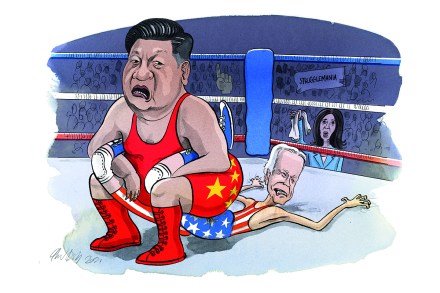
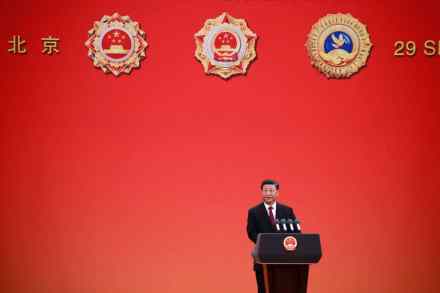
china

China could be more dangerous than ever in 2022

From our UK edition

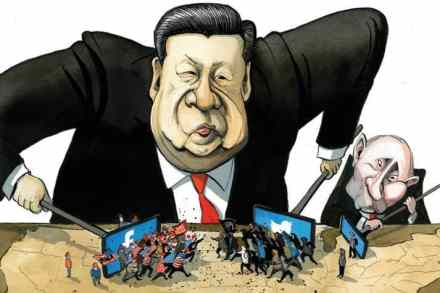
Twenty twenty-two is the year that Xi Jinping plans to seize power for life, but it is not going according to script. He is retreating further into his bunker – a self-isolation that is amplifying the Communist party’s arrogance and insecurities. Challenges are mounting at home and abroad, which will make for a bumpy year in China’s growing rivalry with the West. Xi’s most immediate problem is Covid-19, where he has backed himself into an increasingly untenable ‘zero tolerance’ cul-de-sac, just as most of the rest of the world is learning to live with the virus. Just before the new year, gun-toting police in the city of Jingxi paraded four people accused of breaching Covid control measures through the streets.

America needs more than ‘guardrails’ with China

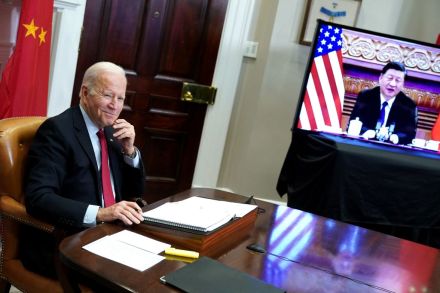
As recently as a week ago, there was talk that Monday night’s virtual summit between President Joe Biden and Chinese Communist Party general secretary Xi Jinping was an opportunity to “reset” the US-China relationship. By the time the two leaders sat down in front of their video screens, the summit had been downgraded to a “meeting” and the White House made clear that little concrete agreement, and no breakthrough, was to be expected. The meeting lived down to expectations, uneasily combining a more sober and realistic US assessment of the parlous state of bilateral ties with what seems a return to a pre-2017 model of surface bonhomie and references to the “the long-term work that we need to do together,” according to a senior US official.

xi

Communist China abandons Confucius

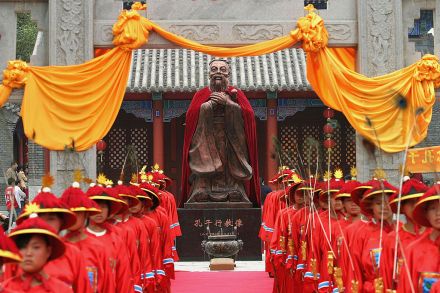
China in late September celebrated the 2,572nd birthday of Confucius, a mark of pride for the Chinese Communist Party. A week later, it celebrated its 72nd “National Day,” commemorating the founding of the People’s Republic of China. Chinese President Xi Jinping regularly gushes over Confucius in speeches and even in his 2015 book. Since 2004, the Chinese government has sponsored more than 500 “Confucius Institutes” — public educational and cultural promotion programs — to the price tag of billions of dollars. But how Confucian is China? And is Confucian statecraft a good thing?

The rise and fall of Jack Ma

From our UK edition

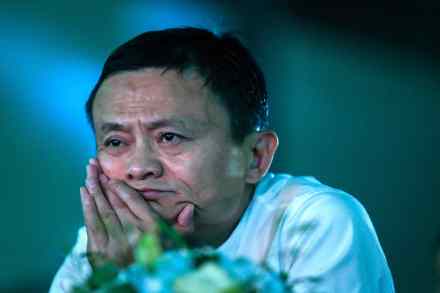
Jack Ma used to give rock star performances for his employees at Alibaba, Asia’s biggest online commerce company. He once dressed as Michael Jackson. But those halcyon days are gone. Over the last year, China’s richest man has had his wings clipped by the Chinese Communist party. The flamboyant Ma has only made a handful of public appearances (prompting rumours of a ‘disappearance’ at the hands of the CCP). This week, it transpired that Alibaba has almost halved in value — losing a record $373 billion over just the last 12 months. Ma’s downfall can be traced back to a misjudged speech he made in Shanghai this time last year.

How to counter China

From our UK edition

When another country does something to upset the Chinese Communist party, it gets accused of ‘a Cold War mentality’. This is psychological projection, in Freudian terms, a defence mechanism which projects onto others the negative aspects of one’s own self. But the CCP is right in a way: we should have more of a ‘Cold War mentality’ or at least a ‘values and systems war’ mentality. China is not the Soviet Union. We never co-operated with the USSR on trade and investment or science and technology. We do with China. Indeed the CCP sees itself as fighting a ‘values and systems war’.

There is no Russia-China axis

From our UK edition

You should be careful what you wish for, because you might just get it, so the old cliché goes. In diplomacy at the moment, it seems you should be careful of the threats you prepare for, because you may end up producing them. There is a growing trend in the West towards treating Russia and China as some single, threatening ‘Dragonbear’ (a reference to the two countries' national animals). This underrates the very real tensions between Moscow and Beijing, but risks pushing them even closer together. The most recent case in point was Nato secretary-general Jens Stoltenberg’s interview in the Financial Times, in which he criticised ‘this whole idea that we either look Russia, or to China… because it goes together.

Xi threatens Taiwan because he’s weak

From our UK edition

Over the weekend, China sent waves of warplanes racing towards Taiwan in numbers not seen before, forcing the democratic self-ruled island to scramble fighters and ready its air defence missiles. The United States says it is ‘very concerned’ by Beijing’s ‘provocative’ actions and reiterated Washington’s ‘rock solid’ commitment to the island. According to Taiwan’s defence ministry, 38 Chinese aircraft, including nuclear-capable bombers and J-16 fighter jets, entered its air defence identification zone on Friday, and another 39 did so again on Saturday — the largest incursion to date. Some 16 more were sent on Sunday.

How China’s economic revolution created billionaires overnight

From our UK edition

In the winter of 1992, the retired octogenarian Deng Xiaoping toured China’s southern coasts. From there he gave a spirited warning to his communist successors: ‘Whoever doesn’t reform will have to step down! We must let some people get rich first!’ These words were the starting-gun for the country’s opening, and its intense economic reform. In the decades since, Chinese cities have never stopped hungering for more space, with new suburbs swallowing up old villages and steel skyscrapers growing ever higher. Even taxi drivers lose their way. One sheepishly explained to me: ‘That road never used to be there.

How ‘Xi Jinping Thought’ is taking over China’s classrooms

From our UK edition

From this month, in an extension of a personality cult not seen since Mao Zedong, ‘Xi Jinping Thought’ is being incorporated into China’s national curriculum. School textbooks are emblazoned with Xi’s smiling face, together with heartwarming slogans telling readers as young as six that their leader is watching over them. ‘Grandpa Xi Jinping is very busy with work, but no matter how busy he is, he still joins in our activities and cares about our growth,’ reads one. ‘Xi Jinping Thought’ must be taught at all levels of education, from primary school to graduate programmes, and there is special emphasis on capturing the minds of the youngest children.

Did Chinese fentanyl kill Michael K. Williams?

From our UK edition

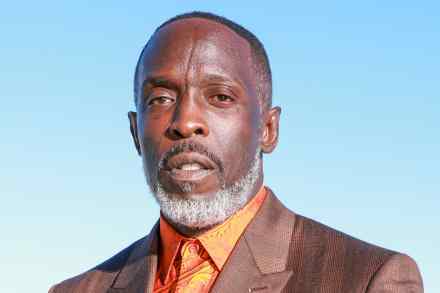
Did Chinese-manufactured fentanyl, a synthetic opioid, kill Michael Kenneth Williams, the man who played ‘Omar’ in The Wire? Within minutes of his death being announced yesterday, speculation was circulating on Twitter. New York Police Department sources have told the Daily Mail they suspect fentanyl was involved. The world only seems to notice when a celebrity overdoses. In 2016, Prince's death from a cocktail of fentanyl and other substances was an important milestone in awakening America to the horrific opioid drug epidemic that had crept up on the country since the 1990s. But lots of non-famous people are dying all the time because of fentanyl from China, which has flooded the US criminal scene in recent years.

What kind of empire is China building?

From our UK edition

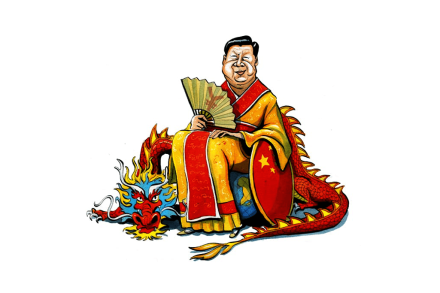
As Britain’s small fleet, headed by HMS Queen Elizabeth, cruises towards the South China Sea, there remains a question over the nature of China’s geopolitical ambitions. When Xi Jinping came to power in 2013 it was assumed that China would follow the relatively unthreatening path begun by Deng Xiaoping. But Xi was intent on following a different agenda. Xi’s brutal clampdown on corruption showed that there was a new sheriff in town. High profile politburo members were imprisoned. Such was the scale that Qincheng Prison began to run out of cells. Expensive wristwatches suddenly disappeared from the arms of modestly paid bureaucrats. The West applauded.

Wang Huning: the man behind Xi Jinping

From our UK edition

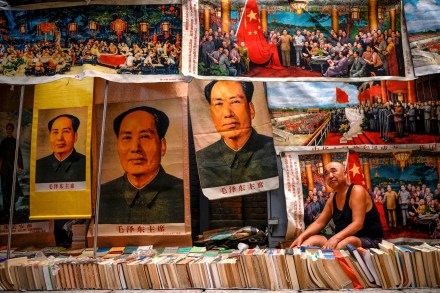
At the height of the Cultural Revolution, over a billion copies of Mao’s Little Red Book were distributed across the People’s Republic. This small pocket-sized collection of quotations provided the scaffolding for an era of communist purges. Utopians need theory. And while the Maoist orthodoxies of the last century have faded, China's need for a solid intellectual foundation is as strong as ever. Xi Jinping Thought on Socialism with Chinese Characteristics for a New Era is that new theory. But it is written not by the General Secretary himself but by an unassuming 65-year-old: his supreme theoretician. Wang Huning has quietly shaped China over the last three decades, despite the fact that few of his countrymen could pick him out of a line-up.

Is critical race theory in the US military ‘dangerous’?

After renewing their Cold War-era alliance earlier this week, Beijing and Moscow challenged the US military hegemony by claiming American global dominance was 'over' and threatening to strike back if any 'boundaries are crossed.' GOP lawmakers on the House Armed Services Committee told The Spectator that the Defense Department's focus on critical race theory under the Biden administration is ‘stupid and wacko’ while the Sino-Russian powers are on the march. Xi Jinping and Vladimir Putin met Monday during a virtual summit to extend their cooperation treaty between their respective countries, both of which have strained their ties with the US ever since the treaty was initially signed 20 years ago.

armed services critical race theory

Has Xi Jinping overplayed his hand?

The Chinese Communist party’s origin story, like so many of its official lines, appears to be an apocryphal tale. But a month-long patriotic extravaganza leading up to its centennial celebration has featured military parades, skyscrapers emblazoned with hammer-and-sickle decor and propaganda blitzes on TV. None of the agitprop raised eyebrows as much as the main speech delivered by the Chinese president and general secretary of the party, Xi Jinping, in which he marked the milestone and praised China’s ‘tremendous transformation’ and the historical inevitability of its ‘national rejuvenation’.

xi jinping

Prepare for China’s nationalist turn

From our UK edition

In recent days, it has been striking how many people in Westminster and Whitehall now think the lab leak theory is the most plausible explanation of Covid’s origins. China’s apparent success last year at stamping out the virus at home — with technological competence and sheer brutality — while cases spiked in the West, created a fear that the future belonged to Beijing.  But, as I say in the magazine this week, the growing plausibility that the virus leaked from a lab highlights the Achilles’ heel of the Chinese system: its lack of a mechanism for error correction. It is not that a lab leak couldn’t have happened in the democratic world, but it is far harder to imagine it being covered up here.

What China wants from Britain

From our UK edition

What are we to do about China? To turn a phrase beloved by the Chinese Communist party (CCP) on its head, Beijing is increasingly ‘interfering in our internal affairs’. Yet if you hoped to answer that question by reading the recent integrated review of defence and foreign policy, the most you would find is that China is a ‘systemic competitor’. But recognition is not a strategy; at best, the review indulged in ambiguity, or perhaps obfuscation. The Prime Minister wants good relations with China. Who doesn’t? Certainly, a new Cold War would be disastrous, for us and for the CCP.

The fightback: it’s time for the West to take on China

From our UK edition

Boris Johnson says it is a mistake to ‘call for a new Cold War on China’. Yet China is, in many ways, a more formidable foe than the Soviet Union ever was. It is more integrated into the world trading system and its economic model is less flawed. This gives it a commercial pull in the West that the USSR never had. Its purchase over businesses and institutions goes some way to explaining why there is such reluctance in the UK, and the West more broadly, to take a tougher line on Beijing. ‘It’s the money, there wasn’t that complication in the Cold War,’ laments one cabinet minister. Yet in the past year China has made a series of tactical missteps.

China vs America: the struggle for south-east Asia

From our UK edition

Is Antony Blinken, President Joe Biden’s secretary of state, preparing to abandon Barack Obama’s powder-puff Asian foreign policies? It is now widely agreed that Obama, under whom Blinken served as deputy secretary of state, ceded to China uncontested control of the South China Sea. Obama’s so-called ‘pivot to Asia’ was all talk and no trousers. Blinken, who believes that diplomacy must be ‘supplemented by deterrence’, may be about to implement a more aggressive foreign policy in south-east Asia and elsewhere. In his first speech as general secretary of the Communist party in 2012, Xi Jinping made his intentions clear.

Buying power: how China co-opts the UN

From our UK edition

It was one of those forgettably historic moments at the United Nations. The year was 2015, the UN’s 70th anniversary, and China’s President Xi Jinping was in New York, speaking in person to the UN General Assembly. In festive spirit, Xi announced that China would set up a $1 billion trust fund to be dispersed over ten years to ‘support the UN’s work’ and ‘contribute more to world peace and development’. So began the Peace and Development Trust Fund, one of China’s more insidious projects to co-opt the UN, its logo and its global networks.