Vaccine

Six things we need to know about the vaccine rollout

From our UK edition

We are supposedly getting a lot more data on the numbers of us being vaccinated, later on Monday. What's less clear is whether we will be getting data that is useful. Here is what we should be told on a granular daily basis, to reinforce confidence both that the vaccination operation is efficient and effective and to provide hope that the end of this social and economic misery is a realistic prospect: 1. Numbers vaccinated per day should be published. 2. This number should be broken down between first and second dose so that we know how many are protected to the maximum possible. 3. The status of those vaccinated – are they in the 80 plus category, or healthcare workers, for example? 4.
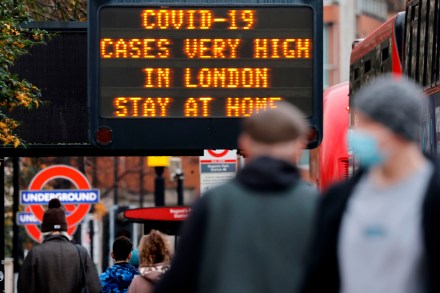
Covid sparks a major incident in London

From our UK edition

Is the NHS at risk of being overwhelmed? That's a question of increasing concern in Westminster as hospital admissions rise. Sadiq Khan has today declared a 'major incident' in London — calling the situation 'critical' with the spread of the virus 'out of control'.  With the coronavirus infection rate in London now exceeding 1,000 per 100,000 people, Khan said that the London Ambulance Service was currently taking up to 8,000 emergency calls a day (compared to 5,500 typical for a busy day). It comes as the reported daily death toll on Thursday — 1,162 — reached the highest recorded since April. There’s little, too, to suggest things are about to improve anytime soon.

Why Merkel and Putin are cooperating on the Sputnik vaccine

From our UK edition

Churchill, FDR and Stalin could cooperate against Hitler, so perhaps we shouldn’t be too surprised that even amidst talk of a new Cold War, sanctions and more than a little sanctimony, people in the West are willing to make deals with Moscow in the name of fighting the new global threat, Covid-19. Russia’s Sputnik V vaccine may have been rushed through its certification at home and been the subject of some overblown nationalist hype (not that the Oxford-AstraZeneca vaccine has been entirely free of the latter), but so far it appears to be a serious and effective jab, with a potential 91.4 per cent efficacy.

What have we learnt from this pandemic?

From our UK edition

So great have been the government’s failures over Covid that it would be easy to forget to give credit where it is due. The fact that Britain was the first country to begin a public vaccination programme — and this week became the first to have two vaccines in use — did not come about by chance. It happened because the government had the foresight to pre-order large quantities of promising vaccines and because Britain’s medicines regulator, the MHRA, worked fast and effectively to assess the data from the trials of those vaccines. The vaccines from Pfizer and AstraZeneca underline the lifesaving role played by an often-maligned pharmaceutical industry. But Britain’s head start will count for little if the momentum cannot be sustained.

The EU has botched its vaccination programme

From our UK edition

It was the most excruciating moment of Ursula von der Leyen’s short tenure as President of the European Commission. On Friday morning she hastily put together a press conference to counter the growing media storm across Europe over the EU’s handling of vaccine procurement. She doubled down on ‘solidarity’, announcing that the Commission had managed to secure more doses of the BioNTech/Pfizer vaccine, but also that the EU would stick absolutely to buying together. ‘We have all agreed, legally binding, that there will be no parallel negotiations, no parallel contracts,’ she insisted testily. ‘We’re all working together.’ At the same moment, however, her former colleagues in Berlin, where she was never popular, were busily undermining her.

A race against time: can the vaccine outpace the virus?

From our UK edition

The next three months may well prove to be the hardest of the whole pandemic. The new variants of Covid-19 appear to be the wrong type of game-changer. After our national lockdown in March, infection levels started falling because of extreme measures — including closing schools, places of worship and non-essential retail. But the infectiousness of the ‘Kent strain’ suggests that as it becomes prevalent, a new lockdown might be unable to contain it. When ministers first locked down, they did so in the expectation of taming the virus. This time, it’s more in hope. Boris Johnson didn’t show us any graphs when he announced the latest lockdown. He didn’t need to; the situation is clear.

Merkel’s government faces civil war over vaccine failures

From our UK edition

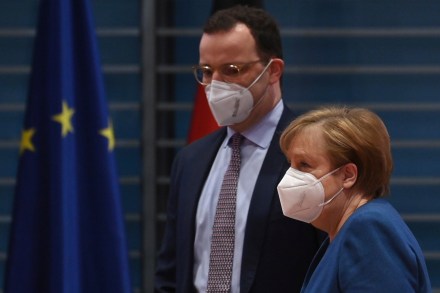
European health ministries have not been happy places of late. Earlier this week, the German daily Bild reported a spat between national governments and the EU, frustrated at the bloc’s failure to procure vaccine doses in any serious numbers. That failure has now ricocheted back from Brussels, destabilising Germany’s increasingly fragile coalition government. So infuriated are Angela Merkel’s junior partners that they are now calling for a parliamentary inquiry into Germany’s vaccine failures, centring on one of her possible successors. Problems began when health ministers in Germany, France, Italy and the Netherlands (the four countries with the most advanced pharmaceutical industries in the EU) joined forces to try to get their order books filled.

Boris Johnson’s justifications for lockdown

From our UK edition

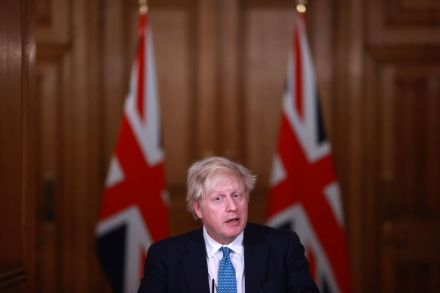
Boris Johnson this evening tried to give a little more background to why he had called England’s latest lockdown – and why he had confidence that this really was the darkness before the dawn. The Prime Minister told the Downing Street coronavirus briefing (yes, we are back in that sort of lockdown) that more than 1 million people in England are now infected with Covid – around 2 per cent of the population, according to the ONS – but that as of today, the same number of people in England, and a total of 1.3 million people across the UK, have received the vaccine. He had to explain why he had changed his tune on schools so rapidly, going from insisting that most schools should return to cancelling face-to-face teaching within 36 hours.

We need to cut vaccine red tape

From our UK edition

As I mentioned on Monday, in a fortnight AstraZeneca will be putting 2 million doses of its coronavirus vaccine into vials every week. At that point the limiting factor on how many people can be vaccinated will switch from manufacturing to distribution – and in particular how long it takes to ‘process’ each person who turns up to be vaccinated. It allegedly takes three times longer in the UK than in Israel to do the on-site paperwork for each vaccinated person. Which, if true, means the UK would be processing a smaller number of people than it could be vaccinating every day. And in the current raging epidemic that would not just be an academic underperformance, but would have a big and huge cost in lives.

Britain has two key advantages in the vaccine race

From our UK edition

Everything now turns on how quickly the vaccines can be rolled out. When this lockdown ends – and when all the restrictions can be lifted – depends on how fast people can be immunised. Last night, Boris Johnson set the state the target of having vaccinated 13 million people by the middle of February so that the lockdown measures can be eased later that month. There is an understandable scepticism about this target —people remember when test and trace was meant to prevent the need for a second national lockdown.  But the UK has two great advantages when it comes to rolling out a vaccine. First, it has a domestically-manufactured vaccine approved which only needs to be kept at fridge temperature.

Emmanuel Macron’s desperate New Year wishes

From our UK edition

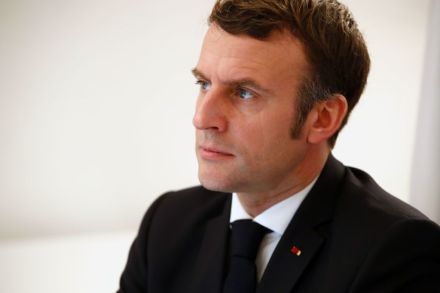
Emmanuel Macron was not quite his cock-a-doodle-do self in his New Year’s Eve broadcast to the French people. This, the fourth presidential broadcast of the plague year, saw Macron, in black suit and black tie, resembling a small-town funeral director attempting to conjure optimism. Macron promised a France on the comeback by the spring, with new economy jobs and a European recovery fostered by an ever more ambitious European Union. The reality is that much of the country is under a 6pm curfew. Everywhere, bars, restaurants and ski resorts are shut. Pension reform has gone. Unemployment, deficit and debt are massively up. There’s been close to a 10 per cent decline in GDP in France in 2020, nearly twice that of Germany.

The UK’s vaccine approach isn’t ‘anti-science’

From our UK edition

In order to vaccinate as many people as possible, the government has decided to change the length of time between the first jab and the second. What’s more, there has even been a suggestion that — in exceptional circumstances — the NHS could use a different vaccine for the second jab from the one used in the first. Cue a wave of criticism, not least from medical professionals and academics, concerned the government is pushing for something different to what the science suggests. The New York Times reported that the government’s decision had ‘confounded’ experts, while the MP Claudia Webbe called the move ‘dangerously anti-science’.

Could the South African strain affect the vaccine?

From our UK edition

Today begins the second phase of the Covid-19 vaccine programme, with the first members of the public receiving doses of the easier to use Oxford-AstraZeneca vaccine. But will the effort be thwarted by the emergence of two new variants of the SARS-CoV-2 virus, the Kentish strain and the South African strain? Yesterday, Sir John Bell, regius professor of medicine at the University of Oxford, gave his opinion. The Kentish strain, he said, does not greatly worry him. Although it has mutations that appear to make it more transmissible, they should not, he says, interfere with the working of any of the vaccines.

How Israel became a world leader in vaccination

From our UK edition

On a cold night three days before the end of the 2020 I drove down to Jerusalem’s Pais Arena. The area is usually a sports venue, next to Jerusalem’s stadium and mall, but in December it was transformed into a centre for mass vaccinations, open from morning till ten in the evening. By the first day of 2021 Israel had vaccinated more than 1 million people in two weeks, an unprecedented number, making the country a global leader in vaccinating against Covid-19. I was one of those who received the first jab of the Pfizer vaccine. Israel’s path to this milestone has been a rollercoaster of lockdowns and struggles over the last year. Back in February 2020 the country was on alert for the spread of the coronavirus.

Let’s bust some vaccine myths

From our UK edition

Today is a great day for all of us. The licensing of the ChAdOx vaccine will mean a step change in vaccine deployment and is one of the most significant developments of the year. As is widely known, the vaccine developed is cheap, easy to store and we have enough doses to meaningfully start talking about widespread programmes of vaccination. Now is a good time to address a slow motion and avoidable car crash. Vaccines are not a political issue – don’t let anybody persuade you otherwise. You can see this happening and it affects both our interpretation of vaccine development and, more importantly, the likelihood of having one. The development of vaccines themselves can be appropriated by all political camps.

What does the Oxford vaccine approval mean for the UK?

From our UK edition

This morning the Oxford/AstraZeneca vaccine has been approved by the UK medicines regulator, the MHRA. This is almost more of a game changer than the approval of the first Pfizer vaccine, because the UK government has ordered 100 million doses of it – and it is also much easier to distribute, as it does not need to be stored at the same very low temperatures as the Pfizer jab. It means that there really is a chance of life returning to normal in the not-too distant future. Ministers had been very clear in private that if this immunisation didn’t pass, it would mean society would have to work out how to live with Covid-19 over a much longer term – and that this would be very difficult politically.

Would it be immoral to raise cash for the NHS by selling £100,000 vaccines?

From our UK edition

It is easy to be offended by the idea of the super-rich trying to buy their place in the queue for the Covid-19 vaccine ahead of your granny, and easy to feel a warm glow of satisfaction that they are being rebuffed – all supplies are being held on such a tight rein by the NHS that private clinics can’t get a look in. But would it really be such a bad idea if a handful of very wealthy individuals were allowed to have the vaccine ahead of schedule and raise some very useful cash for the NHS in the process? If we are going to vaccinate our way out of the Covid-19 crisis we are very shortly going to have to be administering millions of doses a week.

Could 30 per cent of Brits have some Covid immunity?

From our UK edition

How big is the job of vaccination? The aim is herd immunity, to protect enough people so that the virus starts to run out of people to infect and rates fall. This is expected to happen when between 60 to 80 per cent of the population is protected, so quite a job for the NHS. Until this is achieved, ministers seek to use lockdown as a tool to keep the R below 1. This means the cycle of lockdown and release could be with us for some time, especially in light of the new ‘mutant’ strain of the virus. But are ministers seeing the whole picture? As a professor of risk management, my coronavirus modelling has shown a large gap in the data on coronavirus cases between the government’s dashboard figures and the ONS weekly surveillance data.

Brits don’t appear to have been influenced by anti-vaxxers

From our UK edition

Has the influence of anti-vaxxers been hugely overstated? That is one interpretation of the Office for National Statistics’ latest survey on social attitudes towards Covid-19 and the government’s efforts to tackle it. While fears abound that people might refuse the vaccine, with their minds turned by lies disseminated on social media about Bill Gates wanting to impregnate them with microchips, there is scant sign that the British public is becoming anti-vax. Across all adult age groups, 78 per cent say they are ‘fairly likely’ or ‘very likely’ to take the vaccine if offered it (and it is government policy that all will be offered it in time).