Ukraine

Podcast: Putin’s war on the West and the disappearing Lib Dems

Is Vladimir Putin drawing a new Iron Curtain over Europe? On this week’s View from 22 podcast, Anne Applebaum and Ben Judah discuss the new Spectator cover feature on whether Putin’s is winning his war on the West. Is Putin worried about the strength Western liberal democracies or the power of the European Union? How does his influence extend into Britain, France and Poland? And how much important is Ukraine as a battle line between the Putin and the West? James Forysth and Isabel Hardman discuss whether the Liberal Democrats are scared of the upcoming election As the election campaign ramps up, the minor party of this government is nowhere to be seen. Are they being pushed out of the political debate?

Want to understand the conflict in Ukraine? Compare it to Ireland

What seemed this time last year to be a little local difficulty in Ukraine has metastasised to the point where a peace plan drafted in Paris and Berlin may be all that stands in the way of war between the West and Russia. Over the months, many of those watching, appalled, from the safety of the side-lines, have combed history for precedents and parallels that might aid understanding or offer clues as to what might be done. Last spring, after Russia snatched Crimea and appeared ready to grab a chunk of eastern Ukraine too, the favoured comparisons were with Nazi Germany’s 1938 annexation of Sudetenland. It was a parallel that seemed all too plausible, given the Kremlin’s statements about the need to protect Russian 'compatriots' wherever they might live.

Portrait of the week | 29 January 2015

Home Party leaders mercilessly launched 100 days of campaigning before the general election on 7 May. David Cameron, the Conservative leader, said he would reduce the annual maximum household receipt of welfare to £23,000 from the current limit of £26,000. Ed Miliband announced a ten-year plan for the National Health Service, but Alan Milburn, a former Labour health secretary, said: ‘You’ve got a pale imitation actually of the 1992 general election campaign and maybe it will have the same outcome.’ Amjad Bashir, a Ukip MEP, switched to the Conservative party, upon which Ukip said he was being investigated over ‘unanswered financial and employment questions’, allegations he denied.

Portrait of the week | 22 January 2015

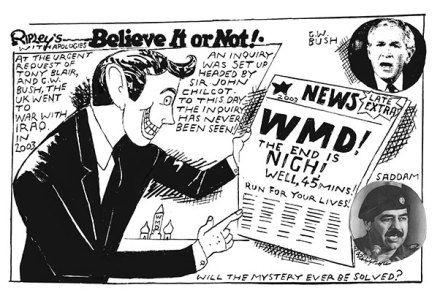
Home More than 1,100 imams and Islamic leaders received a letter from Eric Pickles, the Communities Secretary, and Lord Ahmad of Wimbledon, the communities minister, saying: ‘We must show our young people, who may be targeted, that extremists have nothing to offer them.’ Imran Khawaja, from Southall, west London, who had posed for a picture in Syria with a severed head before trying to re-enter Britain, pleaded guilty to four terrorism offences and will be sentenced next month. Sir John Chilcot confirmed that the report of his inquiry into the Iraq war, which took its last evidence in 2011, would not be published until after the election. A workers’ dispute left 1,300 houses in Northern Ireland without water; some people boiled snow.

Europeans no longer fear Germany. But do the Germans still fear themselves?

In the old Death Strip between East and West Berlin, which runs through the centre of the city, there is a graveyard full of German war heroes and a few war criminals too. From the Red Baron to Reinhard Heydrich, the best and worst of the German military are buried here. There’s also a mass grave full of civilians, killed by Allied air raids, and a memorial to the 136 East Berliners who died trying to cross the Berlin Wall — which ran through this cemetery. The Death Strip is still an empty space. Germany has been marking two anniversaries this year — one a celebration, the other a painful duty. The 25th anniversary of the Mauerfall (as Germans call the fall of the Berlin Wall) is one of those rare events in German history about which they can feel unequivocally happy.

Transnistria: a breakaway republic of a breakaway republic

Transnistria is not an area well-served by travel literature or, really, literature of any kind. The insubstantial-seeming post-Soviet sandwich-filling between Moldova and Ukraine, it doesn’t have a bad reputation. It has no reputation. As Rory MacLean, the author of the ‘across-the-old-Iron-Curtain-in-a-Trabant’ bestseller Stalin’s Nose, explains: ‘Transnistria is a breakaway republic of a ba lot smaller than Devon. And it is recognised by no country in the world except itself. You could indeed be forgiven for thinking that Transnistria is a made-up place (and at times the author of this book almost treats it as if it is).

The crash of the ruble — and what’s next for Russia

Since the Russian invasion of Crimea last February, many different phrases have been used to describe the tactics of the Russian President, Vladimir Putin. Some have spoken of a ‘new Cold War’. Others have described him as ‘anti-western’ or ‘anti-American’. But there is another adjective one could also use to describe his behaviour: ‘experimental’. For apart from everything else he has said and done, Putin has, in effect, launched a vast experiment into whether it is possible to extract a large and relatively well-integrated country from the global mainstream, and to reject the rules by which that mainstream runs. In truth, the experiment began long before Crimea.

Russia Today is Putin’s weapon of mass deception. Will it work in Britain?

Anyone making the journey to Westminster by public transport will be confronted by a series of posters warning them about the state of British media. The word ‘redacted’ is in large letters, and readers are advised to look up a website for ‘the ad we can’t show you here’. If you do, you see a picture of Tony Blair advocating war. ‘This is what happens when there is no second opinion,’ the webpage says, advising people to ‘question more’. This is how Russia Today, the Kremlin’s fast-growing English language broadcaster, is selling itself: as the challenger to an out-of-touch establishment. At a time when there’s a widespread distrust of political elites, it’s not a bad line.

Why Vladimir Putin’s threats about cutting off Europe’s gas supply are all bluff

Has the West found a secret new weapon in its battle with Putin’s expansionist ambitions: reversible gas pipelines? Putin has never made a secret of his willingness to use energy as bludgeon against his neighbours. In 1999, the year before he became Russian leader, he wrote a pamphlet making the case that energy exports provided the means by which his country’s greatness could be restored. Putin’s behaviour over Ukraine has been typical. Over the past 15 years Russia has constructed a network of pipelines which can be used to bypass Ukraine. Starve Ukraine of energy, goes Putin’s thinking, and it might be forced back into Russia’s fold.

How worried should the West be about Russia?

The most sobering column you’ll read today is the FT’s Gideon Rachman, no doom monger, warning about the risk of a nuclear war. Rachman is concerned about how quick Vladimir Putin’s Russia now is to rattle the nuclear sabre. Now, as Rachman points out, part of the reason that Russia does this is to make the West think that it might just use these weapons. But the worry is that Putin might miscalculate. For instance, if the Russians did in one of the Nato member Baltic states what it has done in Ukraine, the situation could get out of hand very quickly. What makes this more alarming is the possibility of another global economic crisis.

Portrait of the week | 30 October 2014

Home The last British combat troops turned over Camp Bastion in Helmand to Afghan forces and withdrew from Afghanistan after 13 years and 453 deaths. Michael Fallon, the Defence Secretary, spoke of ‘whole towns and communities being swamped by huge numbers of migrants’. He later withdrew the word ‘swamped’, but David Blunkett, a former Labour home secretary who used the word 12 years ago, said: ‘I believe that both Michael Fallon and I were right to speak out.’ This came after Angela Merkel, the Chancellor of Germany, responded to an idea of David Cameron, the Prime Minister, that European Union migration could be renegotiated; she said: ‘Germany will not tamper with the fundamental principles of free movement in the EU.

Postcard from Ukraine – meet the artists in exile from the People’s Republic of Donetsk

It was Orthodox Trinity Sunday when Luba Michailova received word that separatists would soon occupy the premises of the Donetsk art centre she founded. She was in Kiev at the time, and recalls now that her first response was religious: 'Any difficulties in life you get, it's for your good, and for testing you.' The following morning, at 8 o'clock, several staff were at work cleaning when 15 men in balaclavas appeared, firing Kalashnikovs into the air. Michailova tells me, 'So when it happened, I knew it would happen, but I never thought it would be so painful.' Donetsk now is in the hands of the masked separatists who brought down MH17. But before May, Donetsk boasted TEDxDonetsk talks, literary festivals, residencies, and exhibitions by artists from abroad.

The European market hangover – bad news is bad news again

In the latest Spectator, Liam Halligan takes a sobering look at European markets bearing the brunt of sanctions against Russia. 'The western economy that’s suffered most, by far, is the largest one in the eurozone. Germany’s manufacturing thoroughbreds have sunk tens of billions of euros into Russian production facilities in recent years. . . . 'This helps explain why, having grown 0.8 per cent during the first three months of 2014, German GDP shrank 0.2 per cent in the second quarter. The eurozone’s powerhouse is now on the brink of recession. Industrial production dropped 4 per cent in August, the biggest monthly fall since early 2009. Exports were down 5.8 per cent — again, the steepest drop since the Lehman collapse in 2008.

Here’s how to remain cheerful in the face of such a multitude of scares

I don’t think I can remember a time when there have been so many scares about. They come at us from every direction, and even sometimes from out of the blue, with names we’ve never heard before. Take Isis, for example, or maybe Isil (there’s not even now a consensus on what to call it). Yet neither name was known to any normal, newspaper-reading person until it was already in control of half the Middle East and beheading western hostages at will. Now the Prime Minister says that we must bomb the Islamic State in Iraq because it threatens our security at home. How can such a powerful and terrifying organisation appear on the scene so suddenly and without warning?

Europe will reconcile with Russia, and soon. It can’t afford not to

After months of escalating tensions over Ukraine and talk of a new cold war, Russia and the West could soon reach a surprising rapprochement. The eurozone economy is suffering badly and sanctions against Russia are partly to blame. Winter is also upon us, and that reminds every-one Vladimir Putin still holds the cards when it comes to supplying gas. The clincher, though, is that Ukraine is heading towards financial meltdown. Unless an extremely large bailout is delivered soon, there will be a default, sending shockwaves through the global economy. That’s a risk nobody wants to take — least of all Washington, London or Berlin. Sanctions against Russia were always going to hit western Europe hard.

Letter from Donetsk: peace, with missile attacks

For what is technically peacetime, there’s a lot of shelling going on round here. Donetsk airport is still held by the Ukrainian army and the rebels of the Donetsk People’s Republic bombard it furiously every day. The Ukrainians reply by lobbing back artillery shells and Grad missiles. Both sides bristle with anti-tank and anti-aircraft missiles, so the war is a static one, fought by a series of artillery duels, first world war-style. Underneath the smart new airport built by Turks for the Euro 2012 championships is a warren of deep Soviet-era bunkers and tunnels, where the Ukrainian defenders retreat with their howitzers when the barrages get too heavy. Construct your own metaphor: deep, indestructible veins of the past lying underneath the fragile modernity of the present.

Michael Fallon: parliament needs the ‘courage’ to vote for war

The Ministry of Defence is like a sauna on Sunday. The air circulation system has been switched off and the place is hot — and deserted. Yet when you reach the Secretary of State’s floor, a small team is hard at work. As you enter Michael Fallon’s office, you see why. On an easel sits a map of Iraq and Syria. Tellingly, though, this isn’t the only map on the stand. Sitting behind it are ones of Pakistan, the Central African Republic and Sierra Leone. It emerges later that the one of Ukraine has gone missing. Fallon is 62, but he has the energy of a man half his age. Our conversation is punctuated with regular requests from him to his staff to bring him a map, a copy of the Nato charter or some other piece of paper.

Portrait of the week | 11 September 2014

Home England suddenly began to take the prospect of Scottish independence seriously after a poll of 1,084 people by YouGov put support for it at 51 per cent and opposition at 49 per cent. A survey by TNS showed 38 per cent of Scots backed independence compared to 39 per cent opposing it (with 23 per cent not knowing). The pound fell to its lowest for ten months against the dollar. George Osborne, the Chancellor of the Exchequer, in concert with Labour and the Liberal Democrats, promised a timetable for further devolution if voters in Scotland would only reject independence. The Prime Minister and the leader of the opposition agreed to cancel Prime Minister’s Questions and fly to Scotland, in the apparent belief that it would help. Nick Clegg, the Deputy Prime Minister, went too.

Portrait of the week | 4 September 2014

Home Britain’s terror threat level was raised from ‘substantial’ to ‘severe’ in response to fighting in Iraq and Syria, meaning that an attack on Britain was ‘highly likely’. Three days later, David Cameron, the Prime Minister, in a hesitant statement to the Commons, proposed that: police should be able to seize temporarily at the border the passports of people travelling overseas; there should be all-party talks on drawing up powers to prevent suspected British terrorists returning to Britain; those under terrorism prevention and investigation measures (Tpims) should be subject to ‘stronger locational constraints’.