Ukraine

Ukraine won’t join the European Union any time soon 

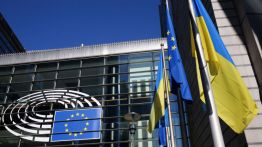
In the wake of Russia’s aggression in Ukraine, President Volodymyr Zelensky has renewed his country’s wish to join the European Union. This week, the European Parliament approved Ukraine’s application to join the EU with an overwhelming majority. But Ukraine will not join the European Union this year, and possibly not even in the next five years to come. The reasons for that lie within the structure of the EU. The closening ties between Brussels and Kyiv had been the reason for Ukraine’s revolution back in 2014. Then Ukrainian president Viktor Yanukovych had rejected the EU-Ukraine association agreement, which tied both partners closer together, politically and economically.

european union

The Russian army is failing – but not enough to lose the war

From our UK edition

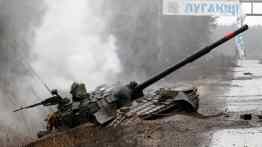
There have been three major surprises for military analysts since the Russian military invaded Ukraine. The first has been the extent of the difficulties faced by the Russian army in terms of logistics, coordination of forces, morale and mobility. The second has been the failure of the Russian air force to achieve air superiority over Ukrainian air defences, and to operate against Ukrainian ground forces at scale. The third has been the extraordinary unity and effectiveness of the Ukrainian resistance, which has significantly slowed the Russian advance in the north of Ukraine and inflicted major personnel and vehicle losses on Russian forces on all fronts.

Fasting this Lent for the people of Ukraine

Last Wednesday was Ash Wednesday, the first day of Lent for Christians in the West. Many of us will give up sweets or video games or online shopping. Some intrepid souls will even give up coffee. I tried that last year, but my priest reminded me that my wife didn’t choose “dealing with a crabby husband” as her penance, so I found another penance. It’s a little different for our brothers in the East. Their season of fasting begins on Meatfare Sunday and ends on Pascha (Easter). They’ll give up meat… then dairy… then fish…then wine... then oil. They’ll go from eating three meals to two, and then from two to one — and their one meal is basically just a peanut butter sandwich and carrot sticks. The most devout won’t eat at all from Holy Thursday until Easter Sunday.

Putin’s Stalinist playbook

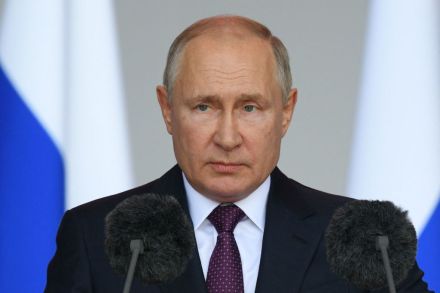
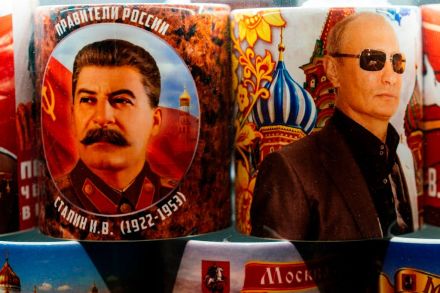
Vladimir Putin's actions have shocked many Western observers over the past few days. But his moves bear all the hallmarks of one of his predecessors: Joseph Stalin. Last Monday, the Russian Duma passed a direct appeal to Putin to recognize the Russian-controlled separatist states of Donetsk and Luhansk. The Russian president first said he would not immediately recognize the so-called republics. The reason for this was he wanted it to appear that when he finally did recognize them as independent republics, he was simply reacting to popular pressure from below. This is straight out of the Stalin playbook.

stalin

Russia’s war is not a Trump redux

I hate going back, again, to Orwell, but since the world is intent on using Nineteen Eighty-Four as an instructional guide, I have no choice. So proles, take note: this week's Two Minutes Hate will be split between Vladimir Putin and Donald Trump. They apparently share the goal of destroying American democracy via the invasion of Ukraine. Something very sinister has happened in the American mind-space over the last few days. Ukraine, a country of little importance to the United States, suddenly became the sole focus of most media-consuming Americans. This was constructed to appear organic, but it is impossible not to imagine guiding hands behind the shift of every single media outlet to a single story told in a single way.

trump-russia hoax

Saboteurs and looters: life in Ukraine’s capital

From our UK edition

Lviv, Ukraine Russian troops have yet to reach the centre of Kiev. Instead, locals have two more immediate concerns: saboteurs and looters.   Photos shoot across messaging groups. One shows a huddle of supposedly Russian agents caught in a metro station, along with an eviscerated teddy bear in which they were hiding rifle cartridges. The Ukrainians believe that saboteurs have been in most cities since January, marking out key infrastructure and military targets. Another photo shows an agent bound and gagged with masking tape. Blood streams from his head. The looters don’t fare much better. A paunchy man has his wrists cable-tied around a utility pole, his belt used to strap his knees against it.

georgia

Pro-Ukraine citizens clash with authorities in Georgia

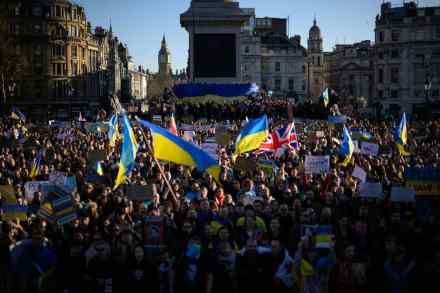
Tbilisi, Georgia After one week of fighting, Russia's invasion of Ukraine has already caused far-reaching geopolitical consequences, most of which point to gross miscalculation from the Kremlin. Following an arguably hesitant start, the Western world has united to provide Ukraine with lethal and non-lethal aid, as well as economic and humanitarian support. In addition, despite Putin ostensibly launching his war to prevent Ukraine from becoming a NATO member and curtail the alliance's easterly expansion, Kyiv's relations with the West have ironically become closer. Both Sweden and Finland appear to be closer than ever to considering joining NATO.

Holyrood offers Ukraine counselling

From our UK edition

It's now a week since Russia's invasion of Ukraine and there's no sign of an end in sight yet. The casualty lists have mounted on both sides, with the Kremlin admitting to 500 Russian dead, compared to America's estimate of 2,000 on Moscow's side. One millions Ukrainians meanwhile are estimated to have fled the country in the past seven days, with Kiev claiming that 2,000 civilians have been killed in Russian attacks. Sanctions meanwhile continue to be applied by a raft of European and Western powers against the embattled Putin regime. Such suffering now appears to have extended all the way up north to the Scottish parliament, where staff and MSPs are being told they can now receive counselling if they have been affected by the 'distressing' 'evolving situation in Ukraine.

Could the Ukraine war save Taiwan?

From our UK edition

The phrase wuxin gongzuo – ‘working with your mind on Ukraine’ – has been trending on Chinese social media network Weibo. Essentially what it means is ‘distraction from work because you’re obsessed with the war’. One blog that monitors the site, What’s on Weibo, reports that shortly after Russia’s invasion of Ukraine a page with updates on the conflict had received more than two billion views. Censorship, of course, limits what Chinese social media commentators can say, but there is clearly plenty of sympathy for the dying civilians and fleeing refugees.

The free world’s new reality

From our UK edition

We are about to see brutality in Europe on a scale that will be almost beyond our comprehension. Russia is turning to increasingly indiscriminate bombardment of Ukraine to try to achieve its aims after the failure of its initial military strategy. Vladimir Putin’s invasion has shattered the old belief that the era of wars between European nation states was over because the consequences were simply too grim. The policy of sanctions as a deterrent failed. The assumptions that have driven European geopolitics for a generation are changing before our eyes. Nowhere is this shift more dramatic than in Germany. After reunification, the country’s defence spending plummeted and for decades subsequent governments rejected requests from allies to spend more on military.

The return of Actual Badness

From our UK edition

In the spring of 2020, I advanced an abnormally hopeful proposition: that one blessing that might arise from a pandemic with otherwise few redeeming features was a cultural sobering-up. Maybe we’d regain a sense of perspective about the trivial non-problems of identity politics once finally faced with a proper problem. Boy, was I wrong. Instead, what proved a relatively mild disease, in the big, smallpoxian picture, fostered an even greater frenzy of ineffectual pettiness – park benches wrapped with police tape, government edicts about Scotch eggs, fisticuffs in supermarkets over thin, gap-prone facial napkins.

My escape from Kiev

From our UK edition

I spent my last night in Kiev in the ‘Presidential Suite’ of a city hotel – what used to be known as the underground car park. The general manager, a man whose name I never knew but who I hugged tightly before leaving, had promised to make it a shelter for guests who hadn’t checked out by the time it was clear that war was looming. We stayed there with his staff, their young children and elderly parents, their dogs and cats too. It is still the home of the BBC staff who remain in Kiev: the reporters and presenters you know as well as those whose roles are just as important but whose names you seldom hear.

Has Putin saved Boris?

From our UK edition

It was with some relief that I heard that Labour’s Diane Abbott was opposed to the Russian invasion of Croatia, because you cannot always tell with the far left what way they are going to swing. The Stop the War mob, along with 11 serving Labour MPs, have been anxious to exonerate Vladimir Putin and, in the usual fashion, blame the West. Their Russophilia has easily survived the end of communism and the transformation of Russia into a fascist state. But Croatia presents additional problems for lefties – and I know many former communists who will not visit Croatia because of the role of the Ustase during the second world war: their loss, in my opinion, as it is a beautiful country full of people who wish they were Austrians, which is a noble aspiration.

The complicated business of swearing in Ukrainian

From our UK edition

‘This will interest you,’ said my husband, looking up from the smeared screen of his telephone. For once he was right. It was a Twitter post about a memorable remark during the invasion of Ukraine. Snake Island is a small, bare outpost in the Black Sea near the Danube Delta. When a Russian cruiser invited the Ukrainian soldiers stationed there to surrender, they replied, ‘Йди на хуй’, transliterated as ‘Idi na khuy’. The point of the tweet was that their remark had been translated in a rather American way as ‘Go fuck yourself’, and a more idiomatic version in British English would be ‘Fuck off’. I agree, though it is not that simple.

In Lviv, the mood is inspiring – and fanatical

From our UK edition

Lviv, Ukraine On the Ukrainian side of the Polish border, near a place called Shehyni where the refugee crisis is brewing, an old black man approaches us. ‘Am I in Moldova?’ he asks gently in French, pointing to the fence. ‘No,’ I tell him. ‘That’s Poland.’ Moldova is 250 miles away. The man shrugs and returns to the endless queue of North African migrants. Several young men tell us that they have been there for four days waiting to cross. The Ukrainian guards hold baseball bats. British newspapers have reported ‘shocking racism’ at the border, and of course it is easier to get into Poland if you have a European or British passport and white skin. Yet we witness no ill-behaviour. It’s just a very cruel situation.

Britain must give Ukrainians an unconditional right to asylum

From our UK edition

During the Cold War, any citizen of a Soviet bloc country who made it to Britain and claimed asylum was welcomed with open arms. The fact people wished to take great risks to move westwards for safety and shelter, while hardly anyone wanted to move in the opposite direction, settled the question of which system was better. Besides, the numbers who made it out were tiny – the brutality of border guards patrolling the Iron Curtain saw to that. In recent years, the concept of asylum has been complicated by the debate on how to handle the much larger flow of migrants who are prepared to risk their lives fleeing poverty. One of Boris Johnson’s biggest headaches before the Ukraine crisis was his inability to stop the new wave of small-boat crossings to the UK.

Portrait of the week: Russia bombs Ukraine, MPs get a pay rise and Tube staff strike

From our UK edition

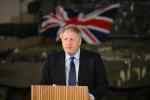
Home Boris Johnson, the Prime Minister, said of the invasion of Ukraine by Russia: ‘Never in all my study or memory of politics and international affairs have I seen so clear a distinction between right and wrong, between good and evil, between light and dark.’ He was speaking during a visit to the Ukrainian Catholic cathedral in London, where he lit a candle. He flew off to visit Poland and Estonia, and said he was worried that Vladimir Putin might ‘Grozny-fy’ Kiev, which would be ‘an unalterable moral humanitarian catastrophe’. Britain might take in 200,000 Ukrainian refugees after a scheme for close relatives of Ukrainians in the UK was widened to include other family members.

The Russian Orthodox Church eyes Ukraine

Christopher Hitchens, allergic to the idea that secular regimes might actually be more bloodthirsty than religious ones, infamously attempted to blame the atrocities of Stalin’s Soviet Union on the Russian Orthodox Church. It was an end run worthy of the NFL Hall of Fame, and no doubt Hitch would be attempting something similar if he’d lived to see Russian President Vladimir Putin’s invasion of Ukraine. He would be wrong, but as Putin fights to reclaim territory once held by the Soviet and tsarist empires, the church appears to be conducting its own parallel campaign of spiritual imperialism. There’s little doubt Putin sees the church as politically useful.