Uk politics

RIP Lord Walker

Peter Walker, Baron Walker of Worcester, has died aged 78. He served as a Cabinet Minister in both the Heath and Thatcher governments. He was what might be termed derisively as a ‘Wet’, and was a leading figure on the liberal side of the Conservative Party for thirty years. He was a founder member of the Tory Reform Group, which propounds One Nation Toryism and economic efficiency, ideals that have, it might be argued, profoundly influenced David Cameron’s leadership. Walker served with distinction throughout the Thatcher government, carrying the brief for Wales, Energy and Food and Fisheries. As Energy Secretary, he was a key figure during the Miner’s Strike.

How good intentions can be counterproductive

Might the coalition’s emphasis on fairness be making it harder to get people off welfare and into work? Not a question that I can answer with confidence, but certainly one which has been thrown up by the IFS's Budget briefing. Take the government's action on child tax credits, for instance. By increasing it at the lower end of the income distribution, and restricting it at the upper, some claimants now stand to lose more, more quickly, by moving up the income ladder. Or, as the IFS put it, their marginal effective rate of taxation has increased. Of course, this will have been offset by other measures such as the rise in personal allowances. But it does present a conundrum for government policymakers, eager to prove that their measures aren't hitting the poor.

IFS: there could be deeper cuts to come

An unfamiliar mood before the Institute for Fiscal Studies' Budget briefing today: many of the gathered journalists, economists and policymakers had decided that, for once, this wouldn't be an exercise in spotting the Chancellor's deceptions, because, quite simply, there aren't many. And they could well be right. In his introductory remarks, Robert Chote, the director of the IFS, said that "the government is certainly to be congratulated for the transparency with which it presented [yesterday's policy announcements]." What we've heard, so far, backs up that tribute.

Loving Hattie

The unthinkable has happened. I’ve started to admire Batty Hattie’s performances at PMQs. Her career may be over, her party may be trashed, her movement may drift leaderless, and her colleagues’ reputation may have been shot to pieces but Hattie always turns up and gives it everything. Nature has not overburdened her with talent. She can’t count. She can hardly speak. She reacts to events about as quickly as a self-timing oven but she has epic quantities of pluck. Every week she pounds out into the surf, like a battleship equipped for the last war but two, and heads for the centre of the fray where she refuses to sink under the heaviest fire.

The road to recovery | 23 June 2010

This is a slow-burning budget. Not because Osborne has concealed, like Gordon Brown did, but because the reverse is true. The budget is, as Osborne says, a third of the size but with three times the amount of information. It has layers: some policies and language are there just to assuage the LibDems. Some are pure Tory. James has a brilliant cover piece in tomorrow’s magazine which spells out the political, rather than economic, forces at work in this budget. Osborne, that great player of three-dimensional chess, sees in this budget plans to restore a Tory majority government. The Red Book itself is, for wonks like myself, a joy to read: straight figures, with nothing concealed.

The EU must face cuts too

This is a balancing act Budget. At every stage and on almost every topic there's a bit of good news and a bit of bad news for taxpayers. Spending cuts are (finally) on the way, but at over £30 billion by 2014-15 they aren't large enough, and there is plenty of dead wood that the Coalition intends to leave in place. Similarly, the rise in the income tax threshold is extremely welcome, but the VAT hike will hit the poorest hardest of all. And so it goes down the list of Government financial activities. Indeed, the theme the Government are keen to communicate is one of leaving no stone unturned, looking at every item of expenditure and every tax for ways to raise or save money....except for one area.

Osborne winning the Budget PR battle – but VAT remains a thorny issue

Well, that's gone as well as can be expected for the coalition.  Most of today's newspaper coverage highlights the severity of George Osborne's Budget – but, crucially, it adds that the Chancellor had few other options.  The Telegraph calls it a "brave Budget".  The Times says that it delivers "the best of fiscal conservatism combined with no small measure of social justice".  And even the FT – no friend of the Tories in recent years – suggests that Osborne might be "remembered for doing Britain a great service." The sourest notes chime around the government's welfare cuts and the hike in VAT.  Already, it's clear that the latter will be particularly difficult for the Tories and embarrassing for the Lib Dems.

A well-crafted Budget but the spending review will hurt more

George Osborne’s Budget today was the first dose of pain. The second will be the spending review in October, which I suspect will put far more of a strain on the Coalition than today did. Non-protected departmental Budgets, everything apart from health and DFID, are going to be cut by 25 percent on average. But Osborne told the House he would hope that the cuts to defence and education would be significantly less than that. The unspoken part of that is that the cuts to some other Budgets will have to be significantly bigger than that; I expect there are a few people at BIS and DCMS looking around rather nervously this evening. When the cuts are laid out that’s when the current feeling of unease among a chunk of the Lib Dem backbenches will crystallise.

A credible start

Today’s Emergency Budget announced the most ambitious fiscal consolidation programme in decades.  It sets out a framework returning the government broadly to a state of fiscal solvency by 2014.  To do this, George Osborne announced a deficit reduction programme amounting to just over £100 billion in real terms – entirely in line with our recommendations.  The ratio of spending cuts to tax rises – 74:26 is largely in line with the international best practice model (which we also endorsed) of 80:20.

Why must VAT rise? Because not enough will be cut

There is plenty of very good news in the Budget.  A two year public sector pay freeze, the abolition of the Child Trust Fund and cuts in welfare spending are all longstanding TPA recommendations that will be absolutely key to getting the public finances under control.  As a result of all the measures proposed, annual spending will be £31.9 billion lower than planned by 2014-15.   The Government are also scrapping more organisations.  The Emergency Budget report says (page 31) that "Regional Development Agencies will be abolished through the Public Bodies Bill.

Slice not structure

Two weeks ago, when launching the Spending Review, George Osborne called for a once-in-a-lifetime debate about the shape of government in the UK.  He implied that there is a right and a wrong way to cut the deficit.  It would be right to cut spending by addressing the structural causes of the deficit - i.e. public sector inefficiency and the UK's unwillingness to cut its pensions and health entitlements.  It would be wrong to leave the shape of public services and welfare unchanged, but limit their costs temporarily – “salami slice” – with public sector pay freezes for instance.

Unspectacular, but quite effective

Well, that was excitingly unexciting.  There was little in George Osborne's Budget that we didn't expect, either in terms of rhetoric or policy.  But it still felt new and different nonetheless.  Here we had a Chancellor setting out exactly how much spending he will cut, and putting plenty of emphasis on both our deficit and debt burdens.  It drew a stark contrast with the Brown years, and was a solidly understated performance in itself. There will be plenty of attention paid to the hike in VAT, and rightly so.  But there were some macroeconomic forecasts which were just as eyecatching.

Budget 2010 – live blog

1343, PH: Harman has sat down now, so we'll draw the live blog to a close.  I'll write a summary post shortly. 1342, FN: I wish I could trash Harman's response, but it's actually quite good.  Many a Tory would be secretly cheering her trashing of the LibDems. "The LibDems denounced early cuts, now they're backing them - how could they support everything they fought against, how could they let down everyone who voted for them?" Again, a fair point. "The LibDems used to stand up for people's jobs, now they only stand up for their own." Her main point - that forecasts for unemployment have risen - is a fairly strong one if true. Osborne did indeed shy away from admitting to VAT rise plans in the election campaign.

George Osborne must put spending cuts ahead of tax rises

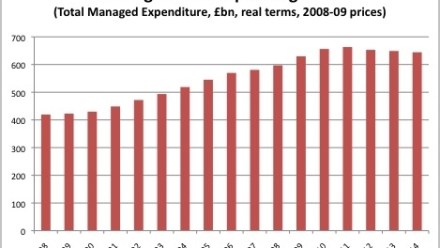
In 2009, Britain borrowed more, as a share of its national income, than any country that isn't being bailed out by the IMF and the Eurozone (Greece) or already making drastic spending cuts (Ireland).  That huge deficit is the critical challenge to our economic stability that George Osborne needs to tackle with the Budget today.  We have got away with high borrowing so far on the understanding that cuts are coming now the election is out of the way.   If you think tax hikes are the answer, then you're asking the wrong question.  Our present fiscal crisis is built on a decade of bumper rises in spending, not tax cuts.  Over the last decade, spending rose from 36.6 per cent of GDP to 53.4 per cent this year according to OECD data.

Osborne makes the “progressive” case

During the Brown years it was "stability," but it looks as though the watchword for Chancellor Osborne's first Budget will be "progressive".  This is the word that's being bandied about behind-the-scenes, and the coalition seems confident that it has the policies to match the rhetoric.  As the Guardian reports today, it's likely that the personal income tax allowance will be raised by £1,000 or so, to help shield the least well-off from tax rises elsewhere.  And the paper quotes a Tory aide saying that the richest will pay more, "both in absolute terms and as a percentage of their income." Whether he drops the p-word or not, the arguments behind it are comfortable territory for Osborne.

Osborne looks to the long-term

There are plenty of details for Budget-spotters to look out for tomorrow, but among the most important is just how far Osborne reaches into the future.  The current expectation in Westminster is that he will offer quite a few glimpses into the long-term.  A possible commitment to reduce the main rate of corporation tax to 20 percent over the next five years, perhaps.  Or similar provisions for making the first £10,000 of income tax-free. There are, of course, economic and political motives behind this.

Why a public sector pensions levy makes sense

Today's papers are awash with stories that a public sector pensions levy will be announced in tomorrow Emergency Budget. Trade unions have already issued dire warnings, ranging from the PCS's promise to "organise the widest possible popular opposition," to Bob Crow of the RMT’s rather prosaic: "when someone’s winding up to give you a kicking you have a clear choice — you can either take them on right from the off or you can roll over and hope that they go away."  Public sector workers, however, should not be so dismissive.   In our report, released on Friday, we argue for an "Irish style" graduated public pensions levy of 7.5 percent.  We estimate this will ‘save’ 322,000 jobs.  Why?

The two sides of the VAT question

There are two main aspects to the VAT issue: one distasteful, the other less so.  The distasteful one is the issue of whether the government has a mandate for hiking VAT in tomorrow's Budget.  Of course, government is often the art of the unexpected, so we shouldn't be surprised to see measures implemented that weren't explicitly raised in the election campaign – particularly when it comes to tax rises.  But all the claims that there were "no plans" to raise VAT do jar against reports like: "Osborne insisted the budget measures would be spread fairly across society, suggesting capital gains tax will rise and promising a new banking levy.