Uk politics

The China arms embargo should be discussed – though not lifted

Today's Times splashed on the spat between Britain and EU foreign policy "czar" Catherine Ashton over the embargo barring arms sales to China. The embargo was put in place after the Tianamen Square massacre and has remained in place, largely at US insistence, ever since. But is it the right policy? The policy has not prevented China from becoming a military power — its annual defense budget officially stands at $70 billion, although the Pentagon believes the real figure to be twice as high. China is developing carrier-killing missiles that even NATO does not have, and will soon sell weapons rather than seek to import them. There is, of course, a moral argument: the sanctions were put in place because of China's human rights violations.

Exclusive – Adonis: I back Gove

Is Michael Gove’s school reform a hideous distortion of the Labour Academies programme, as Ed Balls put it, or the fulfillment of that agenda? Until now Lord Adonis, the architect of the Academies programme, has kept silent on the issue. But he’s interviewed in The Spectator tomorrow by Matthew Smith, editor of Attain magazine. Here is a brief extract: 'Ed Balls has declared Gove’s plans for academies as ‘a total perversion of Labour’s policy, which was about turning round under-performing schools in disadvantaged areas’. Adonis’s response is rather different.  ‘Neither I nor Tony Blair believed that academies should be restricted to areas with failing schools.

Eric Illsley announces his resignation

With the Labour party motioning to unseat him, and David Cameron and Ed Miliband speaking out against him, it was always likely to end thus for Eric Illsley. The receipt offender has just issued this statement: "I would like to apologise to my constituents, family and friends, following my court appearance, for the distress and embarrassment caused by my actions that I deeply, deeply regret. I have begun to wind down my parliamentary office, following which I will resign from Parliament before my next court appearance. I will be making no further comment." Which leaves us with the prospect of a by-election in Barnsley Central, probably in May. It's one that Labour will expect to win, not least because they achieved 47.

An ill-tempered exchange

The first PMQs of the year was a bad tempered affair. The Prime Minister had clearly decided that attack was the best form of defence, hurling insult after insult across the despatch box. He accused Ed Miliband of being a ‘nothing man’, told him that his Shadow Chancellor can’t count and that he doesn’t count and mockingly brought up Miliband’s brother. But Cameron didn’t do anything to politically detoxify the bonus issue, which is going to carry on haunting this government, note that Lloyds — partly state owned — is going to award its boss a £2million pound bonus.

PMQs live blog | 12 January 2011

VERDICT: Woah. If you ever needed a PMQs to brush away the last morsels of festive cheer, then this was it. Every question and answer came laced with some sideswipe or other, and it made for a scrappy exchange between the two party leaders. Both struck blows against each other, but both were also guilty of errors and mis-steps. Miliband squandered an easy attack on bankers' bonuses, even allowing Cameron to turn it back against Labour. While, for his part, the Prime Minister was so relentlessly personal that it came across as unstatesmanlike. I don't think either one really emerged victorious, or well, to be honest. It was simply unedifiying stuff. 1230: And that's the end of the first PMQs of 2011 - and what a heated one it was, too. My verdict shortly.

Clegg: time to air our differences

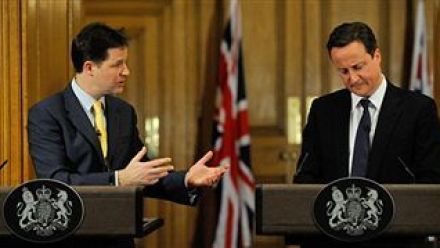
Why vote Lib Dem? Even Nick Clegg is now asking that question. After 8 months of broken pledges, deep cuts and atrocious polling (due to reach its nadir tomorrow in Oldham East and Saddleworth), Clegg worries that his party is losing its identity. Speaking to the Guardian, Clegg reveals that he hopes to arrest decline by expressing publicly his private differences with David Cameron. This is not defiance from Clegg but a statement of positive intent. Taking brave decisions, he says, has proved that the Liberal Democrats can govern and that coalition works; the government’s strength is sufficient to withstand disagreement. That’s all very well, but Clegg needs more than mere differences: all politicians have their differences.

Illsley’s untenable position

After David Chaytor's conviction last week, the dominoes just keep on tumbling. Today, it was Eric Illsley's turn to confess to his expenses-related sins – and he did so by pleading guilty to three "false accounting" charges in Southwark Crown Court. Given that he's still MP for Barnsley Central – although now as an independent, rather than the Labour MP he was elected as – that makes him the first sitting parliamentarian to face sentencing as a receipt offender. A dubious accolade, to be sure. In terms of day-to-day politics, the next question is whether Illsley will be able to hang on to his seat. He could, theoretically, remain in place if his sentence is under a year's jail time.

Mixed attitudes towards the cuts

Forget the voting intentions, the real action in YouGov's latest poll comes in the supplementary results. There, as Anthony Wells suggests, are attitudes towards spending cuts that will both perturb and hearten the coalition. Let's take the bad stuff first: "Asked if the government’s cuts will be good or bad for the economy only 38% now think they will be good, compared to 47% who think they will be bad. In comparison between October and December last year it was roughly even between people thinking the cuts would be good and those thinking they would be bad. On whether the cuts are being done fairly or unfairly, 57% now think the cuts are being done unfairly, again the highest we’ve shown so fair.

Opposing the EU Bill

The EU Bill is back in parliament today, amid speculation that Cameron has a Europe-fuelled rebellion on his hands. Despite the talk, the chances are that the Bill will go through Parliament wholly unscathed in its first test.   Today’s debate is about the so-called ‘sovereignty clause’ – or Clause 18 – within the EU Bill. Of the Bill’s 17 pages, the clause only takes up four lines, but has still managed to cause the most fuss (the vast majority of the text relates to the EU ‘referendum lock’).

The broken Lib Dem pledge that didn’t provoke riots

Coalition politics sure does throw up some peculiar situations. Take today's vote on the EU Bill. As part of the horse-trading that's going on around it, Tory Eurosceptics have put forward a series of amendments to mould the Bill more to their liking. Of these, the most striking is Peter Bone's suggestion that Parliament should legislate for a referendum, not on this minor constitutional change or that, but on whether we should leave the EU altogether. So far, so unsurprising. But the curious part of all this is that the Lib Dems once offered an in-out referendum on Europe themselves. If you remember back to the row over Lisbon, Clegg's get-out clause was what he called "a referendum on Europe with substance".

The coalition decides to accept the flak over bonuses

The truth, as they say, is out: it doesn't look as though the coalition will be doing much about bankers' bonuses after all. According to this morning's Times (£), it's a case of the Tories getting one over the Lib Dems – and particularly Vince Cable – by not pushing down with more taxes on the City. But that, I suspect, is only half the story. The other half is that the coalition never had much in their armoury, but harsh rhetoric, in the first place. If they want the banks to start lending to business again, then their most substantial hope has always been a trade-off over bonuses. Which – as Benedict Brogan suggests in an insightful post over at the Telegraph – is hardly an ideal situation for the coalition.

The crash from an Austrian perspective

It’s not all politics at Westminster. There’s a pretty good think-tank scene too, with lectures on topics that you’re unlikely to read about in the newspapers. One took place today: the Adam Smith Institute hosted a lecture by Steven G. Horwitz, from St. Lawrence University, entitled “An Austrian perspective on the great recession of 2008-09”. As many CoffeeHousers will know, "Austrian" refers to von Mises, Hayek and the others whose analysis of bubbles and crises certainly seems to fit current events. My colleague Jonathan Jones was there, and took some notes – which I have moulded into a six-point briefing.  It’s not often we do a post based on a think-tank talk – we may do more, if CoffeeHousers find them useful.

Clegg sets his alarm clock

My prediction for this week: we're going to see a whole lot of defiant frontage from Nick Clegg. The last parliamentary session closed with him under attack over tuition fees; this one begins with the possibility of heavy defeat in Oldham East – and he's got to respond accordingly. Hence his interview on Today this morning, in which he dismissed the idea of a Lib Dem drubbing in May's local elections as "total nonsense," and stressed that the coalition is "setting in motion a number of very liberal reforms". There was also a warning over bonuses, along the usual lines, for state-owned banks. But the most intriguing news in Lib Dem Land is much more sedate than all that – revealed, as it was, in an unassuming paragraph at the bottom of a Sunday Times story (£) yesterday.

Johnson running out of his nine lives

Ed Miliband's press conference today was a classic example of clever opposition politics. He and Alan Johnson said that Labour would continue the bonus tax on the banks for one more year. This policy has the twin advantage of maximising the coalition's discomfort over the whole issue of bankers' bonuses and expiring well before the next election. The rest of Miliband's press conference was devoted to an attempt to defend the record of the previous Labour government. Miliband kept making the valid point that in the years before the crash Cameron and Osborne weren't saying that Labour was spending too much but were instead committed to matching Labour's spending plans.

Will Balls and Cooper capitalise from Johnson’s mistakes?

You've probably heard about Alan Johnson's latest slip-up yesterday. But it's still worth highlighting the response made by a Labour spokesman – as Dizzy has – because it's simply extraordinary. Here it is: "We have a Shadow Chancellor who lives in the real world. He knows the difference between a progresive and regressive tax. He knows what it takes to get on in the real world. That is more important than taking part in a Westminster quiz game." Extraordinary that Labour should already have to make excuses on behalf of Johnson. But even more extraordinary that they should be made in this manner.

Cameron sells the coalition’s economic policy

David Cameron was on Marr this morning (with yours truly doing the warm-up paper review), talking about the "tough and difficult year" ahead. Others have been through the interview for its general content. What interested me was its economic content: not the most sexy subject in the world, I know, but, as Alan Johnson unwittingly demonstrated on Sky this morning, the Labour Party looks unable to scrutinise the government's economic policy. Anyway, here are ten observations:   1) "Because of the budget last year, we are lifting 800,000 people out of income tax, we're raising income tax thresholds. That will help all people who are basic rate taxpayers." Thanks to the Lib Dems. But it's a great claim, and I'm glad Cameron is making it.

The pollsters have Labour running away with it in Oldham East

The same, but completely different. That's the electoral paradox that emerges from a couple of opinion polls on the Oldham East & Saddleworth by-election this morning. The same, because both the Lord Ashcroft survey for the Sunday Telegraph and the ICM survey for the Mail on Sunday produce the same result as in the general election: Labour first, the Lib Dems second and the Tories in third. Completely different, because this is no longer the achingly close contest that it was back in May. Both polls have Labour soaring 17 percentage points above the yellow bird of liberty. Of course, the polls aren't always right. Yet these latest will surely furrow some brows in Coalitionville.