Uk politics

How the Tories could capitalise on the eurozone’s woes

With events in Greece moving at pace, next week’s European Council meeting (which was scheduled to be a low-key affair) could be the place where attempts to resolve the crisis in the eurozone take place. I’m told that Number 10 has now woken up to this possibility and is doing some preparatory work on the matter.   But, frustratingly, there’s still no strategy for how David Cameron could use this crisis to advance the British national interest. As I wrote last week, if the eurozone countries decide that a solution will require a treaty change, then Britain has a veto over that — and could use the negotiations to secure various things that Britain wants from the EU.

Danny’s maths

And so Danny Alexander has further angered unions by making it clear that "painful decisions" are needed to reform public-sector pensions, including raising the retirement age. But his proposals should no come as a surprise. Rapid demographic transitions caused by rising life expectancy and declining fertility mean that the proportion of old to young is growing rapidly. But when the Lib Dem minister says that "people are living much longer now," he is in fact underplaying how dramatic the change has been in the last decade. According to the Office of National Statistics, the proportion of people in Britain aged 65-and-over increased from 15 per cent in 1984 to 16 per cent in 2009, an increase of 1.7 million people.

Greece on the precipice

Europe is a doom-monger's paradise at the moment. Riots in Greece; summary Cabinet reshuffles; meetings between Merkel and Sarkozy to save the single currency — and there's still the potential for things to get worse, much worse. If the Greek government defaults on its debts, then there's no knowing where the contagion will spread, only that it it will spread wide: from Spain and Portugal to markets across the world. Share indices have already been trembling at the prospect, although many of them rallied slightly today. One consolation, however scant, is that all this crystallises just what can happen to governments who operate beyond their means.

Alexander’s not for turning

After the vacillations of recent days, the government could do with a show of hardheadedness — and Danny Alexander is delivering just that today. He is announcing the government's plans for public sector pension reform later, and they're exactly the sort of plans that will set the union bosses frothing: an increase in the public sector retirement age to 66, an increase in contributions, that sort of thing. But the Chief Secretary to the Treasury is unapolgetic. In an article for the Telegraph, he effectively says that this is a take-it-or-leave-it offer for the public sector. "It may be that those who oppose change think they can force the Government to change its mind," he writes, with his pen pointed accusingly at the unions planning strikes for next month.

Balls’ bloodlust gets the better of him

Ed Balls’ problem is his killer instinct. If he were a Twilight vampire, he’d be a Tracker: someone whose uncontrollable bloodlust takes him to places he should avoid. His position on the deficit is so extreme — more debt, more spending — that he’s pretty much isolated now. People are mocking him. John Lipsky, the acting IMF chief came two weeks ago and rubbished Balls’ alternative (as Tony Blair did) — so Balls, ever the fighter, has today given a long speech where he sinks his fangs into Lipsky and says (in effect) "I’ll take on the lot of you!" But Balls is brilliant. Often George Osborne seems not to bother arguing, and instead seeking approval from an alphabet soup of external agencies ("I must be right, the ABCD says so!

General outspokenness 

Recent wars have given rise to an unusual phenomenon in British civil-military relations: frequent, and often high-profile interventions, by serving or recently retired senior military officers in public debates. The latest has been the intervention of Britain's chief naval officer, Admiral Sir Mark Stanhope, who questioned the Navy’s ability to sustain the Libya campaign. Different prime ministers have dealt with this kind of outspokenness in different ways. Tony Blair was too weak to rein in Army chief Sir General Richard Dannatt, while Gordon Brown did not have the credibility, vis-à-vis the military, to do so either. David Cameron is different. He is at the height of his powers and determined that he, not the military leadership, should exercise command.

Gove goes forwards, while other reforms stall

The good, the bad and the ugly of the coalition’s reform agenda are all on display this morning. The good is the quickening of the pace in education. As Michael Gove tells this week’s Spectator, the 200 worst primary schools will now be taken over by new management, 88 failing secondary schools are to be converted into academies and any school where half the pupils are not reaching the basic standard of five good GCSEs including English and Maths will be earmarked for a takeover. Gove’s aim is remarkably simple: he wants good schools to take over bad ones.   The bad is yet another delay to the public service reform white paper, the longer things stay in the Whitehall system the less radical they become.

Milburn withdraws the Blairite seal of approval

Alan Milburn's article for the Telegraph this morning is a rhetorical blitzkreig against the coalition and their NHS reforms. From its opening shot that "The Government health reforms are the biggest car crash in NHS history," to its closing call for Labour to "restake its claim to be the party of progressive, radical reform," it is searing stuff. And no-one is spared, least of all Andrew Lansley and his "foolish bout of policy-wonking". Such fierce language is unusual, even by the standards of cross-party rough 'n' tumble. What makes it extraordinary is that Milburn is employed by the government to work on their social mobility agenda. The coalition's last report on the matter even expanded and prolonged his role.

Osborne to sell off the Rock

George Osborne will use his Mansion House speech tonight to, in the words of one source, "fire the starting gun" on the sale of Northern Rock.   Robert Peston, who had the story first, reports that "The chancellor hopes that the sale of Northern Rock will send a powerful signal that the banking industry is on a path back to more normal conditions, following the crisis of three years ago."   In an attempt to maximise return for the taxpayer, the whole of the "good bank" part of Northern Rock will be sold off to a single bidder. This means that the whole issue of discounted bank shares, which splits Osborne and Cable, with the Chancellor in favour, doesn’t arise.

Ed Miliband volunteers for a kicking, gets kicked

"First he denies his own policy, then he tries insults." So said Ed Miliband of David Cameron's performance in PMQs today. But I wonder what he'd say of the hundreds of Twitter users who went straight for the insults in a special Q&A with the Labour leader earlier. Urged on by Guido, plenty deployed the #AskEdM hash-tag to be rather unkind to MiliMinor. Here's a selection of some of the crueller, funnier and less comradely tweets: @MTPT: If a train leaves Paddington at 1136, carrying 200 commuters, what time will the RMT bring it to a standstill? @FelicityParkes: Where did Ed Balls touch you? Show us on the doll. @MShapland: hows your brother @Charlesm186: how many knives did you put in Tony Blair's back? @alexmassie: Was Brutus an honourable man? Discuss.

Why the battle of the bins matters

The government is, rightly, receiving a monstering from the papers for its u-turns on weekly bin collections. But what is at stake here is more than just the issue of bins. The government’s failure to honour its promise on this matter casts doubt on whether ministers are strong enough and tough enough to impose their will on their departments. The two ministries dealing with the rubbish question are the Department of Environment, Food and Rural Affairs and the Department of Communities and Local Government. Both are run by Conservative Secretaries of State. If this was not enough, both the Secretaries of State involved — Caroline Spelman and Eric Pickles — are personally associated with the Tory policy on bins.

Ed’s not dead

Crafty old Ed. After a week on death row, he was expected to arrive at PMQs and do the decent thing. Drink down a foaming cup of hemlock and depart the political stage for good. But Ed is made of sterner stuff than many of us realised. He was cunning, passionate and articulate today and his performance will have steadied the nerves of his anxious troops. It all began oddly. As soon as Miliband stood up he was greeted by a slightly over-done chorus of cheers from his backbenchers. This absurdity prompted a burst of satirical catcalling from the Tories. They knew this would be fun. Cameron would run rings around Dead Ed. Miliband’s team of researchers have earned their dough this week.

Miliband and the past

Labour's simmering resentments and self-doubts have been boiling over recently — and today is no different. Compare and contrast The Sun's interview with Tony Blair with Andrew Grice's article on Ed Balls in the Independent. For Blair, Labour ought to be claiming more credit for their preparatory role in some of the coalition's reforms, such as the Academies programme. For Balls, they ought instead to be dodging blame for the state of the public finances. As Grice reports, "Ed Balls has rejected demands from allies of Ed Miliband that he admit Labour spent too much when they were in power." From the rest of the piece, the shadow chancellor's position sounds rather like that of John Wayne's Captain Nathan Brittles: "Never apologise.

PMQs live blog | 15 June 2011

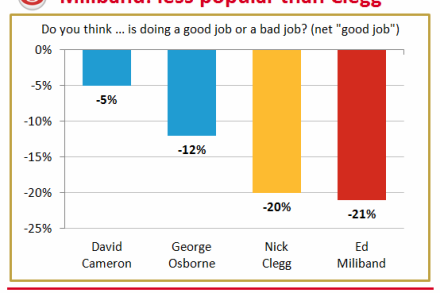
VERDICT: The specifics of today's exchange between David Cameron and Ed Miliband may have everyone rushing for this Macmillan press release, but the rhetorical positions were clear enough. There was the Labour leader, angrier and more indignant than usual, painting the government's welfare reforms as cruel and insufficiently thought-through. And there was the PM, painting his opponent as yet another roadblock to reform. Neither really triumphed, although their battle will most likely set a template for in future. The coalition has extensive public backing for its changes to the welfare system. So, Miliband's challenge is to attack certain aspects of them, without making Labour appear to be — as he put it on Monday — "the party of those ripping off our society".

Bring on the strikes

An old boss of mine once said to me: when you start a new assignment, seek out a fight — and win it. The same advice should be given to incoming Prime Ministers. U-turns, as Mrs Thatcher knew, just create demand for more U-turns. If the government is willing to revise its NHS plans, then why not reopen the Defence Review, or alter the pledge to spend 0.7 of our national income on overseas aid (or at least abandon the questionable idea of legislating for it)? But seeking out and winning battles, while avoiding too many retreats, is not enough. To be great, a Prime Minister needs good enemies. Mrs Thatcher had great enemies in Michael Foot and Neil Kinnock. Tony Blair did too.

Osborne comes to a decision on the banks — but the story doesn’t end there

In his speech to Mansion House last year, George Osborne asked a question of his frosted and cumberbunded audience: "Should we restrict or split the activities of banks?" In his speech tonight, he looks set to deliver an answer of his own. As Robert Peston reports, the Chancellor is to announce that the investment and retail arms of banks will be ringfenced off from each other, so that the dice rolls of the Masters of the Universe cannot tumble across everyday savers' cash. This does not mean a complete, Glass-Steagall-style separation between the two halves.

Pressure at the pumps

Away from the clamour in the chamber over the bowdlerisation of the NHS reforms, a group of MPs led by Robert Halfon convened in Westminster Hall earlier this afternoon to debate how rising fuel costs might be abated. Treasury minister Justine Greening attended for the government. With the average price of unleaded at 136.9p/litre and diesel at 141.5p/litre last month, fuel costs are now a major concern for ordinary families. According to the campaign group Fair Fuel UK, who are working with the MPs, the average motorist who has to drive to work spent £33/week on petrol last year, taken from median pre-tax earnings of £499/week in 2010. With inflation now rampant, this burden is becoming unsustainable for many. Campaigners implore that it needn’t be so.

More than a soap opera

David Miliband is considering a return to frontline British politics. At least that is what Andrew Grice has heard. He reports: ‘David Miliband is considering a surprise comeback to frontline politics in an attempt to end speculation about a continuing rift with his brother Ed. Friends of the former Foreign Secretary said yesterday that his joining the Shadow Cabinet was a "live issue" in his circle of political allies. "There is a debate going on. Some people are arguing that it would be better to be a team player than look as though he is sulking on the sidelines," said one source.’ Better for whom, I wonder?