Uk politics

Stop Funding Hate: a nasty, elitist campaign for press censorship

From our UK edition

Intolerance wears a progressive mask in the 21st century. Students hound political undesirables off campus in the name of ‘protecting diversity’. Adverts are banned from the London Underground in the name of women’s rights. Rappers and other hotheads are barred from Britain on the basis that their utterances are ‘not conducive’ to our good, progressive way of life. And now assorted leftists and tweeters are seeking to punish tabloid newspapers, to starve them of big revenue, in the name of promoting tolerance. Yes, intolerance - in this case of the redtop press and its right to say what it wants - is tolerance.

Theresa May now has some Trumps in her Brexit negotiating hand

From our UK edition

Britain’s position heading into its Brexit talks is far stronger than it was a week ago, I argue in The Sun today. Why, because Donald Trump has changed the dynamics of global politics. Brexit’s critics used to claim that this country would be isolated after it left the EU. But it is hard to make that case when the president-elect of the most powerful country in the world is in favour of it. Indeed, the next US President is more enthusiastic about it than the British Prime Minister. He was for it before June 23rd. Theresa May now has a chance to create a strong relationship with Trump before other European leaders even start trying.

In defence of the Daily Mail

From our UK edition

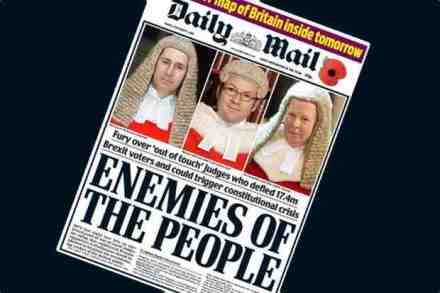
Who’s more hysterical: the Daily Mail for branding three judges ‘enemies of the people’ or the Dailymailphobes who have spent the past three days promiscuously breaking Godwin’s Law and accusing the Mail of being a paper-and-ink reincarnation of Hitler, an aspiring destroyer of judicial independence, and a menace to British civilisation that ought to be boycotted by all decent people and no longer handed out on British Airways flights because it is ‘against democracy and the rule of law’? I’m gonna go out on a limb and say it’s the latter. And that the irony is delicious: the very people accusing the Mail of being unhinged have themselves given new meaning to the word unhinged. Seriously, someone should take their temperatures.

Government’s high court defeat sparks election chatter

From our UK edition

What worries government ministers, as I say in The Sun this morning, is not the actual vote on the Article 50 bill—voting against the bill as whole would be akin to rejecting the referendum result—but attempts to tie Theresa May’s hands ahead of the negotiation through amendments to the bill. One senior Cabinet Minister tells me that peers and MPs ‘won’t be able to resist’ trying to amend the bill. Though, it is worth noting that because of public concern about free movement there probably isn’t a Commons majority for staying in the single market, post referendum. Downing Street is adamant that they don’t want an early election, and that if they lose their appeal to the supreme court they can get this bill through clean.

The unhinged backlash to the High Court’s Brexit ruling

From our UK edition

As a general rule, any day the government loses in court is a good day. So yesterday was an especially fine day. A delicious one, too, obviously, in as much as the fist-clenched, foot-stamping, whining of so many Brexiteers was so overblown and ludicrous it toppled into hilarity. People who shouted for months about the urgent need to restore parliamentary sovereignty now reacted in horror to the restoration of parliamentary sovereignty. 'That's not what we meant', they spluttered. We meant governmental supremacy only when it suits us. Well, tough. A certain amount of squealing was only to be expected since, if Nigel Farage has taught us anything, it is that the Brexit-minded really don't like it up 'em. But, still.

The tough fight for democracy has begun

From our UK edition

This week, national treasure David Attenborough joined the post-Brexit pile-on of the plebs. Should the little people really be trusted to make decisions about complicated matters like the EU, he asked? You know the answer: of course we shouldn’t. We’re too dim. We don’t have as many degrees as him. The point of parliamentary democracy, he says, is that ‘we find someone we respect who we think is probably wiser than we are’ and then we trust them to ‘ponder… difficult things’. That’s far preferable to asking people who’d prefer to go to a funfair than the National Gallery — he really says this, in reference to a quote from Ken Clarke's new book — to decide the fate of Britain's relationship with the EU.

Spectator Parliamentarian of the Year 2016: the speeches

From our UK edition

The Spectator’s Parliamentarian of the Year awards, sponsored by Benenden, has already made the headlines. What started out in 1983 as a lunch with two dozen people has turned into the British equivalent to the White House Correspondents' Dinner - where politicians turn up with their best lines, teasing themselves and each other, with results that routinely make the national news. The tone was set brilliantly this year by George Osborne, our guest of honour. His speech was so funny, so searingly sharp, they he set a bar for everyone else. Here it is. Then, the awards kicked off. My own spiel is below - and then that of the winners.

Morrissey is right – Brexit really is magnificent

From our UK edition

Being an out-and-proud Brexiteer, someone who would go to the barricades for Brexit, someone who might even take a bullet for Brexit, I often get emails from people who feel the same way but feel they can’t express their Brexitphilia in public. This week, in response to my Big Issue column on, yes, the beauty of Brexit, a correspondent tells me that, like me, he voted Leave for liberal, democratic reasons, not Little Englander ones, but such has been the ‘name-calling’ and ‘toxicity’ in response to his decision that he's had to slink off social media and keep his head down. It’s awful.

In defence of Zac Goldsmith

From our UK edition

I’m baffled by the reaction to Zac Goldsmith’s decision to resign as the Conservative MP for Richmond Park. It is being interpreted, even by MPs on his own side, as an act of opportunism, a chance to rehabilitate himself with the metropolitan elite after his bruising defeat in the London mayoral election. Surprisingly few people seem willing to entertain the idea that he might be acting on principle. Exhibit A in the case for Zac’s defence is the fact that he’s the MP for Richmond Park in the first place. Zac could have applied to be the candidate in any number of safe Conservative seats in 2010 and, given his profile, easily have been selected. Yet he chose a seat that was held by a Lib Dem with a 3,731 majority.

GDP data shows strong growth in UK economy after Brexit vote. Who’d have thunk it?

From our UK edition

After the Brexit vote, the Financial Times summed up the general mood in the City by running a weekly doomometer, which was expected to chart the impending economic collapse in real time. But after a brief wobble, the economy got back to normal fairly quickly. Soon, the weekly data started to rather contradict the mood of panic – which baffled the various experts, many of whom had by then forecast an immediate recession. Pieces of good economic news were dismissed as deceptive snapshots. And when Q2 GDP came in looking very strong – 0.6 per cent (it was revised up to 0.7 per cent today) – that was dismissed as containing just a few weeks of post-referendum data. The real story, it was said, will come when the Q3 data arrives for July, August and September.

If Zac Goldsmith is standing again, what is the point of his resignation?

From our UK edition

Quite a few MPs are driven by a strange need for validation, but Zac Goldsmith might be the first politician in history to ask his constituents to vote for him three times in two years. Once as Mayor (the less said about that tawdry campaign the better) and, it seems, twice as MP for Richmond Park. He always said he’d resign and trigger a by-election if the Government approved Heathrow, as it did this morning. Originally his threat had force because Richmond was a Tory-Lib Dem marginal and his resignation would mean that the Tories would probably lose a seat. It was Richmond’s way of saying to the Tories: 'Yes, we’ll vote for you – but only if people like Cameron and Theresa May are being honest about their opposition to a third runway.

Sturgeon’s secessionist fantasy has been rejected by Europe. So why does she ask Theresa May?

From our UK edition

'Downing Street says the PM is set to rebuff calls for a flexible Brexit, which would allow parts of the UK to have their own arrangement,' said the BBC radio news this morning. Not quite. This notion has been rejected in Europe, where the idea of doing some kind of separate deal with Scotland or any constituent part of the UK was never a deal. The 'options' that the SNP talk about do not exist as far as the EU is concerned: it is a giant bluff. It's far from clear why she is asking Theresa May for something that the EU has already rejected.

Suzanne Evans and Paul Nuttall announce Ukip leadership bids

From our UK edition

Suzanne Evans, former deputy chairman of Ukip, has announced her intention to run for the leadership of the party. 'I think I'm the right person to lead Ukip into the challenges ahead,' she told Andrew Marr, adding, 'first and foremost, I think I'm absolutely the right person to champion the cause of those 17.4 million people who voted to leave the European Union.' Nigel Farage's former deputy, Paul Nuttall, also announced his intention to run telling Andrew Neil that he would 'stand on a platform of the unity candidate – Ukip needs to come together.' [embed]https://youtu.be/EKpAs4FTKmA[/embed] Evans and Nuttall are the latest candidates to join a field that includes Raheem Kassam, Farage's former spin doctor and now a blogger for Breitbart UK.

We should be flattered not threatened by France’s bid to take on the City

From our UK edition

The French are trying to seduce the British to come and work in Paris. A video hymns the delights of La Defense, the Gallic Canary Wharf. It is a healthy Brexit effect that the French now feel that they can no longer fight the City of London solely by trying to regulate it, and must try persuasion instead. The prospect of British departure reawakens the spirit of competition in a continent which had largely replaced it with bureaucracy. By leaving, Britain ought to win first-mover advantage in this contest, but even if we don’t, we will have done a service to our neighbours which we could never have managed if we had voted to stay.

Boris Johnson’s ‘secret’ article is not the smoking gun his critics had hoped for

From our UK edition

As part of its preview of Tim Shipman's keenly-anticipated Brexit book, the Sunday Times today reveals draft article written by Boris Johnson intended to make the case for his voting to stay in the EU. The existence of such an article was known, and a lot of his enemies thought it would expose him as a fraud. In fact, the article (full thing here) reads like an advert for Brexit with a pathetic "but I'm still going to back Cameron" bolted on to the end. It purports to balance both arguments, but weighs in far more favourably for Brexit. It's not the first time he describes the case for remaining (he revealed his agony in the Daily Telegraph on 7 Feb). So what's new?

Britain shouldn’t stay in the customs union after Brexit

From our UK edition

A Brexit deal that would end free movement and see UK goods able to access the EU market without tariffs or the need to jump through any additional hoops sounds, superficially, attractive. These arrangements could also be in place by the 2020 general election, as I say in my Sun column. But this idea of leaving the EU single market, but staying in the customs union is a bad one—however keen some in the Treasury and Whitehall are on it. For if Britain remains in the customs union, then it can’t do proper trade deals with non-EU countries. Instead, it will have to continue to apply the EU’s Common External Tariff. This is designed to protect the EU’s most politically sensitive industries: imposing a 10 percent tariff on cars, an 11.

Theresa May is Blue Labour at heart

From our UK edition

I never really agreed with the central-thesis of The Hitchhiker’s Guide to the Galaxy — that ‘42’ is the answer to life, the universe and everything. I have no great animus against the number — it does its job, filling that yawning gap between 41 and 43. But I had never thought it actually-special until the beginning of this week. That’s when I read that the Conservative Party was 17 points ahead in the latest opinion polls, on 42 per cent. A remarkable figure. I suppose you can argue that it says more about the current state of the Labour party than it does about Theresa May’s stewardship of the country.

Nicola Sturgeon’s cherished Brexit grievance rears its head

From our UK edition

Politics is a question of priorities. Push always comes to shove and that's when you discover what a party really thinks is important. We've seen this repeatedly this year. The Labour party, for instance, has decided power is for other people. And the Conservative party has decided that leaving the European Union is something worth risking the Union for. If we have to break-up the United Kingdom to save the United Kingdom, then so be it. A price worth paying, you know. But don't pretend you weren't warned about this. Because you were. Repeatedly. There's a reason, you know, why Ruth Davidson and most of her Holyrood colleagues campaigned for a Remain vote. They could see what was coming down the pipe in the event of a vote to Leave.

Norway never said ‘nei’ to Liam Fox

From our UK edition

Being half-Norwegian, I can rarely find anyone in Westminster to discuss the Norwegian papers with. But Monday’s front page of the Norwegian business paper Dagens Naeringsliv has been the talk of the town. Why, because its main headline trumpeted Norway said no’ (in Norwegian, of course). The other lines clarified the story – ‘Brits wanted to collaborate on a new EU deal’, but Norway said no… ‘They didn’t get Norwegian help on Brexit’. [caption id="attachment_9646162" align="alignleft" width="302"] @SamCoatesTimes[/caption] What a dream story for those who are still in mourning over June’s referendum. It was quickly picked up by the Guardian, among others.

How the triple lock pension pledge went out of control

From our UK edition

In my Dispatches documentary on the generation wars, which has just aired on Channel 4, I interviewed Iain Duncan Smith about the pensions triple lock. He thinks it has turned into a monster, and discussed how it led to his resignation. He cut working-age benefits and believed that he had cut to the bone. But he was asked to go further. The ‘triple lock’ – that pensions should rise by earnings, inflation or 2.5 per cent, whichever was the highest – was intended a piece of spin. But when inflation hit zero, that turned out to be one of the most expensive pledges David Cameron ever made.