Turkey

When the EU is no longer able to bribe Turkey, the blackmail will begin

As James Forsyth mentioned earlier this week, things could get much worse in Turkey. Indeed, they will. Europe’s hope that Turkey will continue to soak up migrants is at best naive; at worst, irresponsible. Europe desperately needs Turkey to serve as a migrant waiting room on its borders. In exchange, it has offered an acceleration of the EU admission process. In November, Turkey was promised visa-free travel to the Schengen zone by 2016. In December, after five years of standstill, negotiations concerning economic and monetary policies linked to Turkey’s EU membership were reopened. This entire deal rests on the peculiar idea that, if given the chance, Turkey would be a Europhile with the zeal of

How the migrant crisis could get much worse

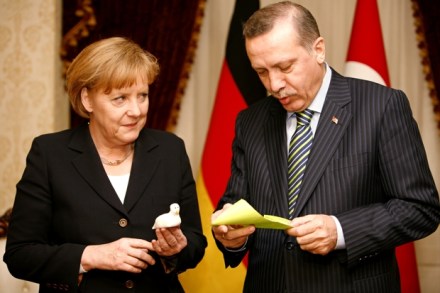
Angela Merkel gave a defiant interview last night in which she defended her handling of the refugee crisis. She declared, ‘I have no Plan B’—worryingly, I suspect this is true. But how much worse the refugee crisis could become worse is made clear in leaked minutes of a meeting between the President of Turkey Recep Tayyip Erdogan and Donald Tusk and Jean-Claude Juncker. As Bloomberg columnist Marc Champion points out, Erdogan is determined to get far more out of the EU than the 3 billion Euros it is currently offering. He tells them that if the offer is for only 3 billion, the conversation might as well end there: “We

Portrait of the week | 18 February 2016

Home David Cameron, the Prime Minister, spent time in Brussels before a meeting of the European Council to see what it would allow him to bring home for voters in a referendum on Britain’s membership of the European Union. The board of HSBC voted to keep its headquarters in Britain. Sir John Vickers, who headed the Independent Commission on Banking, said that Bank of England proposals for bank capital reserves were ‘less strong than what the ICB recommended’. The annual rate of inflation, measured by the Consumer Prices Index, rose to 0.3 per cent in January, compared with 0.2 per cent in December. Unemployment fell by 60,000 to 1.69 million. A

Putin’s great game

[audioplayer src=”http://rss.acast.com/viewfrom22/putinsendgameinsyria/media.mp3″ title=”Putin’s endgame in Syria”] Listen [/audioplayer] Russia’s bombing of the city of Aleppo this week sent a clear message: Vladimir Putin is now in charge of the endgame in Syria. Moscow’s plan — essentially, to restore its ally Bashar al-Assad to power — is quickly becoming a reality that the rest of the world will have to accept. America, Britain and the rest may not be comfortable with Putin’s ambitions in the Middle East, or his methods of achieving them. But the idea of backing a ‘moderate opposition’ in Syria has been proved a fantasy that leaves the field to Putin and Assad. The Syrian partial ceasefire, brokered

Portrait of the week | 11 February 2016

Home David Cameron, the Prime Minister, said that if Britain left the European Union, France could stop allowing British officials to make immigration checks on the French side of the border, and, his spokesman predicted: ‘You have potentially thousands of asylum seekers camped out in northern France who could be here almost overnight.’ Mr Cameron denounced the way prisons are being run by his administration: ‘Current levels of prison violence, drug-taking and self-harm should shame us all.’ Junior doctors went on strike again for 24 hours. Twelve men of Pakistani heritage were jailed for up to 20 years for the rape and sexual abuse of a girl when she was

Turkey can’t cope. Can we?

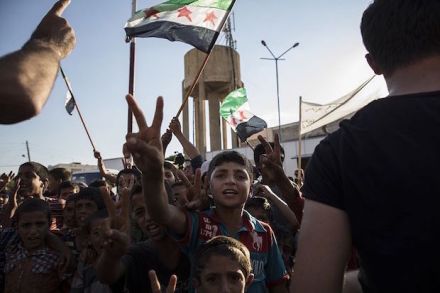
[audioplayer src=”http://rss.acast.com/viewfrom22/thenextrefugeecrisis/media.mp3″ title=”Laura Pitel and Migration Watch’s Alanna Thomas discuss the second migrant crisis”] Listen [/audioplayer]In Istanbul, signs of the Syrian influx are everywhere. Syrian mothers sit on pavements clutching babies wrapped in blankets; children from Homs, Syria’s most completely devastated city, push their way through packed tram carriages begging for coins. Arabic adverts offer rooms for rent. It’s almost inconceivable how many Syrians Turkey has taken in as refugees — around 2.5 million of them so far. That’s almost three times the number who have sought refuge in Europe. And while the Turks are hospitable, Turkey has more than any country should bear. Yet still more refugees arrive. This

Portrait of the week | 28 January 2016

Home Donald Tusk, the president of the European Council, prepared a paper on the four areas of concern between Britain and the European Union, as formulated by David Cameron, the British Prime Minister, for the EU to chew on at a summit in February. Nicola Sturgeon, the leader of the Scottish National Party, said that to hold a referendum on the EU in June would be ‘disrespectful’ to elections being held in Scotland. Tony Blair, the former prime minister, said he thought Scotland would leave the Union if the United Kingdom voted to leave the EU. Lord Parkinson, who as Cecil Parkinson was party chairman when the Conservatives won a

Turkey’s climate of fear

   Istanbul Few AK party supporters hanker after the Isis way of life: for many of them, it would be a death sentence Turkey is less and less a democracy, more and more a paranoid one-party state. If you don’t believe that, look at what happens to those who draw attention to the government’s failures and crimes. The editors of Cumhuriyet, a centre-left broadsheet, have been delivering their editorials from jail since November. A statement issued this month by the Izmir Society of Journalists claimed that 31 journalists were in prison while 234 were in legal limbo awaiting trial. Over the course of last year, they added, 15 television channels

National pride is blinding Turkey to the threat from Isis

On Tuesday, Isis’s strategy in Turkey changed. Nabil Fadli, a 28-year-old Saudi national linked to Isis, blew himself up in the heart of Sultanahmet, a tourist district of Istanbul. 11 tourists were killed, including ten Germans. In some ways, it was familiar: this was Isis’s fourth successful attack on Turkish soil since June. Previous bombs, however, had targeted pro-Kurdish and leftist groups: one, last July, targeted Suruç in the Kurdish south-east; in October, another took over 100 lives in at a peace rally in Ankara. The perpetrators of both these attacks were traced back to an Isis cell in the Turkish city of Adıyaman, and the government was criticised for failing

Iran may have the upper hand in the Middle East’s power struggle

It isn’t just Iran who have been angered by the execution of Shia cleric Nimr al-Nimr. Protests have erupted in Bahrain, Lebanon, Pakistan and Iraq, all places where the 1400-year-old Shia-Sunni divide remains a faultline. Iran’s reaction may seem uncompromising, with Ayatollah Khamenei tweeting: ‘The unjustly spilt blood of this martyr will have quick consequences’; but they have also sounded a note of caution. President Rouhani called for the arrest of the mob who stormed the Saudi embassy buildings. Perhaps he knows that, in the long run, Iran’s star is rising and the Saudis’ is falling. In January of last year, Douglas Murray observed in The Spectator that ‘the region’s two most ambitious centres of

Tis the season for disagreeing with your spouse about everything

The older I get, the more Scrooge-like I become. I’m dyspeptic, misanthropic, curmudgeonly, parsimonious and unsentimental. Caroline, by contrast, is even-tempered, sweet-natured, charitable, generous and easily moved. Yet paradoxically, I love Christmas, whereas she regards it as a time of year to be endured rather than enjoyed. This inevitably leads to a number of arguments and, as with everything else connected with the festival, they’ve become ritualised. So here are the rows that are guaranteed to occur in the Young household at this time of year. The season always begins with a heated discussion about external lighting. My ideal is to go Full Chav, with a giant neon-lit Santa plastered

Long life | 3 December 2015

I have always found Thanksgiving, which was celebrated in the United States last week, the most agreeable and least stressful of holidays. It involves no present-giving, so it is almost free of commercialism and the anxieties associated with shopping; and it has no religious or political connotations, which means it can be enjoyed in equal measure by Americans of every kind. Christmas, on the other hand, despite all the efforts made in America to play down its religious origins, retains an element of exclusivity about it: if you are not a Christian, it is not really your day. Thanksgiving, with its emphasis not only on gratitude but also on goodwill

What’s the plan in Syria? Yesterday’s debate gave us few answers

David Cameron may now have his bombing mandate, but he still has no strategy. The PM’s ‘hope for the best’ rhetoric yesterday was distinctly un-Churchillian: ‘I know that will take a long time and that it will be complex,’ he said, ‘but that is the strategy, and we need to start with the first step, which is going after these terrorists today.’ It is not much of a plan, and those in the know know it: from defence chiefs – some of them friends of mine – giving anonymous briefings, to Parliament’s own foreign affairs committee, and even the voters, whom polls show swinging ever further away from air strikes.

Silent strongman Sergey Shoigu is the real force behind Russia’s military aggression

‘Crimea is ours,’ President Putin boasted last May. He was speaking on a documentary viewed by millions of Russians, and it was the culminating moment in the militarisation of Russia. Moscow had attracted criticism for spending unprecedented sums on its armed forces under Putin, despite a weak economy over-dependent on oil. The successful annexation of Crimea seemed a perfect vindication. Yet the huge expansion of Russia’s armed forces budget was instigated not by Putin but by the defence minister, the mysterious Sergey Shoigu. The ascendancy of the military has propelled Shoigu up the ranks of the power elite to the extent that he is now regarded as the favourite to

Portrait of the week | 26 November 2015

Home David Cameron, the Prime Minister, announced, as part of the Strategic Defence and Security Review, plans for two 5,000-strong ‘strike brigades’ that could respond to terrorist attacks on Britain. Spending on defence would go up by £12 billion, keeping it above 2 per cent of GDP. The estimate for replacing Britain’s four Trident ballistic missile submarines rose from £25 billion to £31 billion. The Nimrod maritime patrol aircraft, scrapped in 2010, would be replaced with nine Boeing P-8s. Aircraft for the Navy’s two new aircraft carriers would be ready by 2023. The government made preparations for a vote in the Commons in favour of Britain bombing Islamic State targets in Syria.

English Cooking: Discover the true value of pie

We all know what we think of as the great English Christmas lunch/dinner — turkey (originally from America) or goose (a worldwide bird, first domesticated in Ancient Egypt), Brussels sprouts (from Rome via Belgium), potatoes (also from the Americas). So, in fact, there is no such thing as a great English feast. Or is there? While the poor had little choice of food, the English traditionally knew how to feast. Christmas, which took over from the Roman pagan festival of Saturnalia, has for centuries been the year’s best excuse for eating, drinking, dancing, and showing off – showing off not just in silly tinsel hats, but in what you spread before

Ethical Eating: How to raise and, perhaps, even kill your own Christmas turkey

Christmas is a time of celebration and giving thanks. In the old days we did this by feasting on meat. Whether it was a goose or a turkey at the centre of the table, it was a treat. The whole family would understand where the animal came from and perhaps have contributed to feeding, killing and preparing it. Every morsel would be appreciated. Nothing would be wasted. Somewhere along the way, we have forgotten this. We eat meat all year round, including turkey. We have little idea of how the bird was raised, slaughtered or even cooked. We just gobble it up without a thought and the bones go in

Portrait of the week | 12 November 2015

Home David Cameron, the Prime Minister, outlined four changes he sought in Britain’s membership of the EU. He wanted to protect the single market for Britain and others outside the eurozone; to increase commercial competitiveness; to exempt Britain from an ‘ever closer union’; and to restrict EU migrants’ access to in-work benefits. Mr Cameron put the demands in a letter to Donald Tusk, the President of the European Council. David Lidington, the Europe minister, said that others in the EU could put forward ‘alternative proposals that deliver the same result’. In a speech to the Confederation of British Industry, Mr Cameron had said: ‘The argument isn’t whether Britain could survive

Portrait of the week | 5 November 2015

Home The all-party Foreign Affairs Committee urged David Cameron, the Prime Minister, not to press ahead with a Commons vote on British air strikes against Islamic State positions in Syria. At its conference, Scottish Labour adopted a policy of opposition to Trident renewal, though Kezia Dugdale, its leader, remained in favour, while the Labour party in the United Kingdom as a whole favoured retaining the nuclear deterrent, though its leader, Jeremy Corbyn, opposes it. Britain was smothered in fog, except in Wales, where temperatures on 1 November reached a record 22˚C. A man had his ear bitten off in a pub in Aberystwyth on Halloween. Shaker Aamer, a Saudi citizen

The EU is sucking up to Turkey to help reduce migration – but it could seriously backfire

You might have thought, mightn’t you, that a million arrivals in a year to a single European country, Germany – well, more than 800,000 and counting – would be enough to be going on with, wouldn’t you? After that, you wouldn’t actually be going out of your way to solicit more incomers into Europe in the long term, even if you were going to be sensible about the influx and were admitting refugees on a purely temporary basis until they could safely return home? But that’s not how the EU works. Turkey at present hosts about two million refugees, mostly from Syria.  EU governments would obviously prefer them not all