Turkey

Monitoring social media is easier said than done

The three British girls who packed their bags and took a flight to Turkey have apparently crossed the border into Syria. Their intention seems to be to join the Islamic State and it looks like they may have succeeded. It emerged over the weekend that there had been contact between one of the girls and Aqsa Mahmood, a Scottish woman who travelled to Syria herself. Initially communicating through Twitter, it appears Mahmood played a role in their journey to Turkey and now into the heart of the conflict in Syria. Criticism turned on the security services: according to Aamer Anwar, the lawyer for the family of Aqsa Mahmood, they are not even doing the

A cruise around Cleopatra’s wedding present

Legend has it that Mark Antony considered Turkey’s Turquoise Coast so beautiful that, in about 32 bc, he gave it to Cleopatra as a wedding present. The country’s southernmost shore stretches for nearly a thousand miles and combined incredible scenery, clear azure waters and a warm Mediterranean climate. Its strategic location means it has been occupied by various empires over the course of its history, including the Lycians and Ottomans. Two thousand years on, it is still breathtaking. The Taurus mountains provide a dramatic backdrop to the ancient ruins and beautiful beaches. With no road access to many of these hidden gems, the best way to explore them is by

Penelope Lively’s notebook: Coal holes and pub opera

I have been having my vault done over. Not, as you might think, the family strong room, but the place beneath the pavement — the former coal cellar — pertaining to an early 19th-century London house. The vault opens onto the area — mine is the last generation to know that that is what you call the open sunken space between the basement and the pavement — and has been given the latest damp-proof treatment, plus shelving and smart lighting, so that I can use it for storage. Others use their vault more creatively: a couple next door had theirs excavated several feet and made into a troglodyte bedroom. No,

The Spectator at war: Russia and Constantinople

From The Spectator, 14 November 1914: The Spectator for the last twenty years has urged that the Russians are the appropriate successors of the Turks at Constantinople. Russia is by far the greatest of the Black Sea Powers, and she ought to be given the key to her own back door— the possession of the Bosphorus and the Dardanelles being conditioned, of course, by the guarantee of free access to the Black Sea for the shipping of other Powers, on the lines that govern the Suez Canal and the Panama Canal. We do not doubt for a moment that Russia will be perfectly willing to make such an agreement. That

Kurds can pull off miracles, but they need help against Isis

The Kurds can pull off minor miracles when they need to. They require active support, however, now they are at the centre of the global struggle against the self-styled Islamic caliphate, Isis. Recent history shows the Kurdish potential. Eight years ago in Iraqi Kurdistan, there was much talk about oil and gas reserves. Some thought it was all hot air; their oil sector is now huge and has driven another once impossible dream – rapprochement with Turkey, which needs vast energy supplies to fuel its growing economy. Energy could even fuel Kurdish independence. However, a longer history hangs over the Kurds. Nearly a century ago, Kurdish hopes of a single

The Spectator at war: News of the week

From The Spectator, 7 November 1914: THE most important event of the week has been the declaration of war on Turkey by Britain. In the words of the London Gazette of Thursday: “Owing to hostile acts committed by Turkish forces under German officers, a state of war exists between Great Britain and Turkey as from to-day. Foreign Office, November 5th, 1914.” The Gazette also contains an Order in Council annexing the island of Cyprus. The Order points out that the outbreak of hostilities annuls the Convention, Annexe, and Agreement made between us and the Turks in 1878. In addition, the British Fleet during the past week has been busily bombarding

The US won’t beat Isis alone; Qatar and other Gulf allies must help in Iraq

Revelations keep pouring in about the uneasy relationship between Western aid givers and ISIS operators: from bribes given by humanitarian convoys to secure access in war-torn Syria, to food and medical equipment appropriated by Islamists and used to provide basic services to the population under its control. Moreover, USAID personnel working in the area have to be vetted by ISIS: “There is always at least one ISIS person on the payroll; they force people on us” one aid worker told the Daily Beast earlier this month. This is just the start. As the Islamic State makes inroads into Iraqi and Syrian territory, it’s becoming increasingly clear that American promises to

The Spectator at war: The Crescent and the Cross

From The Spectator, 31 October 1914: THE most important event of the past week is the entrance of Turkey into the war, announced in the newspapers of Friday. For some time the Committee of Union and Progress, the gang of desperate and intriguing adventurers who control the Porte, have been doing their best by various unfriendly acts to provoke Russia and Britain into a declaration of war. Having failed in this, and probably also being warned that a peace party of considerable dimensions was growing up in Constantinople, they decided to force war by active hostilities, and on Thursday sent their ships to bombard peaceful Russian towns on the Black

Fear, loathing and an Ottoman shrine in the cold war between Isis and Turkey

Turkey and the Islamic State in Iraq and Syria (Isis) are engaged in a cold war. Although they despise each other, they will avoid direct engagement, for fear of the massive damage that could result. A little known Turkish exclave that lies inside Syria, known as the Tomb of Suleyman Shah and currently under siege by Isis, is a case in point. The Tomb of Suleyman Shah – a 2.47-acre sovereign Turkish district that houses the shrine of an Ottoman patriarch – holds immense emotional value for the Turks. It is the burial place of the grandfather of Osman Bey, who founded the Ottoman Empire, and is guarded by 80

Never mind the Baghdad politics, Iraqi Kurds need help to fight Islamic State

The threat from Daish, the Arabic acronym for the so-called Islamic State in Iraq and Syria, has gone from a side issue to a central imperative, judging by discussions with Kurdish leaders on my four fact-finding trips to the Kurdistan region in the last year. Last November, I was told how Daish operatives were assiduously measuring building sites in Mosul in an extortion racket. In February, I learned of their external funding and their continuing growth. In June, they captured Mosul with a small force that immediately acquired thousands of adherents, and established a 650-mile border with the Iraqi Kurds. The major shock, though, was how quickly the Iraqi Army

Turkey in Europe? Now there’s a migrant backlash waiting to happen

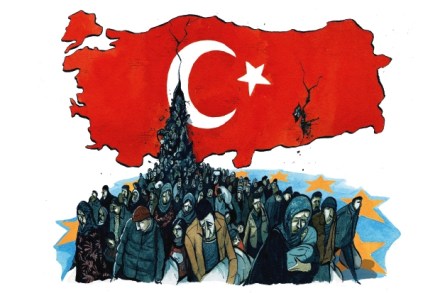
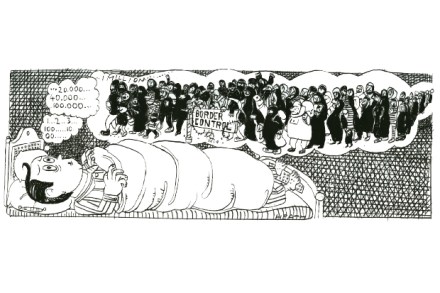
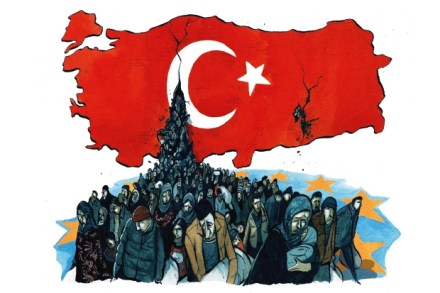
Well, I don’t know how José Manuel Barroso came across in the broadcast accounts of his address to Chatham House today but in person the man was geniality itself and rather impressive with it. He shares the mildly irritating tendency of EU bigwigs to attribute to the European Union developments that would have happened without it – recalling that within memory, Europe had moved from totalitarian regimes in half of its states to a democratic and peaceful unity. But in general, he gave the impression of trying to be as straight as he could with his answers. In laying stress on Britain’s freedom to stay outside the eurozone and the Schengen

If Turkey turns on the West, what hope is there for Syria and Iraq?

Turkey has long been a bridge between the West and the Middle East. Its record on free speech may be lamentable and it treats its Kurdish minority shoddily, but against that stands a genuine will to improve its human rights record and an ambition to become a modern, free and prosperous state. This has long been the basis of Britain’s support for Turkey joining the European Union. But this week we have seen a reminder of how far the priorities of Turkey’s political establishment are from those of Europe. Its parliament recently consented to the use of an airbase at Incirlik by US forces launching airstrikes against the Islamic State,

The Spectator’s portrait of the week

Home Checks began at British airports for passengers who might have come from west Africa with Ebola fever (even though there are no direct flights from the countries most affected). People who rang 111 with suspicious symptoms were to be asked whether they’d come from a high-risk country. Police arrested three men and three women from Portsmouth, Farnborough and Greenwich as part of an anti-terrorism operation. Of five men arrested the week before, two were released. The trial began before a jury at the Old Bailey of Erol Incedal on charges of preparing for acts of terrorism; parts of it will be held in secret. Ofsted said that ‘very little

How independence will impoverish Scottish culture

[audioplayer src=”http://traffic.libsyn.com/spectator/TheViewFrom22_11_Sept_2014_v4.mp3″ title=”Fraser Nelson, Tom Holland and Leah McLaren discuss how we can still save the Union” startat=50] Listen [/audioplayer]An explosion of confetti will greet the announcement of Scottish independence. This isn’t another one of Alex Salmond’s fanciful promises, but an installation by a visual artist named Ellie Harrison. She wants Scotland to become a socialist republic. She has placed four confetti cannons in Edinburgh’s Talbot Rice Gallery. They will only be fired in the event of a Yes vote. Most artists in Scotland favour independence. Harrison’s installation is typical of the pretentious agitprop they produce. This isn’t a uniquely Scottish problem. ‘Nationalist’ art is by definition functional: it promotes

Dear Mary: Is it rude to answer my child’s call when I’m already on the phone?

Q. My problem is that an older friend, with whom I enjoy lengthy telephone chats, becomes furious when my call waiting service flashes up the number of one of my elusive children and I ask if I may put her on hold very briefly. She says it is rude to her, that I have spoilt my children, and ‘they’ll just have to wait’. My friend is not in touch with the frantic pace of the modern world and does not grasp that the child may not respond if I call back five minutes later, thus causing me anxiety. I value our conversations but we have reached an impasse. What should I

Portrait of the week | 28 August 2014

Home Theresa May, the Home Secretary, said that Britons who went to Syria or Iraq to fight could be stripped of their citizenship, if they had dual nationality or were naturalised. Her words came during a search for the identity of the British man in a video of the beheading of the American journalist James Foley. David Cameron had returned to London from his holiday in Cornwall to confer with security officials, but decided against recalling Parliament. In revenge the Daily Mail carried photographs of him in a wetsuit, which gave him a phocine look. Lord Dannatt, the former Chief of the General Staff, suggested Britain should deal with President

A lesson of Iraq in 2014: the nation-state is the future

The collapse of some of the Sykes-Picot states in 2014 will spur people to ask which way the world is heading and what it all tells us, just as with the fall of Communism in 1989. After Communism we had at first Francis Fukuyama’s The End of History,which foresaw the triumph of western-style liberal democracy, and then the more prescient, although equally controversial, The Clash of Civilizations by Samuel Huntingdon, which viewed the world as essentially consisting of power blocks centred around ancient civilizational, religious ties. So what does 2014 mean? A clear lesson that the Yazidis and Christian Assyrians have learned is that without a patch of land for

‘It’s jihad, innit, bruv’: meet the British Muslims going to fight in Syria

Turkey, Syria, Iraq: ‘It’s jihad, innit, bruv.’ The young British Muslim cut an absurd figure in ski mask, dark glasses and hoodie. He had not used that exact phrase but it would have summed up our faintly comical encounter. I remembered a security analyst’s remark that British Islamists in the Middle East are best explained by Four Lions, the mock documentary about some Yorkshire jihadis on an incompetent quest for martyrdom. He called himself ‘Obeid’ and he described, in a Leeds or Bradford accent, how he had arrived in Turkey on a tourist visa. Then, speaking no Arabic, and barely knowing one end of a Kalashnikov from the other, he

Hamas has fallen out of favour with ordinary Gazans

Earlier this year, Daniella Peled suggested that Hamas had finally lost its grip on Gaza: Gaza City   Tattered green Hamas flags still flap above the streets in central Gaza and posters of its martyrs hang in public spaces. But these are tough times for the Hamas government, and not just due to the recent flare-up in tensions with Israel. In December last year, they cancelled rallies planned for the 26th anniversary of their founding, an occasion celebrated ever since they seized power here in 2007, and though usually secretive about their financial affairs, they revealed a 2014 budget of $589 million, with a gigantic 75 per cent deficit. So,

Is Hamas finally losing its grip on Gaza?

 Gaza City Tattered green Hamas flags still flap above the streets in central Gaza and posters of its martyrs hang in public spaces. But these are tough times for the Hamas government, and not just due to the recent flare-up in tensions with Israel. In December last year, they cancelled rallies planned for the 26th anniversary of their founding, an occasion celebrated ever since they seized power here in 2007, and though usually secretive about their financial affairs, they revealed a 2014 budget of $589 million, with a gigantic 75 per cent deficit. So, what’s gone wrong for Hamas? Just a year ago, it seemed to be enjoying a honeymoon