Turkey

If Ukraine’s protests were a revolution, why wasn’t the Stop the War march?

It’s ages since I last went on a decent demo and had a bit of a dust-up with the pigs. I should get out more, there’s a lot of fun to be had, throwing stuff at the police and shouting things in a self-righteous manner. I think the last one I attended was in the very early 1980s, in Cardiff. Sinn Fein was marching through the centre of the city in support of its right to maim and murder people, and the National Front decided to march against them. As a consequence, the Socialist Workers Party’s most successful front organisation, the Anti-Nazi League, insisted that it had a right to

Syria’s humanitarian crisis must be addressed by Turkey

On Tuesday morning, Turkish police in the border cities of Kilis and Gaziantep arrested 25 people on suspicion of aiding Jihadi fighters in neighbouring Syria, including two said to be high ranking Al Qaeda operatives. Seven Conservative MPs had flown out of Gaziantep less than twenty-four hours previously. I was with them, meeting with Syrian opposition leaders and observing Turkish efforts to house the refugees flowing across the border. Most of those arrested have links to the IHH, a religious organization repeatedly accused of terrorism offenses by US politicians, and behind the ‘flotilla’ attempt to break Israel’s blockade on Gaza in 2010. But in Turkey, the IHH is both legal

Forget the MINTs, the next economic success story will be in the BALLS

Jim O’Neill, the Mancunian former chief economist of Goldman Sachs in London, commands attention whenever he speaks and has a claim to fame as the coiner in 2001 of the acronym ‘Bric’ for the four rapidly developing countries — Brazil, Russia, India, China — to which economic power looked set to shift during the early part of the new century. Undeterred by the hindsight view that he should have gone for ‘Bic’, like the throwaway razor, because Russia has lagged so dismally behind the others on almost every measure of progress, O’Neill has now come up with ‘Mint’, for Mexico, Indonesia, Nigeria and Turkey, as the next cohort of economic

Bye-bye Bric, hello Mint — are Mexico, Indonesia, Nigeria and Turkey really the new boom economies?  

New year new ideas as we woke up on Monday morning to find ourselves in Lagos with Evan Davies trying to convince us that Nigeria really is undergoing an economic earthquake. It’s part of a week-long campaign by Radio 4 to make us believe that the next economic leaders among world nations will be Mexico, Indonesia, Nigeria, Turkey. These new Mint countries are destined, we are told, to take over from the Bric countries, now deemed passé after just a decade in the limelight generated by the economist fashionistas. It’s stimulating stuff for this hibernating time of year. Bulletins and programmes high on optimism and imbued with the belief that

Portrait of the week | 9 January 2014

Home George Osborne, the Chancellor of the Exchequer, made it clear in a speech that he intended to cut £25 billion after the next election, with about half of the savings coming from cuts in welfare payments. Nick Clegg, the Liberal Democrat Deputy Prime Minister, said that the means proposed were ‘unrealistic and unfair’ and showed that the Conservatives wanted to ‘remorselessly pare back the state for ideological reasons’. Nick Clegg told the Commons that official estimates suggest that more than 1,500 Syrians had entered Britain last year through the asylum system. Boris Johnson, the Mayor of London, said that Mr Clegg had ‘a very important ceremonial function as David Cameron’s lapdog-cum-prophylactic

Christmas past in Spectator letters

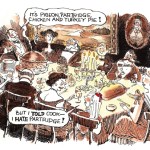
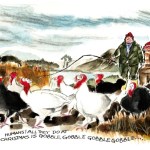
This is a selection of seasonal letters from The Spectator’s 185-year archive, now online at archive.spectator.co.uk. The emblem to the right is by our cartoon editor, Michael Heath. It was his first drawing for the magazine, and appeared in 1959.   Spare the turkey Sir: Of the thousands who within the next few days will be ordering their Christmas turkeys, are any aware of the fact that the useless custom that makes it the proper and correct thing to have its most useless head upon the dish condemns the poor thing to a cruel and lingering death, while but for this custom, its head would be cut off comfortably and

Britain’s stated aim of getting Turkey to join the EU is mad

Rather to my embarrassment, I find that I missed last night’s episode of the BBC2 three-part series on The Ottomans, Europe’s Muslim Conquerors, in which I briefly featured. So Heaven knows what I actually said in it; it’s been a while since filming. But I’m rather hoping that the point I wanted to get across did, viz, that it’s nuts, barking mad, insane, away with the fairies, for Britain to be agitating for Turkey to be part of the EU. On David Cameron’s last visit to Turkey in 2010, he expressed anger at the delay in Turkey’s admission to the Union and blamed opponents for playing on fears of Islam

Kuma would shine at any time of the year

Mid-August is a hopeless time for films; so hopeless, useless and bleak, if I don’t use three words when one would have done, I am just never going to fill up this space. The assumption is people don’t wish to visit the cinema on summer evenings, or they are on holiday (I wish!), so the studios put out all their rubbish. This week sees the opening of Bachelorette (a Bridesmaids rip-off), Planes (a Disney film, originally intended for DVD only) and The Lone Ranger, which is said to be so lousy, terrible and awful the producer is going to be hung from a lamppost on Sunset Boulevard, as a warning

Turkey’s agony – how Erdogan turned a peaceful protest into a violent nightmare

  Istanbul By now, everyone has heard of the brutal suppression of protests all over Turkey, which began with a peaceful sit-in in Istanbul to protect a hapless apology for a park from demolition. Right by the city’s unofficial centre, Taksim Square, Gezi Park had been slated to become yet another one of the ruling AKP’s signature Ottoman-cum-Disneyland construction projects. It was hardly much of a park, by London standards, but it was one of the last remaining places in the area with a few trees and a bit of room to stroll around. The protesters found the idea of losing that tiny refuge from Istanbul’s urban chaos unbearable. The

The tragedy of Taksim square

First he set the police on his own people, now ‘democratic’ Prime Minister Erdogan is refusing even to meet them. The peace talks he promised are being held not with protestors themselves but with a group of official mediators the protestors have never met. In the days to come, Erdogan will try to persuade the world that he is battling extremists, but as Claire Berlinski points out in her heart-breaking piece in this week’s magazine — written from the centre of the riots in Istanbul last night — the demonstrators were until recently very ordinary citizens from all walks of life, brought together in peaceful protest. She describes the scene

Turkey redux

It must be boring for you too, returning to the same complaint, over and over again. Report on the BBC’s 10 O’Clock News about the trouble in Turkey. Not a single mention, in the three minutes, of the words Islam, or Muslim, or Islamification. You had to infer everything. Without prior knowledge of what was going on, you would have been utterly mystified as to why people were unhappy. You noted that all of the protestors were young, middle class, educated and the women fashionably unveiled; well spoken, good English and so on. And you would have wondered then who the alleged ‘50 per cent’ who support the Prime Minister

The Spectator’s Notes | 6 June 2013

What a strange country this is. On the same day that we celebrated the 60th anniversary of the coronation, a mystical rite founded for the ancient kings of Israel and continuous here for a thousand years, our almost equally venerable House of Lords voted to undermine the basis of the oldest of all human relationships recognised in law. The new Archbishop of Canterbury spoke very well on both subjects. In Westminster Abbey, he praised the Queen’s ‘servant leadership’, and reminded the congregation that Jesus ‘did not count equality with God a thing to be grasped, but humbled Himself and took the form of a slave’. But in Parliament, equality was

What’s eating Turkey

  Ankara ‘Islam, politics, economics — choose two’ is a great line, said by one of my Turkish students, and it would make a good exam question. Tayyip (the name means ‘very clean’ in Arabic — cf. ritual washing) Erdogan (meaning ‘strong hawk’, a Turkish nationalist reference) came to power in 2002 with a very good press. This was to be what the world wanted — a Muslim version of German or Italian Christian Democracy — and for years he gave it that. The rival parties destroyed themselves in silly bickering and corruption, and Erdogan’s party was very successful, with reforms in health and housing that improved the lives of

How social media helps authoritarians

Have you heard? Do you know? Are you, as they say, ‘in the loop’? When the Mail on Sunday said a ‘sensational affair’ between ‘high profile figures’ close to Cameron had ‘rocked’ No. 10, did you have the faintest idea what it was talking about? I did, but then I’m a journalist. Friends in the lobby filled me in on a story which had been doing the rounds for months. I even know which law stopped the Mail on Sunday  following the basics of journalism and giving its readers the ‘whos’, ‘whats’, ‘whens’, ‘whys’ and ‘hows’. (Although with most affairs the ‘whys’ are self-evident. It is the ‘whos’ and, for

Is it time to aid Turkey’s protestors?

Is it now time for William Hague to send money, and possibly arms, to the rebels now participating in what we might call a Turkish Spring? There have been violent demonstrations, clashes with police, petrol bombs thrown and the like. The protestors are largely from Turkey’s most secular cities and regions and include gay rights supporters, students, professionals, football supporters (?), women’s groups, journalists and the like. Their objection, principally, is the growing Islamification of what was, until comparatively recently, a proudly secular and fairly modern state. They complain too that the state’s medieval leader, Recep Erdogan, is a ‘dictator’ who has brutally suppressed freedom of speech in a country

Why Greece isn’t recovering: the view from a cruise ship

This column comes to you from the cruise ship Minerva in the Greek port of Piraeus. Why I’m aboard is a story for another day — and let me admit up front that, as financial-crisis reportage goes, observations provoked by a Homeric vista of islands and cocktails on the poop deck are unlikely to match Newsnight’s Paul Mason choking through tear gas outside a burning Athens bank. But still there are parables to be trawled from the placid Aegean waters. As the anti-austerity bandwagon gathers momentum, the Greeks seem to be in deep denial about the other element of the recovery equation. Even if you sincerely believe that fiscal pain

Stopping Assad

The situation in Syria grows worse by the minute. President Assad seems to have taken the UN Security Council’s deadlock as carte blanche to launch an all-out attack on Homs. Russia looks like she wants to mediate, while Turkey is preparing a new initiative with countries who oppose the Syrian government, a sort of anti-Assad group. Meanwhile, the Gulf States have expelled all Syrian ambassadors.   The chances of a ceasefire are low, as are the prospects of a military intervention. Russia has an interest in persuading Assad to abdicate, but can Assad be persuaded? Syria still has friends in Iraq and Iran, where the governments are supporting the regime

Uncertainty reigns in Syria

The Syrian situation is worsening by the day. Now the Arab League has pulled back its monitors in recognition of their failure to ease the violence. Foreign Secretary William Hague has said he is ‘deeply concerned,’ while the Gulf states are pushing for the whole mater to be referred to the UN Security Council. But the chances of a ceasefire and the start of a transition are low. The Russian government is growing tired of Bashar al-Assad but does not want to condone any kind of intervention, which they think is likely if the matter is referred to the UN Security Council. Russia still regrets backing the Libya resolution, believing

Turkish anger, French parochialism, British benefit

The relationship between Turkey and France — which started with the alliance between Francis I and Suleiman the Magnificent — is in precarious territory following the French Parliament’s decision to ban denial of the Armenian Genocide. Turkey’s moderate Islamist government has taken as hard a line on the issue as previous Kemalist governments did, and has announced, in response to the French move, that Turkey would halt ‘all political consultations, joint military activities and manoeuvres.’ Not content with a formal rebuke, Turkish Prime Minister Recep Tayyip Erdogan has sought to make the conflict personal; claiming (falsely) that Sarkozy’s father served in Algeria in the 1940s and would have direct knowledge

Stopping Maliki’s coup

The year is ending not with a successful US withdrawal from Iraq — as President Barack Obama claims — but with what amounts to a coup d’etat by the country’s Shiite prime minister (and former ally of the US) Nouri al-Maliki. Less than 24 hours after the last US soldier left Iraq, the country’s Sunni vice-president Tareq al-Hashemi was wanted on charges that he led death squads, in a case most observers think could reignite the sectarian slaughter of 2006-07. Violence in Iraq has subsided since 2006-07, when Sunni insurgents and Shiite militiamen killed thousands of civilians each month — but, without U.S. troops to act as a buffer, many