Troy

The illiterate poet who produced the world’s greatest epic

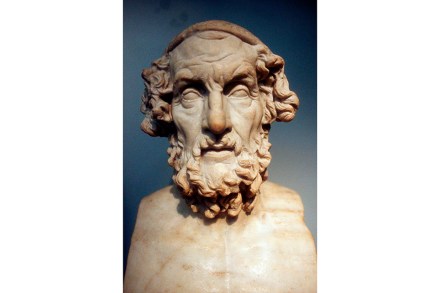
Odysseus is tossed on the sea when he notices a rock and clings to it. ‘As when an octopus is drawn out of its lair and bits of pebble get stuck in its suckers,’ says Homer, ‘so his skin was stripped from his brave hands by the rock.’ There is such elegant tricksiness in that simile. Homer still sits at the apex of western literature thanks to the beauty and influence of his verse. Robin Lane Fox has been teaching the epics for 50 years and studying them for many more. His lifelong fascination with the texts has bred a sort of feverish passion in him that makes him declare Homeric poetry to be ‘beyond us’ today (he is probably right) and without equal anywhere in the world, except perhaps in the books of Tolstoy (who is surely still inferior).
In search of the Iliad

From our US edition

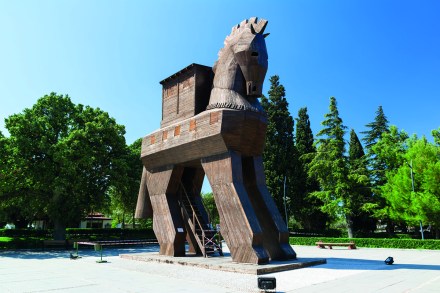
A wooden horse, a fallen hero and Helen, the most beautiful woman in the world. These three things transformed a hillock in Asia Minor into a legendary city. Few places can conjure up such stories of love and loss, homesickness and heroism, gallantry and grief as Troy. Over 3,000 years after Homer wrote in The Iliad of the 10-year siege of King Priam’s mighty citadel, I’m standing on an unremarkable patch of scrubland in northwestern Turkey. This unpromising site claims to be the real Troy — the very spot where Zeus’s daughter Helen fled to make love to Paris; where the mighty Hector, the Trojan general, fell at the hands of Greek warrior Achilles; and where the giant Trojan Horse entered the city concealing Greek warriors in its wooden belly.

troy

The famous cities of the ancient world were surprisingly small and fragile

Greg Woolf didn’t know his book would come out during an urban crisis. Thanks to coronavirus, Venice’s population, for example, is now somewhere between 25,000 and 40,000 — the lowest for centuries. Horrific pandemics were nothing new for ancient cities, which, as this scholarly book shows, have gone through heady rises and catastrophic falls. Rome had a population of nearly a million under the Emperor Augustus. By the sixth century AD it was down to 10,000. Troy, one of the great Bronze Age cities, was buried by the time Byron visited: ‘Where I sought for Ilion’s walls, the quiet sheep feeds and the tortoise crawls.’ Still, plenty of cities have staying power.